

What is an employee portal?
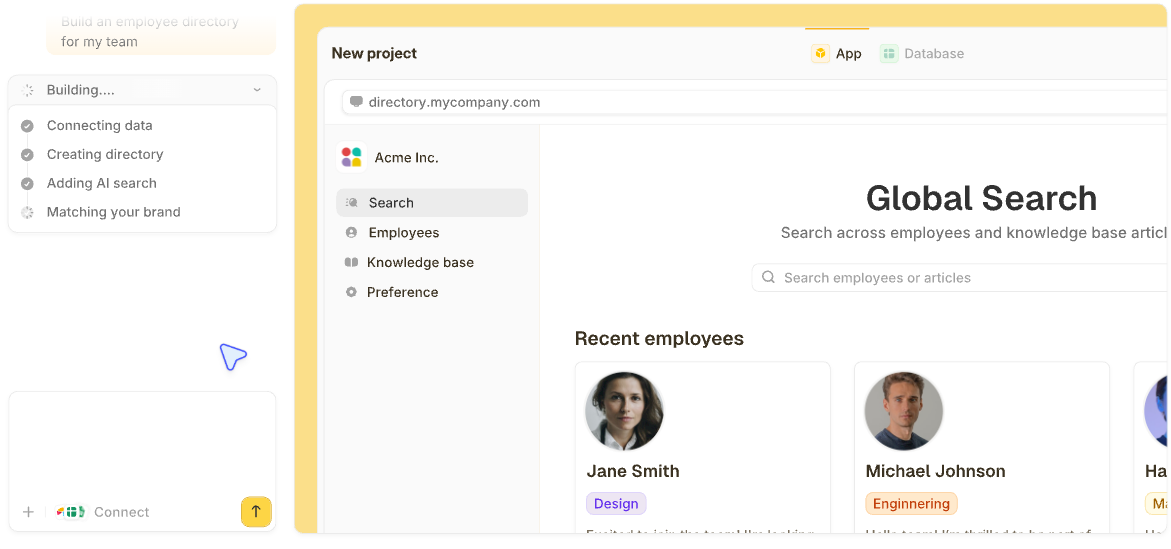
An employee portal (also called an employee self-service portal or intranet) is a secure internal website or app where your staff can access company information and handle common HR and IT tasks themselves. For example, employees log in to request PTO, check company news, find policy documents, or update their personal information.
The portal serves as a centralized place for the tools, documents, and workflows employees rely on each day.
3 ways to build an employee portal
Most teams don’t need to hire a bunch of expensive engineers to build their portal without programming. Depending on the amount of control and level of maintenance you want to take on, there are 3 main ways to build one without code:
- Use a no-code tool
- Buy off-the-shelf software
- Use AI-powered vibe coding platforms.
We’ll look at how each works and when you’d use it.
Method 1: Use a no-code tool
What it is: No-code platforms let you build employee portals using prebuilt components instead of writing code. You assemble pages, forms, and workflows visually from ready-made components. Examples of no-code tools include Zite and Knack.
How it works
At a high level, you create the portal by following these steps:
- Define your data: Specifying the information your portal needs. Instead of designing database tables, you fill out forms with fields such as name, email, role, and manager. The platform creates the underlying structure for you.
- Design the interface: Add components like tables, forms, and cards to pages. For example, a table for employee directories, a form for PTO requests, or a card showing upcoming time off.
- Add logic and permissions: Set rules for who can see or edit data and define what happens when someone takes an action. For instance, submitting a PTO request can trigger a notification to the employee’s manager.
- Start from templates if helpful: Most no-code builders offer templates for common employee portal features like directory templates, IT ticketing systems, and onboarding checklists. You customize these with your branding, adjust the fields you need, and connect them to your data.
When to use it
No-code is perfect when you need custom features that off-the-shelf software can't provide and don’t want to spend a lot of engineering hours coding it from scratch.
Example
I built an employee portal for a 45-person marketing agency in Zite. The team needed a way to submit project requests that automatically routed to different team leads based on project type. Zite handled authentication, forms, and integration with Slack for notifications out of the box. The portal went live in three days, mostly because I was using plain English prompts to build and iterate with AI.
Method 2: Use off-the-shelf software
What it is: Pre-built HR or intranet platforms that include employee self-service portals as core features. Examples include BambooHR, Paycor, Zenefits, and Zoho People.
How it works
You don't build the portal; the vendor already has. Your job is to configure it for your organization to start using it. Configuration typically means uploading your employee roster, applying your branding (logo and colors), and setting up access controls.
For instance, BambooHR includes a self-service portal where employees check PTO balances, view pay stubs and benefits, access important documents, and submit time-off requests. Everything's pre-built. You're just turning features on or off and adding your data.
When to use it
Off-the-shelf software works best when your needs are standard and you need a solution immediately. If you want basic HR self-service, for example, and have no custom workflows, this is your fastest path.
Example
A 120-person healthcare services company I worked with chose BambooHR. They needed to centralize their employee details and automate leave processing, onboarding, and offboarding. They were up and running in two days. The downside is they paid for features they didn't use.
Method 3: Use vibe coding tools
What it is: AI-powered platforms like Lovable or Replit that generate working applications from natural language prompts. You describe what you want in plain English and the AI writes the actual code.
How it works
You open the platform and describe your employee portal in conversational language. For example, "Build an employee portal with a directory, PTO request form, and document library." The AI generates the code and produces a working prototype you can immediately test.
Usually, you’ll tweak the build with follow-up prompts, though in some vibe coding platforms like Lovable, you can edit the code and even export it to GitHub.
These tools differ from no-code platforms because they generate new code rather than assembling prebuilt components.
That flexibility is great, but it also means the burden is on you to verify that what the AI generated is secure and won’t break in production. With no-code tools, you take advantage of the authentication layers and integrations that have been tested and hardened over time.
When to use it
Vibe coding works when you have someone on your team who understands basic development concepts (even if they can't code) and you need flexibility that no-code tools can't provide. It's also ideal if you want to own your code and scale beyond platform limitations.
Example
I helped a 30-person SaaS startup prototype an employee portal in Lovable. They wanted a fully branded tool with a team randomizer for lunch groups that could ping Slack automatically. We built the entire prototype in an afternoon, start to finish.
Which method should you choose?
Off-the-shelf tools offer speed and predictability, but flexibility is limited. No-code provides more customization without requiring engineering effort. Vibe coding is great when you want something truly custom, but you’re also taking on the responsibility of reviewing, testing, and securing what the AI generates.
Choose off-the-shelf if:
- You need standard HR self-service without custom features
- You want to launch within a week
- Your team has zero technical skills
- Budget isn't your primary concern (most can get expensive as you add employees)
Choose no-code if:
- You have automation or workflows that off-the-shelf can't handle like unique approval chains
- Your team wants the company’s branding in the portal
- You need integrations with your existing HR, IT, or communication tools
- You have someone available to learn and manage the no-code platform
Choose vibe coding if:
- You have someone technical enough to review and test code
- You need ultimate flexibility and want to own the codebase
- You're comfortable managing authentication and security yourself
- You're prototyping before committing to a full solution
Best practices for building employee portals
These principles apply regardless of which building method you choose:
- Treat the portal as a living system: First, build out the requests your team already sends through email, Slack, or spreadsheets. Then, continuously watch which pages get traffic and where employees still fall back to emails or manual workflows, and update the portal to fill the gap.
- Implement role-based access and security: Set up proper user permissions so each employee sees only what they should. An individual contributor shouldn't see another person's performance review, but their manager needs to.
- Personalize branding and experience: Make the portal feel like an integral part of your company, not generic software. Use your company's logo, colors, and even a custom domain. Also, show employees relevant information on their role and location.
Zite makes building employee portals easier
After exploring these methods, you might wonder if there's a way to get the ease of no-code, the quick start of off-the-shelf, and the flexibility of custom builds.
That's exactly what we designed Zite for.
Zite is an AI-powered no-code app builder tailored for internal tools, portals, workflows, and dashboards.
Here's how Zite helps:
- AI-powered app generation: Instead of dragging and dropping components for hours, you describe what you want in plain English. Zite generates the interface, sets up the data structure and authentication, and creates the necessary workflow logic. You can then refine and customize.
- Production-ready: Zite supports user authentication and management, secure hosting, SSO, audit logs, and is SOC 2 Type 2 compliant.
- Built-in database and data handling: Every portal needs to store data. Zite comes with a built-in no-code database, so you don't need to set up a separate database. You define what data you need, and Zite auto-generates the schema and data relationships.
- Integrations with existing tools: If you already use Google Sheets, Airtable, HubSpot, or other tools, Zite connects to them. Pull in existing employee data and build the portal on top of it.
- Custom branding and domains: Zite supports full branding customization with your company's colors, logo, and even hosting on your own domain. Your portal looks like it's part of your company's website, not a third-party tool.
- Templates and forms: If you prefer starting from templates, browse Zite's library. Need custom forms for PTO requests, IT tickets, or feedback? Use Fillout (made by the same team) to create branded forms that feed directly into your portal.
- Designed for company-wide rollout: Zite doesn’t charge per seat, so you can deploy portals to the whole organization without cost scaling becoming a blocker.
Ready to try Zite?
The best way to see what Zite can do is to try it yourself. Experience how teams at The Athletic and Bombas build production-ready tools from prompts.
Frequently asked questions
How much does it cost to build an employee portal?
You can build an employee portal with Zite for $0 per month to start for unlimited users and apps. Paid plans begin at $19/month. AI-powered code generation platforms generally cost between $20 to $200 per month, depending on features and usage volume.
How long does it take to build an employee portal?
Building an employee portal usually takes one to two days with a no-code tool and only a few hours if you generate the first version with AI-assisted building. The exact time depends on how many pages, workflows, and data connections you need.
What's the hardest part of building an employee portal?
The hardest part of building an employee portal is defining what your team actually needs. Many teams overbuild and later find that only a few features get consistent traffic. A better approach is to launch with the essentials such as announcements, requests, and key resources, then expand based on real usage and feedback.
Do I need to code to build a custom employee portal?
You don’t need to code to build a custom employee portal. Modern no-code platforms let you create pages, workflows, and data models through visual editors, templates, and natural-language prompts. Coding is only required if you want highly specialized logic or custom integrations.
Can Zite help me build a custom employee portal?
Yes. Zite can help you build a custom employee portal from plain English prompts. You describe the portal in plain English, and Zite generates the initial structure, pages, and data models.
What if I need features like user logins or permissions in my portal?
User logins and permissions come standard in most off-the-shelf tools, and no-code platforms like Zite include built-in authentication, SSO options, and role-based access controls. If you use a pure vibe-coding or code-generation tool, you’ll need to set up the authentication layer and permission logic yourself.