

I've helped 30+ companies move off spreadsheets when their data started breaking things. Spreadsheets are easy to start with, but they get fragile once structure, permissions, and scale start to matter. That's where modern tools have closed the gap.
Spreadsheet vs. database: TL;DR
Spreadsheets work great for quick analysis and small teams. Databases are built for when accuracy, scale, and shared access start to matter.
Spreadsheets let you start in seconds. Databases need upfront structure, but that's what keeps your data clean as it grows. Modern tools now give you that database structure while keeping the spreadsheet feel you already know.
What is a spreadsheet?
A spreadsheet is a flexible workspace. Each cell can hold anything: numbers, text, dates, or formulas. Excel and Google Sheets work the same way. Every cell is independent, so you can format and edit each one freely.
You control:
- How formulas calculate across cells
- How data gets formatted and visualized
- How charts represent your numbers
- How cells link to create dynamic models
Spreadsheets excel at calculations because formulas link cells together. When you change one value, everything updates automatically.
The trade-off: That flexibility makes spreadsheets accessible. No technical knowledge required. Just open Excel, start typing, and you're working with data. But this same flexibility means you can type anything into any cell, which is great for speed but becomes a liability when data grows or multiple people collaborate.
What is a database?
In real use, a database enforces structure through predefined fields and relationships, so your data stays consistent even as it grows.
Unlike spreadsheets, where each cell is independent, databases organize information into tables with predefined columns. Every column has a specific data type, and you set those rules before adding any data. The database catches bad entries automatically instead of letting them pile up silently.
The system handles:
- Data validation and type enforcement
- Multi-user access and permissions
- Query optimization across millions of records
- Relationships between different tables
When you set up a customer table, you define fields like CustomerID, Name, Email, and SignupDate, each with a specific type. The database rejects anything that doesn't fit. That means no text in a number field, no invalid dates, no silent errors that surface three weeks later in a report.
Databases also handle relationships between tables. Your Customers table connects to your Orders table through CustomerID. Change a customer's email once, and it updates everywhere that email appears.
The trade-off: Databases take more time to set up, but tools like Airtable or Zite make it manageable even if you're not technical. Once running, they keep your data clean and handle large amounts of information well.
Spreadsheet vs. database: Key differences
Three things separate them: how they store data, how teams work in them, and how they hold up as you grow.
Data structure
With a spreadsheet, you can put anything anywhere. That's the point. No rules, no setup, just open it and start typing. It works great when you're the only one touching the data.
But that same freedom becomes a liability the moment someone else touches the file. Someone enters a date as text, another person reformats a column, and suddenly nothing adds up.
Databases fix this by forcing every field to have a type. A number field only takes numbers, and a date field only takes dates. Messy entries get rejected before they cause problems. This leads to fewer broken reports, and no one manually cleaning data at the end of the month.
Collaboration
Google Sheets works fine for small teams collaborating in real time. The problem shows up when the data gets complex, business-critical, or needs different permissions for different people. A shared spreadsheet breaks down fast in those situations.
Databases keep everyone on the same source. Changes are tracked, and you control who can see or edit what.
Scalability
A spreadsheet that works fine at a few hundred rows can start dragging well before you expect it to, depending on how many formulas, tabs, and connected tools you have running.
Databases don't have that problem. They're built to handle large amounts of data without slowing down, and they stay fast whether you have a thousand records or a million.
When to use a spreadsheet vs a database
The right choice comes down to what your data needs to do and who needs to touch it.
Use a spreadsheet when:
- You're tracking a one-time project like a campaign budget, an event headcount, or a quarterly forecast where the data won't outlive the analysis.
- Your team is small, and edits happen one at a time, not simultaneously.
- The output is a chart, a pivot table, or a report you'll share as a file rather than a live system others interact with daily.
- You need to visualize and format data quickly without routing it through a separate BI tool.
- The cost of a wrong entry is low, and a mistyped number gets caught in review, not in production.
Use a database when:
- Your data connects across entities where customers tie to orders, orders tie to products, and a change in one place needs to reflect everywhere.
- External teams, clients, or non-technical users need to interact with records without ever seeing the raw data.
- You need role-based access where sales sees accounts, finance sees billing, and ops sees fulfillment.
- The same data feeds multiple systems at once, including a CRM, a reporting dashboard, and an ops tool, all pulling from a single source.
- A duplicate record, a missing field, or a wrong data type would have real business consequences.
Build your first database with Zite in minutes
Most teams don't leave spreadsheets because they want more complexity. They leave because their spreadsheet stopped being reliable. Zite is built for that transition. It feels familiar like a spreadsheet, but runs on a real database underneath.
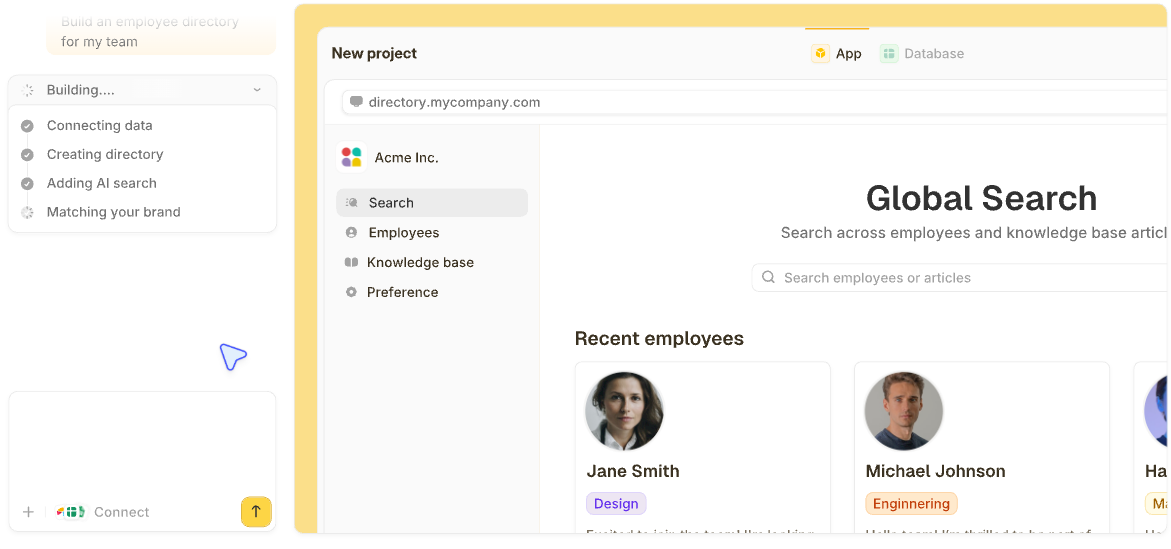
You describe what you need in plain language. Zite builds the tables, fields, and relationships for you. No schema design, no SQL, no technical setup before you can start working.
- Spreadsheet-like interface, real database underneath. The visual simplicity stays. Real field types, validation rules, and table relationships work behind the scenes. Your data stays clean without you having to police it.
- From sheet to structured app. Once your tables are set up, you can add permissions, workflows, and user-facing views on top. A spreadsheet holding your CRM data becomes an actual CRM. No rebuild required.
- Built-in logic and hosting. Infrastructure is handled. No hosting setup, no performance worries as your data grows.
- Zite is SOC 2 Type II certified, so teams can rely on a verified security standard.
- Access control on every plan. Role-based permissions come standard. Enterprise plans add SSO and audit logs for teams that need them.
- Unlimited users on every plan. No per-seat pricing. The free tier includes unlimited users and unlimited apps.
Ready to try Zite?
If your spreadsheet is holding data that's become operationally important, that's usually when teams make the move. Zite lets you bring that data into structured tables, add permissions and workflows, and turn it into something your whole team can actually use. The free plan includes unlimited apps and users, no credit card required.
Frequently asked questions
When should I switch from a spreadsheet to a database?
Switch from a spreadsheet to a database when you start seeing signs like slow load times, multiple people editing at once causing conflicts, or frequent version issues. You also need a database if you're managing data across multiple tables, running reports that pull from several sources, or if you need audit trails for compliance.
Can a spreadsheet work as a database?
A spreadsheet can technically function as a basic database for small datasets and a few users, but it lacks the data integrity controls, referential integrity, and multi-user performance that purpose-built databases provide. Google Sheets offers some validation and concurrent editing, but those features don't scale beyond basic use cases.
What are the biggest risks of using spreadsheets for business data?
The biggest risks of using spreadsheets for business data are accidental data loss, version control problems with multiple copies, and crashes from large datasets, often with no audit trail to catch mistakes. One person can accidentally delete a formula and break your entire forecast without anyone knowing.
Are databases harder to learn than spreadsheets?
Yes, traditional databases are harder to learn than spreadsheets because you need to understand schema design, table relationships, and SQL before you can do much. But that's not the only option anymore. Tools like Zite are built specifically so teams can get a database without the learning curve.