

Inefficient workflows burn money through delays, rework, and manual effort. That’s why I researched the top workflow optimization strategies and reviewed many tools to understand what it takes to improve your processes and which tools actually help in 2026.
What is workflow optimization?
Workflow optimization means reducing the time and effort wasted on a particular task. That could mean cutting three approval steps down to one, or automating the data entry that eats up your Monday mornings.
It’s different from just creating workflows because it’s continuous. Creating a workflow establishes the basic process. Optimizing it means you're constantly improving based on feedback and how it performs.
Benefits of workflow optimization
When you optimize workflows, you stop relying on people to remember what to do next. The process does that job for you.
Some of the main benefits:
- Work moves faster: Instead of someone posting in a general Slack channel and hoping the right person sees it, a request goes through a form or system that automatically sends it to the right owner.
- Fewer mistakes: When work lives in messages, people copy details into docs, spreadsheets, or tools by hand. Optimized workflows capture the information once and pass it along automatically.
- Ownership is obvious: In an unoptimized setup, it’s common to ask, “Who’s on this?” With a defined workflow, each step already has an owner. If a workflow is stuck, you can see where it stopped.
- People are less frustrated: Nobody enjoys chasing approvals or updating the same spreadsheet in three places. When you remove that kind of busywork, employees have calmer and more focused workdays.
- Scaling feels manageable: When volume increases, the workflow absorbs it. You’re not immediately talking about hiring or working nights just to keep up.
6 strategies for workflow optimization
There’s no single switch you can flip to optimize a workflow. Instead, you combine a few practical strategies like removing bottlenecks, cutting waste, and designing for change to make compounding improvements.
Here are 6 you can start with:
- Find the bottleneck (and fix that first)
In any workflow, some steps usually slow down everything else. Fix those steps, and the whole system speeds up.
Common bottlenecks:
- One manager who has to approve everything
- One person with specialized knowledge who becomes a dependency
- One system that's manual, slow, or always down
- Cut waste using lean principles
Lean principles aim to maximize value by eliminating waste. While these concepts started in manufacturing, they are equally effective in the modern office. To optimize your workflow, look at each step and ask whether it’s necessary.
In office work, the three most common wastes to cut are:
- Waiting: Work stuck in inboxes or pending review for days.
- Overprocessing: Doing extra steps that don't change the outcome (like formatting a report no one reads).
- Defects: Rework because details were incomplete, unclear, or wrong the first time.
Get ruthless with your process. If a step doesn't reduce risk, improve quality, or help the end user, remove it.
- Reduce errors by measuring them (Six Sigma thinking)
Six Sigma is a method companies use to cut down errors by treating mistakes as data. You don’t need a certification to borrow the useful parts of this method. Just pay attention to what breaks, fix the real cause, and lock in that fix so it doesn’t slip back.
In practice, that means:
- Track basics like “How often do we have to redo this?” and “How long does this step usually take?”
- Change one part of the process at a time and only keep the changes that reduce mistakes.
- Add guardrails (validations, checklists, automated checks) so the process doesn’t skip critical steps.
This mindset is most useful when errors are expensive or risky. Think billing mistakes that lead to chargebacks, compliance gaps that invite audits, or healthcare workflows where incorrect data can lead to the wrong treatment decision.
- Design for change
Your workflow will change, so design with that in mind.
A few best practices to follow:
- Build a default path that handles 80% of requests, plus a clear path for the exceptions.
- Review the workflow regularly (monthly or quarterly) and make adjustments.
- Avoid setups that require a full IT project to change one rule or form.
- Create an improvement plan (not random fixes)
It’s tempting to optimize by fixing whatever is broken this week, but that usually creates a pile of duct‑tape fixes that break down over time. A business process improvement plan forces you to zoom out and redesign the workflow end‑to‑end.
In simple terms, a good plan:
- Defines the goal by stating what success looks like. Faster turnaround? Fewer errors? Better visibility into status?
- Maps the current reality, including the unofficial workarounds nobody documented.
- Designs the future state with fewer steps, fewer handoffs, and clear ownership so everyone knows what they’re responsible for.
It takes more effort up front, but it stops you from stacking band‑aid fixes that slowly make the workflow harder to understand and change over time.
- Build in regular reviews so improvements stick
To keep improvements from sliding backwards, you need a lightweight way to see when things are getting slower or messier.
Start by tracking these metrics:
- Cycle time: How long does the work take from start to finish?
- Queue time: How long does work sit waiting at each step?
- Error rate: How often does work come back for rework?
Then review these numbers regularly. If you see cycle time creeping up or error rates spiking, you can fix the problem while it’s small instead of discovering it six months later.
Best practices of workflow optimization
Good workflows don’t happen by accident. Below are a few habits that make almost any process easier to fix and keep running smoothly:
Don't optimize before mapping reality
The most common optimization mistake is fixing what you think happens instead of what actually happens.
Document how work flows through your organization by following real tasks. Capture timing, resource needs, decision points, and every step that happens between official milestones.
Process mining tools can analyze event logs from your systems and automatically generate visual maps, including variations and exceptions that teams forget to mention.
Never automate a broken process
Automation makes everything faster, including errors. If your current workflow has unnecessary steps, unclear handoffs, or inconsistent rules, automating it just creates chaos.
Before automating anything, ask:
- Does this step add value for the customer or end user?
- What happens if we skip this step entirely?
- Is this step duplicated somewhere else in the process?
Only automate after the process is producing consistent results manually.
Never allow shared ownership
If two people own a step, no one owns it. Shared responsibility creates confusion about who's accountable when things stall.
Every step in a workflow needs one responsible person and one deadline. Automated routing ensures tasks reach the right person instantly. Built-in escalation rules flag overdue items before they become crises.
Standardize the 80%, not the 100%
When different departments run the same process five different ways, you get inconsistent workflows. But forcing rigid standardization on every edge case can force teams to use workarounds.
To prevent this, standardize the majority of cases that follow predictable patterns. Build explicit paths for exceptions rather than pretending they don't exist.
Have one source of truth
A single source of truth doesn't mean one massive database. It means your systems talk to each other, and there's a clear system of record for each type of information.
If data changes in your CRM, it should automatically update your project management tool.
Teams that skip this spend hours hunting for the real version of information and making decisions based on outdated data.
Measure before declaring success
Capture baseline metrics before you change anything. For example, how long does the process currently take? If you don't know this, you're guessing whether the optimization worked.
Compare post-optimization numbers against your baseline after 30, 60, and 90 days. Workflows that seem fixed have a way of drifting back. Your team can revert to using old approvals or creating workarounds that undo your changes.
Examples of workflow optimization in action
Abstract principles are easier to understand with concrete examples. Here's how you can optimize 3 common business workflows.
Customer onboarding workflows
Customer onboarding typically involves collecting documents, verifying information, setting up accounts, and providing initial training.
A customer onboarding process can look like:
- Sales closes the deal and emails the customer a welcome packet
- Customer fills out the intake form with company details
- Ops team creates an account in the system
- Ops emails the customer requesting documents
- Customer emails documents back as attachments
- Ops downloads, renames, and uploads files to the shared drive
- Ops verifies documents and flags missing items via email
- Back-and-forth until documents are complete
- Ops schedules kickoff call
- Customer success runs a training session
However, steps 4-8 can take weeks. Documents get lost in email threads. Customers don't know what's missing or what's next. Ops spends hours chasing attachments instead of onboarding.
Here’s how to optimize the onboarding process:
- Replace the email-based document collection with a customer portal so customers log in, see exactly what's required, and upload files directly.
- Auto-validate documents on upload (file type, size, required fields) so customers fix errors immediately.
- Trigger account creation automatically once the required documents are submitted and verified.
- Auto-schedule the kickoff call based on completion status and calendar availability.
Invoice processing workflows
Traditional invoice processing involves manual data entry, multiple approval layers, and paper trails that get lost.
The invoice approval process typically follows these steps:
- The invoice arrives via email
- Accounts payable (AP) clerk downloads and logs it in a spreadsheet
- AP emails the invoice to the department that made the purchase
- Department manager reviews, replies "approved" (or doesn't reply for days)
- AP clerk updates the spreadsheet, forwards it to the finance director for invoices over $5,000
- Finance director approves via email
- AP clerk enters the invoice into the accounting system
- Payment is scheduled for the next batch run
Here’s how to optimize the invoice processing workflow:
- Use a portal to accept invoices, then route them automatically based on amount, department, and vendor.
- Escalate overdue approvals to the next level after 72 hours.
- Auto-match invoices to purchase orders and flag discrepancies.
Customer support workflows
Support tickets often bounce between agents, wait in queues, and require customers to repeat their problems multiple times. Support queues clog up when tickets bounce between agents or require customers to repeat themselves.
A manual support flow can look like:
- Customer emails support inbox
- Support agent reads the email and manually tags the issue type
- Agent checks if the customer has an existing ticket in the system
- Agent creates a new ticket and copies the email content into it
- Agent determines that this needs engineering help and forwards the email to the engineering Slack channel
- Engineering responds in Slack (maybe)
- Agent relays the answer back to the customer via email, and the customer replies with a follow-up question
Here’s how to optimize a support workflow:
- Automate ticket routing based on issue type, customer tier, and agent expertise.
- Integrate a knowledge base that suggests relevant articles to agents and customers.
- Use escalation rules that fire when tickets approach or miss SLA targets.
- Use post‑resolution surveys that send automatically and feed back into quality metrics.
The result is faster response times and more consistent customer service.
7 best tools for workflow optimization
When you decide to optimize your workflows, there are several tools you can use. They range from no-code, AI app builders (Zite), automation platforms for connecting existing apps (Zapier, Make, N8n), and workspace tools for organizing data (Notion, Airtable).
Below are 7 worth considering:
- Zite builds custom business software from natural language prompts that match your exact workflows. Unlike many automation-only tools, it creates the actual interfaces and databases your workflows run on, not just the connections between them.
- Zapier remains the go-to for connecting popular SaaS apps without code. It supports 7,000+ integrations, making it easy to start automating quickly. Best for teams that need simple trigger-action automations across many different tools.
- Make offers a visual workflow builder with more advanced branching and logic than Zapier. It handles complex, multi-step automations well.
- N8n gives technical teams the flexibility of code with the speed of visual building. It's self-hostable, which matters for companies with strict data governance requirements.
- Notion works well for teams that need a flexible workspace combining project management, documentation, and basic workflows. It's highly customizable but requires more manual setup for automation.
- Airtable excels at database-driven workflows where you need to track, filter, and organize structured information. Strong for operational workflows, though it has some limitations on record volume for larger operations.
- Nintex handles complex business processes with features like robotic process automation (RPA) and document generation. Better suited for organizations with existing enterprise software stacks that need deep integration.
Optimize your workflows with Zite
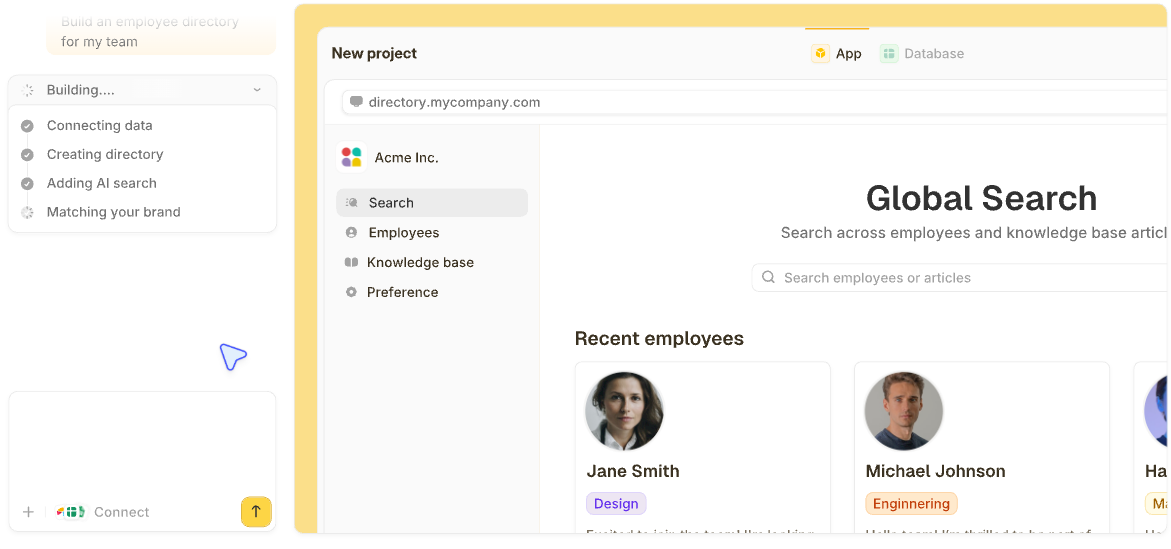
Unlike automation-first tools that connect existing apps, Zite builds the app at the center of your workflow.
Instead of gluing together a form tool, a spreadsheet, an internal dashboard, and a handful of automations together, you design one purpose-built Zite app that does all of that in one place. That means you can replace clunky tool stacks entirely, not just automate the gaps between them.
Here’s how it works:
- Build what you actually need: Instead of adapting your processes to fit generic software, describe what you want, and Zite will create it. Edit the app with more prompts or directly with the visual edit tool.
- Production-ready from day one: This isn't prototype software that breaks under real load. Zite apps handle actual business operations with built-in authentication, access control, SSO, audit logs, and secure hosting. It also meets SOC 2 Type II compliance for data security.
- Visual workflows: View your workflows in a flowchart-style interface. You can quickly understand how the process works, inspect past runs to debug issues, and prompt to make changes.
- Connect your existing data: Zite integrates with Airtable, Google Sheets, and other tools you already use. Your workflows pull from and update your current systems without manual data transfer.
- A built-in no-code database: Instead of setting up an external database, Zite’s built-in database can auto-generate your tables and relationships based on what you are building. No SQL needed.
- No per-user deployment costs: Every Zite plan, including the free tier, supports unlimited users and unlimited apps. With no per-seat pricing, teams can scale without worrying about unpredictable costs.
Ready to start optimizing your workflows? Try Zite for free.
Frequently asked questions
What’s the hardest part of workflow optimization?
The hardest part of workflow optimization is uncovering how work actually happens day to day. Teams tend to describe the official process, while real work relies on exceptions, workarounds, and tribal knowledge that never make it into documentation.
Do I need technical skills to optimize workflows?
No, you don’t need technical skills to optimize workflows at a basic level. Business teams can map processes, remove unnecessary steps, and clarify approvals while no-code tools like Zite, Zapier, and Make handle the optimization.
Can Zite help me optimize my workflows?
Yes, Zite helps optimize workflows by letting you build custom apps that automate manual processes. You can create intake forms, automated routing, real-time dashboards, and structured databases without writing code.
How often should I review and update workflows?
You should review and update workflows at least quarterly to keep them effective. Tracking metrics like cycle time, error rate, and throughput helps catch issues early, while major business changes should trigger an immediate review.