

AI app development costs can range from a low monthly subscription to well over $500,000 for complex products with custom engineering. In this article, I’ll break down what contributes to these costs and show you simpler ways to build so you can avoid overspending in 2026.
AI app development costs: Quick ranges
AI app costs in 2026 mostly come down to how you build (with a no-code builder or a custom dev team), how big the app is (a simple workflow vs. a full consumer-facing product), and how you use the AI each month.
With that in mind, here’s how much you can expect to spend depending on how you build:
- A low monthly subscription for an AI app builder may start at $15-$25 monthly. For example, a no-code AI app builder like Zite lets you build production-ready apps with just prompts, and starts at $19/month.
- Hiring an agency or a dev shop may cost roughly $20,000–$80,000 if you pay an agency to build a small custom AI app on top of existing models. For larger applications with advanced features, higher security needs, or multiple integrations, costs typically start at $100,000 and can increase significantly.
- An in-house engineering team may cost you between $100,000 to hire a single engineer and $500,000+ for a full team of 3-5, depending on how specialized their role is.
On top of the build, there’s the cost to keep the app running, including model usage (every AI request costs a little), regular updates, and ongoing monitoring.
What influences AI app development costs?
The main factors that influence AI app development costs are model complexity, overall project complexity, data requirements, hosting strategy, and developer expertise.
Here’s a look at each one:
Model choice and how much you use it
Model usage usually lands in the low thousands of dollars per year if you design your prompts and workflows well and use existing models.
For most apps, you won’t need a custom AI model, and you can just plug into off-the-shelf APIs (OpenAI, Claude, Gemini) and charge per token or request. For example, Claude Opus 4.6 will cost $5 input and $25 output per million tokens for standard requests. A small app handling 1,000 customer questions per day might run $200–300/month in AI costs. Lighter models cost less.
Custom model training is where you see eye‑watering costs. Meta trained Llama 2 models on over 3 million GPU hours. This would be roughly $3.8M in hardware usage alone if you rented NVIDIA A100s at $1.29/hour. This is just an estimate. Big tech companies have their own infrastructure or can negotiate rates far below retail cloud pricing.
Most businesses don’t have that leverage or hardware, so using existing APIs makes way more sense financially.
Overall project complexity
Custom AI apps have to match your exact workflows, which is why complex projects like ERPs with lots of integrations can easily cost thousands of dollars.
You can always build simpler apps with no-code app builders. For example, you can build an AI chatbot with Microsoft Copilot, which starts at $33.50/user/month for businesses. Building a similar chatbot from scratch could cost $2,000–$15,000 if you use a dev agency.
Once you start layering in multiple user roles, workflows, and integrations with older systems, timelines stretch, and costs climb quickly because you’re paying for extra planning, edge‑case handling, and testing.
Data complexity
Data work alone can eat up 15–25% of the total budget, covering everything from sourcing to cleaning and labeling. Each new data source adds both cost and risk. Legal, security, and privacy reviews become necessary, especially when working with regulated data.
If you're using supervised learning (the most common approach for business applications), every piece of training data needs to be labeled by a human. Simple labels can cost $0.03–$1 per label. Highly complex or specialized annotations, such as medical images or legal documents, can reach $1–$3 per item.
Buying datasets can range from a few thousand dollars for open commercial datasets to hundreds of thousands for large, industry-specific or proprietary data (for example, curated healthcare databases).
On platforms like Amazon Data Exchange, dataset pricing varies widely based on data volume, domain, and licensing.
Ongoing monitoring for data quality is also essential, as unnoticed issues can silently degrade your AI’s accuracy and increase maintenance costs.
Hosting and deployment
You have two main options for running AI workloads:
- Hosted APIs and managed services: You pay per call, per token, or per minute of processing while the provider handles scaling, uptime, and infrastructure. This keeps upfront costs low and removes the need to manage GPUs.
- Self‑hosting or dedicated AI infrastructure: You manage your own GPU or CPU instances, either in the cloud or on‑prem. For example, renting a single GPU from Google Cloud starts at $0.35/hour. This approach can be more cost‑effective at high, predictable volumes and with yearly commitments, but it introduces DevOps/MLOps costs.
For most early‑stage apps, hosted APIs or managed AI platforms offer the simplest and most financially predictable path.
Developer costs
Developer and staffing costs usually make up the largest part of an AI app development budget. If you require specialized roles, expect total costs to rise quickly.
For example, roles like AI/ML engineers, data scientists, and DevOps or platform engineers often command six‑figure salaries in the US.
According to Glassdoor, median US salaries for the roles you'd typically need are:
- $176K/year for AI/ML engineers
- $154K/year for data scientists
- $143K/year for DevOps engineers
With AI app builders like Zite, much of this stack is pooled for you. You don’t hire separate specialists for infrastructure, DevOps, or the front‑end/backend work. The platform provides hosting, deployment, and a builder out of the box.
Build-from-scratch vs. app builders costs compared
Building from scratch gives you maximum control but also requires you to cover 100% of the development and ongoing maintenance costs yourself. App builders, like Zite, flip that cost model. You pay a monthly subscription (Zite starts at just $19/month), plus model API usage if you connect to an AI model. That’s it.
The platform absorbs most of the underlying complexity, like code generation, hosting, and infrastructure.
Your subscription, however, isn’t always a simple flat fee like Zite’s. These are some of the most common pricing models builders use:
- Credit-based pricing: You buy a pool of credits and spend them on AI operations like building and modifying the app. Usually, more complex actions burn more credits.
- Token-based pricing: Some tools map pricing directly to the volume of text processed by models (inputs plus outputs). Very verbose or high‑volume workloads burn through your allowance faster.
- Per-user or per-builder pricing: Some tools also charge for each end user and builder who edits or accesses your app. This can get expensive fast as your team or user base grows, even if your AI usage stays modest.
Top examples of entry-level app builders in 2026
To make this concrete, here’s what entry‑level pricing looks like for several app builders and coding assistants:
All of these tools can help you move faster and more cheaply than a traditional build. However, Zite stands out by letting you visually inspect and edit workflows and databases, so you always understand how your app works without having to dig into code.
Zite makes building AI apps easier
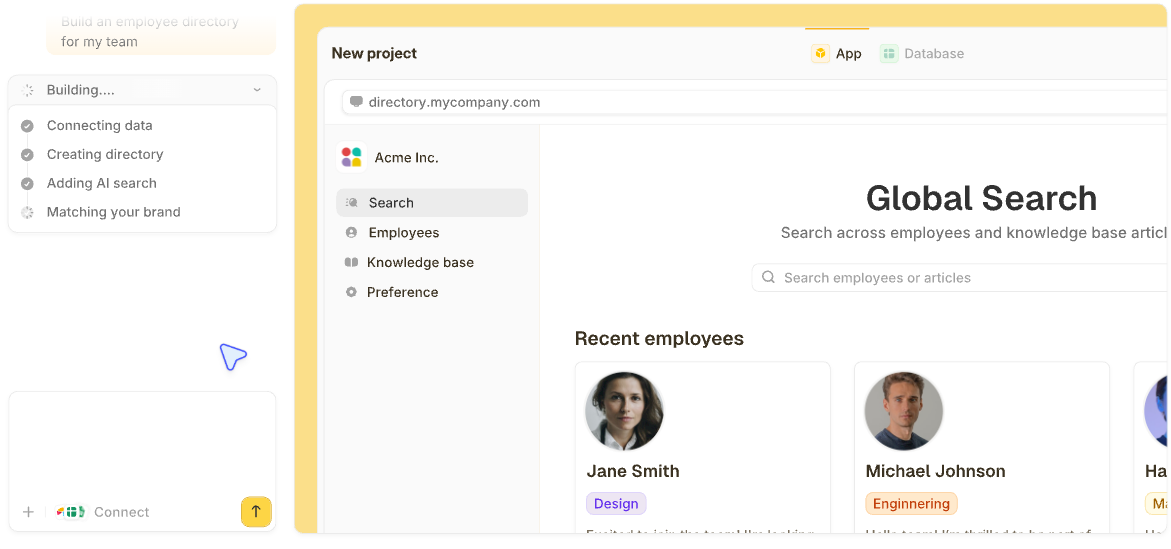
Zite is an AI no-code platform that builds production-grade business software from plain English prompts. It builds the database, generates the UI, sets up authentication, integrations, and provides hosting. You only have to focus on what your AI app should do.
Here’s how that translates into lower development costs:
- You skip most of the boilerplate engineering: With a traditional build, you’d pay engineers to build the app, set up auth, permissions, and hosting. Zite comes with all these built in.
- AI is a building block, not a separate project: In Zite, adding AI to your customer portal, CRM, or workflow is as easy as describing what you want (like auto-classifying support tickets or summarizing customer feedback). Zite will prompt you to connect your model, and then it will write the integration and the logic behind the scenes.
- You don’t pay per user: Many tools get expensive as your team grows because they charge for every user or builder. Zite’s plans support unlimited users, even on the free tier, so you don’t have to do mental math every time someone new uses the app.
- You can keep a small team: Because Zite handles so much of the infrastructure and UI, you don’t need to hire specialized engineers to maintain the AI app. Anyone who understands your business can build the entire app and maintain it.
- Free visual edits: Visual edits in Zite are free, so use them for restyling (font sizes, colors, spacing, layout) instead of regenerating the whole screen with AI. This keeps your credit usage focused on the functionality that actually needs AI, like building new features or adding logic.
- Errors are free to fix: When AI makes a mistake, fixing it in Zite doesn't cost you credits. With many AI app builders, every fix attempt burns tokens, so you end up paying to undo problems, not build new functionality.
- Use Plan or Chat mode first: Chat mode uses fewer credits than full builds because it focuses on analyzing files. Use it to review changes or ask questions. For complex requests, use Plan mode to define the scope upfront. Clear requirements reduce expensive rebuilds, which keeps total credit usage lower.
- Visual workflows: You get visual workflows as flowcharts so you can quickly see how your processes work. This lets you pinpoint where any logic needs updating before you even start editing, usually reducing extra processing and rework.
In short, Zite enables you to launch a production-ready AI app with far fewer developer hours or specialized skills. Today, a single person can launch AI apps that used to demand a huge team and a significant budget.
If you’re ready to start building, sign up for a free account. No credit card required. You get unlimited users, unlimited apps, and enough AI credits to build your first app and make several rounds of changes.
Frequently asked questions
What's the hardest part of building an AI app?
Getting the AI to behave reliably is the hardest part of building an AI app. AI models don't always produce the same output for the same input, and they fail in unexpected ways. You'll spend more time than expected on prompt engineering, handling edge cases, and building guardrails to catch AI mistakes.
Do I need coding skills to build an AI app?
No, you don't need coding skills if you use a no-code, prompt-to-app builder like Zite, Lovable, or Bolt. These platforms let you describe what you want in plain language and generate working applications with databases, authentication, and AI features built in. You will need coding skills if you're building from scratch and not using an app generator.
Can Zite help me build an AI app?
Yes, Zite can help you build AI-powered business apps without writing code. Zite generates the application with a built-in database, user authentication, and AI capabilities from your prompt.
Why do AI apps cost money to run?
AI apps cost money to run because each AI request uses computing resources like GPUs or specialized hardware, which require ongoing operational costs.