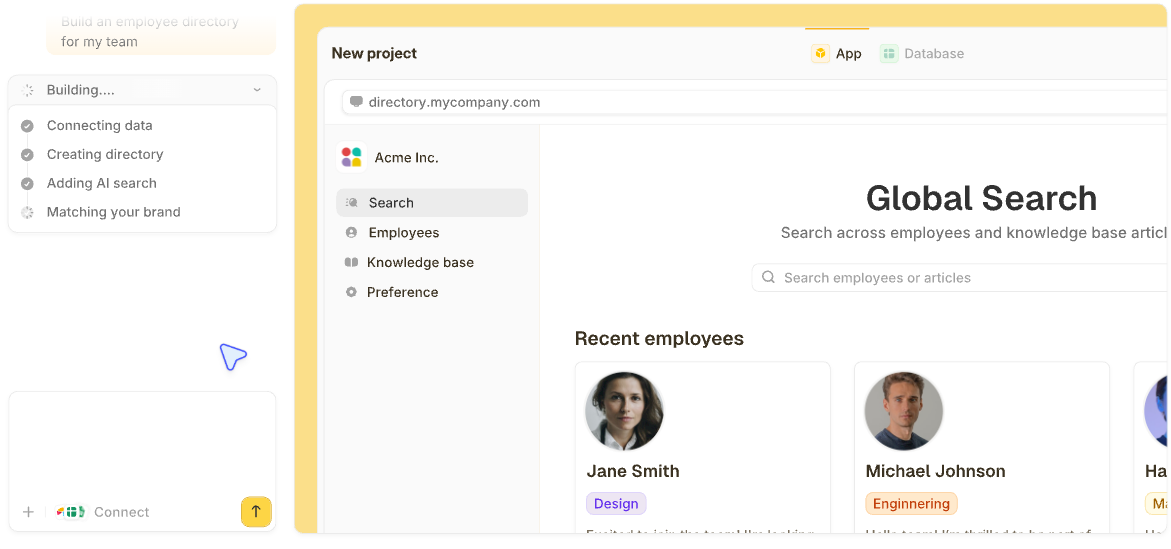


For business apps, Zite outperforms both because it pairs prompt-to-app speed with visual workflows, a click-to-edit interface, and a database non-technical teams can see and control. Base44 and Replit each win in other areas, so here's a full breakdown of how all three compare on features, pricing, and real-world use.
Base44 vs Replit: What’s the Core Difference?
Base44 is built for non-technical users who want to generate apps from prompts without touching code. Replit is built for developers who want AI assistance inside a full coding environment. That's the core split.
Base44 turns natural language descriptions into web apps, complete with UI, database, and authentication generated in one go. Replit is a cloud-based IDE with an AI agent (currently on Agent 4) that helps developers write, troubleshoot, and publish code from a browser.
Both can produce a working prototype in minutes, but they approach the problem from opposite directions.
That distinction matters more than most comparison articles admit. If you're an ops manager building an employee portal, Replit's multi-language IDE is overkill. If you're a developer building a custom SaaS product, Base44 will feel limiting because you can't access or control the underlying code.
How Does Zite Compare to Base44 and Replit?
Zite combines the prompt-based simplicity of Base44 with the real backend logic of Replit, but without requiring code at any stage. It's built for apps that go beyond prototypes and into daily use by business teams.
Like Base44, you describe what you want and get a working app. But where Base44 focuses on fast prototyping and MVP validation, Zite is designed for apps you'll publish to your team or customers. Like Replit, Zite supports real workflows and data logic, but you never have to write code or deal with a technical setup to get there.
The difference that matters most is that with Zite, you can see and control everything the AI builds.
Three things set Zite apart for business apps:
- Visual workflows. App logic shows up as flowcharts you can read, trace, and verify. You can follow exactly what the app does at each step, without digging through code.
- Visual editing. Click on any element in the app and change its properties directly. Tweaks like text changes, color swaps, and small style tweaks can be made without opening a code editor.
- User-friendly database. A spreadsheet-like interface where anyone on the team can view and edit the underlying data. Zite generates the right tables and fields when you describe what you want to build, and the database scales to millions of records.
Three more practical advantages stack on top of the see-and-control story:
- Native integrations. Zite connects directly to Zite Database, Airtable, Google Sheets, Salesforce, Slack, OpenAI, and Stripe with no third-party connectors required. That matters for the dashboards, customer portals, and CRMs that these platforms are typically used to build.
- No per-user fees. Unlimited users on every plan, including free. Adding a 50-person team to your app doesn't change the price. You don't pay for compute or app hosting either, only for actual integration usage.
- Granular permissions and roles. Role-based access, workspace controls, and group permissions for any app where different team members need different access levels. Base44 and Replit offer basic authentication but lack the depth needed for multi-role apps.
Base44 vs Replit vs Zite: Feature Comparison
How Much Do Base44, Replit, and Zite Cost?
Pricing for all three platforms looks similar on paper. But once your app is live with real users, costs diverge fast. Here's what actually matters if you want to avoid surprise bills.
Base44 Pricing
Base44 uses a dual-credit system: message credits (for building) and integration credits (for running). Here are the plans:
- Free: 25 message credits/mo, 100 integration credits
- Starter: $20/mo, 100 message credits, 2,000 integration credits
- Builder: $50/mo, 250 message credits, 10,000 integration credits, custom domains, GitHub export
- Pro: $100/mo, 500 message credits, 20,000 integration credits
- Elite: $200/mo, 1,200 message credits, 50,000 integration credits
Credits don’t roll over. If your app uses AI features (LLM calls, image generation, email sending), each user action burns integration credits. A moderately active app with 50 users could burn through the Builder plan’s integration credits in weeks.
Replit Pricing
Replit overhauled its pricing in February 2026. It uses an effort-based credit system in which costs scale with the amount of work the AI Agent performs. Here are the plans:
- Starter (Free): Limited daily Agent credits, public projects only, apps expire after 30 days
- Core: $20/mo, $20 in usage credits, up to 5 collaborators, private projects
- Pro: $100/mo, up to 15 builders, tiered credit discounts, credit rollover, priority support
- Enterprise: Custom pricing
Heavy Agent users report spending $50 to $300/mo in overages on top of their base subscription. Always-on deployments, database storage, and frequent AI interactions all eat credits fast. Several user reviews mention the unpredictability of costs as a major frustration.
Zite Pricing
Zite uses the same dual-credit model as Base44, with AI credits for building and integration credits for running things like AI calls, emails, and external connections. The difference is that Zite doesn't charge for compute or app hosting, and there are no per-user fees on any plan. Here are the plans:
- Free: 50 AI credits, 1,000 integration credits, 5,000 database records, unlimited users and apps.
- Pro: $19/mo, 100 AI credits, 10,000 integration credits, 100,000 database records, 1 custom domain, remove Zite branding.
- Business: $69/mo, 200 AI credits, 50,000 integration credits, 250,000 database records, unlimited custom domains, advanced AI models.
Visual edits like color, font, and layout changes don't burn credits. Error fixes are free too. Pro and Business are priced for monthly billing; annual billing brings the effective rate down to $15/mo and $55/mo, respectively.
For teams building custom apps, Zite's $19/mo Pro plan delivers more practical value than Base44's $50/mo Builder plan or Replit's $20/mo Core plan, especially when you factor in the included database, hosting, and permissions.
Who Should Use Base44?
Base44 is a solid pick if you’re a solo founder or indie maker looking to validate an idea quickly. Its prompt-to-app speed is impressive. You can go from a text description to a working app with a database, login system, and hosted URL in under 10 minutes.
Base44 works well for:
- Quick prototypes you’ll show investors or test with a small group
- Personal productivity tools (task trackers, habit apps, simple dashboards)
- Exploring whether an app idea has legs before investing in development
Where it falls short for business use: Base44 was recently acquired by Wix in June 2025, and its product direction leans toward rapid prototyping over business-grade apps. The credit system penalizes iteration (every AI prompt costs credits, even debugging).
Backend code export isn’t available, meaning your app’s logic stays locked in the platform. And user permissions are too basic for apps where different team members need different access levels.
Who Should Use Replit?
Replit is the right choice if you’re a developer (or have one on your team) who wants AI assistance inside a full coding environment. Replit's Agent can write, test, and debug code autonomously, and the platform supports 50+ programming languages.
It’s a strong fit for:
- Developers building custom applications who want AI speed without giving up code control
- Teams that need full code ownership and GitHub integration from day one
- Complex technical projects that will eventually need custom backend logic, API integrations, or infrastructure management
Where it falls short for business use: Replit assumes you know what a framework, a dependency, and a deployment pipeline are. Non-technical ops teams, support managers, and SMB owners will hit a wall quickly.
Its database tools are still maturing (production databases remain in beta). And the effort-based credit system makes costs unpredictable for teams that rely heavily on the AI Agent.
Who Should Use Zite?
Zite is the strongest choice if you need custom apps but don't have developers to build them. It's built for ops managers, support leads, IT admins, SMB owners, and anyone else who needs to create and update their own software without writing code.
It’s the strongest option for:
- Customer portals where clients log in to view their data, submit requests, or track orders.
- Internal tools like employee directories, inventory trackers, onboarding workflows, and approval systems.
- Dashboards that pull data from existing tools (Airtable, Google Sheets, Salesforce) and display it clearly.
- CRMs and project trackers that match how your team works, not how a SaaS vendor thinks you should work.
What sets Zite apart from both Base44 and Replit is that you can see and control everything the AI builds. App logic shows up as visual workflows you can trace, the interface is editable with point-and-click changes, and the database sits behind it as visible tables and fields.
You get the ease of Base44's plain-language prompts and the real app logic of Replit without ever writing code.
The native integrations layer adds the practical piece. Customer portals plug into your Salesforce data, dashboards read from Google Sheets or Airtable, and Slack notifications go out from your own workflows, all without third-party connectors stitched on top.
Ready to try Zite?
If you’re curious how Zite works for client portals, the simplest way is to try it yourself. The free plan includes unlimited apps and users, no credit card required.
The Bottom Line
The Base44 vs Replit debate usually comes down to non-technical vs developer. But for building custom apps, the real question is whether the platform can handle production workloads with real users, real data, and real access controls.
Choose Base44 if you're validating an idea quickly and don't need to publish it to a team.
Choose Replit if you’re a developer who wants full code control with AI assistance.
Choose Zite if you're building business software that real people will use every day. You want visible workflows, point-and-click interface edits, and a real database, without hiring a developer to set it all up.
Frequently Asked Questions
Is Base44 or Replit better for building business apps?
Neither is purpose-built for business apps. Base44 excels at rapid prototyping, and Replit is a developer-focused coding environment. For business apps with user permissions, branded domains, and scalable databases, Zite is a stronger fit.
Can I use Base44 without coding experience?
Yes, you can use Base44 without coding experience. You describe your app in plain language, and the AI generates it. Replit requires some coding knowledge to get the most out of its IDE and Agent features.
How much does it cost to build an app with these platforms?
Building an app with these platforms costs from $0 to $200+ per month, depending on usage. All three offer free plans, with paid tiers starting at $19/mo for Zite, $20/mo for Base44, and $20/mo for Replit. All three also use credit systems, but Zite is the only one that doesn't charge for compute, hosting, or extra users.
Does Zite work with tools I already use?
Yes. Zite connects natively to Airtable, Google Sheets, Salesforce, Slack, Stripe, OpenAI, and more. You can pull data from existing sources and build apps on top of them without migrating anything.
Can I deploy Zite apps on my own domain?
Yes. Custom domains are available starting on the Pro plan ($19/mo). You can also match your organization’s branding, colors, and design system so the app looks like yours, not like a third-party tool.