

After analyzing how 15+ top-tier service providers use branded client portals to charge premium rates, here's exactly how they increase revenue through positioning, automation, and retention in 2026.
What is a branded client portal?
A branded client portal is a secure, customized online platform where clients access projects, files, and communications exclusively under your company's branding. It's where all the work happens under your company name, not through Google Drive links or random third-party tools.
The difference shows up fast. When prospects click through Dropbox, then Calendly, then DocuSign (each showing different company logos), friction builds quickly. PwC research shows that 59% of customers will abandon a brand after several poor experiences, and 17% will leave after just one bad interaction.
A branded client portal includes:
- Your logo, colors, and custom URL
- Client onboarding that syncs with your CRM
- Direct messaging without email chains
- Billing and payments in one place
- Mobile access when clients need it
Brand consistency pays off. According to McKinsey's 2026 State of Marketing report, 72% of CMOs plan to increase their branding investment budgets. When everything looks like you built it, clients perceive your service as premium and professional instead of a patchwork of borrowed tools.
How a branded client portal increases revenue
A branded client portal drives revenue through five core mechanisms:
- Premium positioning through brand consistency: Every login shows your branding, not third-party tools. A recent consumer study found that 87% of consumers are willing to pay more for products from brands they trust. Your logo everywhere validates premium pricing.
- Faster payment cycles: Clients pay where they already work. No switching between email and payment sites, no delays. Just one click from invoice to paid.
- Automated upselling: Upgrade offers appear when clients are engaged. Personalized digital experiences generate 40% more revenue. Client finishes a milestone? Premium services appear right there.
- Higher retention: More use and harder to switch. The more clients use the portal, the harder it becomes to switch. Unified platforms increase repurchase by 94%.
- Scalable operations: Self-service lets clients handle passwords, invoices, and upgrades themselves, so your team can focus on growth without adding headcount.
Metrics that prove impact
Track these numbers to measure how your portal affects revenue:
- Client activation rate: Logins divided by invitations sent. A score below 50% indicates your portal isn't solving real problems. Top performers consistently stay above 70%.
- Average payment cycle time: Track how many days pass from invoice to payment each month. When clients pay where they already work instead of switching between email and payment sites, cycles shrink fast.
- Support tickets per client: Should drop as self-service rises. 73% of service teams adopted self-service by the end of 2025. When clients handle routine tasks themselves, your team focuses on actual growth work.
- Customer lifetime value: Track quarterly. A portal that removes friction keeps clients longer and opens more upsell opportunities. Compare CLV before and after portal launch to see the real impact.
- Monthly recurring revenue growth: Monitor how many clients upgrade through the portal versus sales calls. When upgrade buttons live where clients check progress, conversion jumps without extra selling effort.
Implementation roadmap
Setting up a portal correctly could mean the difference between driving revenue and being ignored. These five steps show you how to build it right.
Step 1: Deploy a professional white-label interface
Replace email threads and WhatsApp groups with one secure portal under your branding. When everything looks like you built it, you can charge more.
I've watched agencies lose deals because prospects jumped between Dropbox, then Calendly, then DocuSign. Each showed a different logo. That screams "I borrowed these tools" instead of "I run a tight operation."
Pro tip: Use portal.yourcompany.com so clients never leave your world.
Step 2: Set up onboarding and upsell workflows
Build workflows that fire when someone signs up. Put upgrade buttons right in the dashboard where clients already work. You'll close expansion deals without booking calls.
Timing matters. Client just finished a milestone and logs in to see the results? That's when they spot your premium service offer.
Pro tip: Segment your offers. Consulting clients see advisory packages. SaaS users see implementation bundles.
Step 3: Add payments inside the portal
Connect Stripe or PayPal so clients can pay without leaving the portal. Every extra step between invoice and payment costs you days, so keeping it all in one place means clients pay faster with less friction.
Pro tip: Turn on auto-billing for recurring work to eliminate manual invoicing every month.
Step 4: Give them mobile access
Put your portal on their phone. Your icon on their home screen makes it harder for them to forget and replace you.
Clients who approve files during their commute or check updates from coffee shops stay more active than people stuck waiting for their desk.
Pro tip: Push notifications for new deliverables or unpaid invoices keep things moving.
Step 5: Let clients handle routine stuff themselves
Give clients access to reset passwords, grab invoices, or upgrade plans on their own. You'll handle more accounts without hiring.
Most support tickets are basic. When clients fix it themselves, your team focuses on work that actually matters.
Pro tip: Merge tools into one portal. You'll cut software bills and stop managing six logins.
Common mistakes to avoid
Most businesses set up their branded client portal but miss details that tank adoption and revenue impact. Here's what goes wrong and how to fix it.
Overcomplicating the user interface
Businesses cram every feature into the portal at once. This overwhelms clients. It happens when you focus on what your team wants instead of what clients need. Keep the dashboard clean. Only show modules each client actually uses. A consulting client doesn't need your product catalog.
Ignoring brand consistency
A portal that shows the software provider's logo breaks trust. Generic URLs like app.softwarename.com make you look like a reseller. Use a custom domain. Match your brand colors exactly. Test every page to confirm no third-party branding appears.
Neglecting mobile accessibility
If your portal only works on the desktop, you lose engagement. Clients check updates and pay invoices from their phones. Test key actions on mobile before launch. If they need finger-zooming, clients will email you instead.
Launching without proper integrations
Teams connect to the portal but don't sync it to their CRM, billing, or document systems. This creates outdated info and double data entry. Set up two-way sync before inviting clients. Run full tests with pilot accounts to confirm updates flow everywhere.
Skipping client onboarding
You send a login link without explaining what the portal replaces. It sits unused because nobody knows how it fits their work. Make a quick guide with a short explainer video showing the three main actions. Train your team first. For the first few weeks, redirect email requests to the portal to build the habit.
5 branded client portal tools to consider
Before building from scratch, check if these tools fit your needs. Each handles portals differently.
1. Zite: Best for building custom portals without developers
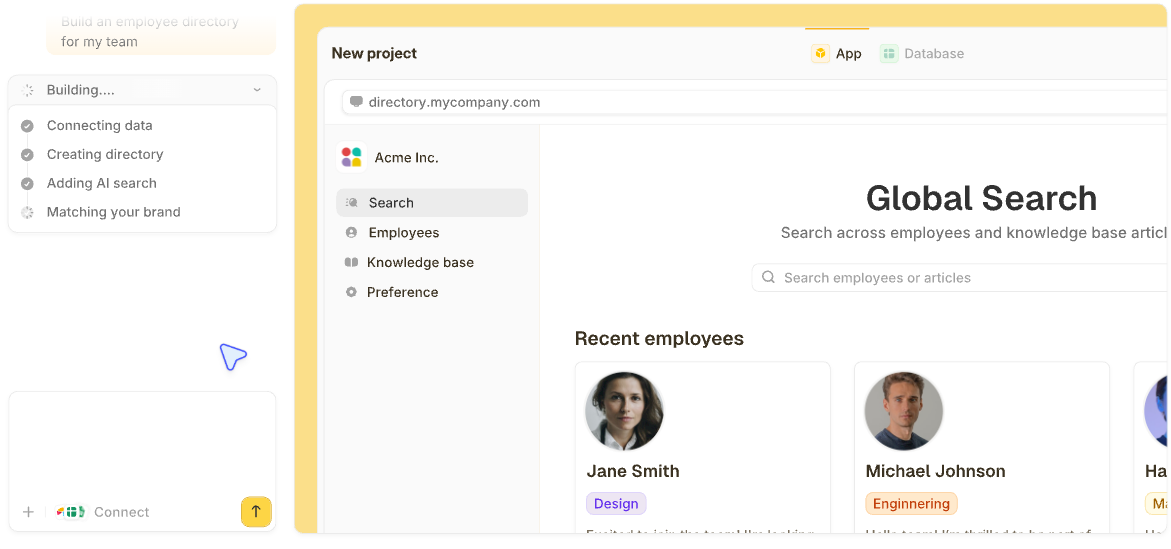
Zite builds custom portals with AI. You describe what you need, and it generates the full portal, including database, authentication, and user permissions, often adding sections you hadn't thought to ask for.
What sets it apart is what happens after generation. Visual workflows let you see and control exactly how the portal operates, and built-in integrations handle emails, payments, and data connections without needing separate tools.
Your team can verify, adjust, and maintain everything without touching code. Because there are no per-user fees on any plan, costs stay flat no matter how many clients you add.
Standout feature: No per-user fees, so costs stay flat as you scale.
Pricing: Starts at $19/month.
2. Zendesk: Best for large-scale customer support
Zendesk is built around ticketing, AI bots, and help centers, which makes it a strong fit for large support teams but a poor match for businesses that want clients actively working inside a branded portal. If your priority is managing relationships and projects rather than resolving high volumes of support requests, you'll hit its limits quickly.
Standout feature: Handles high ticket volume across email, chat, and social in one place.
Pricing: Starts at $55/agent/month.
3. Clinked: Best for agencies managing client projects
Clinked is built specifically for external collaboration, so the white-labeling goes further than most tools in this list. Branded email notifications, custom domains, and native mobile apps all carry your identity, not Clinked's, which matters when the goal is making the portal feel like yours.
Standout feature: Deep white-labeling, including branded mobile apps for iOS and Android.
Pricing: Starts at $299/month.
4. SuiteDash: Best for consolidating business tools in one place
SuiteDash brings CRM, billing, email marketing, and client portals into a single platform, which removes the need to juggle multiple subscriptions. The tradeoff is setup time: the platform is wide enough that getting it configured to your workflow takes real effort before clients ever log in.
Standout feature: Unlimited users and clients on every plan, no per-seat fees.
Pricing: Starts at $19/month.
5. SuperOkay: Best for solo freelancers and small creative agencies
SuperOkay is designed for simplicity, and it shows. The interface is clean enough that clients figure it out without guidance, which cuts the back-and-forth that typically slows down the first week of a new project. Templates for creative work make setup fast on your end too.
Standout feature: Clients can get up and running in minutes with no training needed.
Pricing: Starts at $12/month.
Zite makes it easier to build a branded client portal
You can launch a branded client portal that might have been a month-long project for an engineering team in an afternoon with Zite.
Here's where Zite helps most:
- AI-driven app creation: You start by describing the portal in plain language, and Zite generates the core app automatically. It often even adds sections you might have forgotten to ask for.
- Visual workflows you can actually see and control: Client portals handle onboarding, permissions, and sensitive business data. Visual workflows let you verify exactly what happens at every step.
That means your team can trust, adjust, and maintain the portal as your client base grows, without waiting on a developer every time something needs to change.
- Built-in integrations that make the portal actually work: Client portals need to do more than display information. Workflows can send emails automatically, connect to payment tools like Stripe, and sync with external data sources so the portal handles the operational side end-to-end without stitching together separate tools or managing multiple subscriptions.
- Your data, ready from day one: Zite automatically generates the tables and fields your portal needs. It's fully managed and scalable, so setup, hosting, and performance stay off your plate
- Production-ready features out of the box: Built-in user authentication, secure hosting, and access control on every plan.
- Enterprise-ready when you need it: SSO for single sign-on, audit logs for full activity tracking, and enforced MFA for org-wide two-factor protection.
- Compliance covered: Zite is SOC 2 Type II compliant, with data handling that supports GDPR requirements.
- Easy customization and branding: In Zite, you can adjust the layout, colors, and content on the fly, either with AI prompts or the visual editor. Plus, you can add custom domains and remove Zite's branding to create a fully white-labeled branded client portal.
- Cost and scalability: Zite doesn't charge per user or per app. You can support unlimited clients and build multiple portals, even on the free plan.
Get started with Zite
If you haven't already, sign up for Zite and start building your branded client portal today. Most features are available on the free tier, so you can experiment and prototype without any commitment.
Frequently asked questions
What is the difference between a branded client portal and a generic one?
The main difference between a branded client portal and a generic one is that a branded portal runs on your own domain with your logo and colors, while a generic portal shows the vendor's branding. That distinction matters because clients associate the experience with you, not the software you bought.
What features are essential in a branded client portal?
A branded client portal needs secure file sharing, project tracking, invoicing with integrated payments, role-based permissions, and mobile access. Get these working well before adding anything else.
How do I get clients to actually use the portal instead of email?
Stop responding to requests that the portal is built to handle, and redirect clients with a short explanation of why it is faster there. A brief video showing the three main actions they will use most removes the friction that keeps people defaulting to email.
Is a branded client portal worth the cost?
Yes, for most service businesses it is. A portal that consolidates file sharing, invoicing, and project tracking pays for itself in admin time saved, as long as clients actually use it.