

After spending months studying how companies actually handle workflows (and where they consistently break), these are 13 business process management examples that cut costs, reduce errors, and speed up operations across every major department.
What Is Business Process Management?
Business process management (BPM) is a structured approach to analyzing, improving, and automating how work gets done within an organization. It turns messy, inconsistent workflows into repeatable systems that produce predictable results.
Most companies run hundreds of interconnected processes spanning multiple departments. When those processes rely on email chains, spreadsheets, and institutional memory, things break. Invoices sit in inboxes, new hires arrive without laptops, and contracts expire because nobody tracked the renewal dates.
BPM addresses this by following a five-stage cycle:
- Design: Map the current process and identify what’s broken
- Model: Test how changes would work in different scenarios
- Execute: Implement the improvements (often with automation)
- Monitor: Track performance through metrics and dashboards
- Optimize: Keep refining based on real data
The goal isn’t to automate everything overnight. It’s to make each process visible, measurable, and improvable so your teams stop firefighting and start operating consistently.
13 Business Process Management Examples for Companies
These examples are organized by department so you can jump to what matters most. Each one includes the business pain point, the process before and after BPM, the measurable impact, and practical steps to get it running.
Finance & Accounting
1. Invoice Processing & Accounts Payable
When your finance team processes thousands of invoices every month, even small per-unit costs add up fast. According to Ardent Partners, companies without automation spend around $12.88 per invoice, and each one takes 17.4 days to process.
Here's how manual invoice processing typically plays out:
- Invoices arrive via email, mail, and vendor portals in different formats
- Someone manually enters the data into your ERP
- The invoice gets forwarded to an approver who may not check their email this week
- Payment terms expire, and you miss the early payment discounts
After applying BPM to invoice processing:
- Automated intake captures invoice data regardless of format.
- Automatic routing sends each invoice to the correct approver based on amount, department, and vendor.
- If approval stalls beyond a set number of days, an escalation triggers automatically.
- The system matches invoices against purchase orders and receipts before payment.
Expected impact: Processing costs drop to $3-$5 per invoice. Cycle time drops from 17+ days to 3-5. Your team actually captures early payment discounts instead of letting them expire.
How to implement BPM for invoice processing:
- Map your current approval chain and identify where invoices consistently stall
- Standardize intake with a single portal or form for all vendors
- Set approval rules by dollar threshold and department
- Add escalation triggers and a reporting dashboard so finance can see the full pipeline
2. Budget Approval Workflows
Budget requests at most companies bounce between department heads, finance, and executives with no clear path or timeline. The process runs on email threads and spreadsheet attachments, and nobody knows where a request stands at any given moment.
Without BPM, a typical budget request plays out like this: a department submits via email, finance reviews and sends it back for revisions, the department resubmits, then everyone waits for VP approval. Three weeks later, someone asks, “Whatever happened to that budget request?”
With a structured budget approval workflow:
- A standardized request form captures all required details upfront (no back-and-forth for missing info)
- The request automatically routes through the approval chain based on the amount and department
- Every stakeholder can see exactly where the request sits in real time
- Every change and approval gets logged for a full audit trail
Expected impact: Approval cycles shrink from weeks to days. Version confusion disappears. Your compliance team gets a complete audit trail without asking anyone.
How to implement this:
- Define approval tiers (for example: under $10K = manager, $10K to $50K = director, $50K+ = VP)
- Build a standardized request form with all required fields
- Create routing rules that match your approval hierarchy
- Add a dashboard showing all pending, approved, and rejected requests in one view
3. Month-End Financial Close
The typical company takes 5 to 10+ business days to close the books each month. This process involves reconciliations, journal entries, accruals, and reviews across multiple teams. One missed step delays the entire thing.
Without BPM, finance teams work from spreadsheet checklists and email status updates. When something falls through the cracks (it always does), the CFO doesn’t find out until the close is already behind schedule.
After implementing BPM:
- An automated checklist assigns tasks with deadlines to specific team members
- Dependencies are built in, so Task B can’t start until Task A is marked complete
- A real-time dashboard shows close progress and highlights bottlenecks
- Historical data reveals which steps consistently cause delays, so you can fix them
Expected impact: Close time drops from 10 days to 4 or 5. Fewer errors from missed steps. The CFO gets real-time visibility instead of waiting for a status email.
How to implement this:
- Document every step in your current close process and who owns it
- Identify dependencies between tasks
- Build a workflow with assigned owners, deadlines, and auto-notifications
- Track cycle time per step after each close to find and fix recurring bottlenecks
HR & People Ops
4. Employee Onboarding
If there's one process worth fixing first, it's employee onboarding. It involves HR, IT, finance, facilities, and the hiring manager. When it works, a new hire walks in on Day 1 with everything ready. When it doesn’t, they’re sitting at an empty desk with no laptop, no email, and no building badge.
The root problem is coordination. HR sends emails to IT (“please set up a laptop”), finance (“add to payroll”), and facilities (“order a badge”) manually, every single time. Nothing is tracked, and nobody owns the full process.
With BPM in place:
- Offer acceptance triggers an automated workflow across all departments simultaneously
- IT receives a provisioning task with the start date and role-based access requirements
- Finance gets the payroll setup task, and facilities receives the badge and desk assignment
- Each task has a deadline and an escalation path if it’s not completed on time
Expected impact: Onboarding setup goes from 5+ days of scrambling to same-day readiness. Zero missed steps. Consistent experience across every office location.
How to implement this:
- Map every department involved and their specific onboarding tasks
- Define the trigger (offer acceptance) and timeline for each task
- Build a workflow with parallel task assignments so IT, finance, and facilities all start at the same time
- Add a self-service portal where the new hire can complete paperwork before Day 1
5. Performance Review Cycles
Business-level performance reviews include self-assessments, manager reviews, calibration meetings, and final ratings. The process spans weeks, and HR spends most of that time chasing managers who haven’t submitted their reviews on schedule.
Without BPM, the cycle looks like this: HR emails reminders, managers forget, HR follows up again, and reviews come back in different formats. The calibration meeting is a mess because nobody has a consistent view of ratings across teams.
With a BPM workflow:
- Automated cycle launch sends self-assessments to all employees with a deadline
- Manager review forms trigger automatically after the employee submits theirs
- Overdue reviews generate escalation notifications to the skip-level manager
- A calibration dashboard shows all ratings across teams for side-by-side comparison
Expected impact: On-time completion rates hit 95%+. HR saves weeks of admin time per cycle. Consistent formatting makes calibration sessions actually productive.
How to implement this:
- Standardize your review form so every department uses the same structure
- Define the timeline: self-assessment, then manager review, then calibration, then final share
- Build automated reminders with escalation to the skip-level manager if a review is overdue
- Create a calibration dashboard that aggregates ratings by team and department
Operations
6. Procurement & Purchase Order Approvals
People need to buy things: software, equipment, services. But when the approval process is slow and opaque, they go around it. Maverick spending (buying without approval) is one of the biggest procurement headaches for businesses. It usually happens because the official process is too painful to follow.
Without BPM, an employee emails their manager, who forwards it to procurement, who emails finance. Nobody knows what’s been approved, and finance doesn’t see committed spend until invoices show up weeks later.
After applying BPM:
- A standardized purchase request form captures the vendor, amount, justification, and budget code
- The request routes are automatically based on the amount thresholds and spend category
- Procurement reviews for vendor compliance and competitive pricing
- Approved POs get generated and sent to the vendor automatically, with finance tracking committed spend in real time
Expected impact: Purchase cycles drop from 2+ weeks to 2-3 days. Maverick spending drops because the approved process is now faster than going around it. Finance gets real-time spend visibility.
How to implement this:
- Define approval thresholds by amount and spend category
- Create a purchase request form that captures everything procurement and finance need upfront
- Build routing rules based on amount, category, and vendor status
- Connect approved POs to your accounting system for real-time spend tracking
7. Vendor Onboarding & Management
Before a new vendor can be paid, they must provide tax forms, insurance certificates, compliance documentation, banking details, and an executed contract. At most companies, this process runs on email and spreadsheets and takes 30+ days to fully set up a single vendor.
Missing documents cause payment delays. Procurement manually tracks what’s been received in a spreadsheet. When audit season comes, nobody can confidently say which vendors are fully compliant.
With a structured vendor onboarding workflow:
- Vendors access a self-service portal where they upload all required documents themselves
- An automated checklist tracks what’s been received and what’s still outstanding
- Documents route automatically to legal (contract review), compliance (background checks), and finance (banking setup)
- Annual re-certification reminders go out automatically, so compliance never lapses
Expected impact: Vendor setup time drops from 30+ days to under 10. Document compliance hits 100% because nothing slips through. The spreadsheet tracker becomes obsolete.
How to implement this:
- Create a vendor intake portal with all required document uploads listed
- Build a compliance checklist that routes each item to the right department
- Set up automated reminders for missing documents with clear deadlines
- Schedule annual re-certification workflows that trigger automatically
8. Supply Chain Change Requests
Changes to orders, delivery schedules, or product specifications require approval from multiple teams, including operations, logistics, quality, and finance. When those changes come in through a Slack message or a quick email, they get lost, and the wrong shipment goes out.
This one is personal for me. I’ve seen entire customer relationships damaged because a change request got buried in someone’s inbox. Fixing this is simple. You formalize the request, route it to everyone at once, and require sign-off before anything moves.
With a structured change request process:
- A standardized form captures the scope, impact, and urgency
- The request routes to all affected departments simultaneously
- Each team acknowledges and confirms its portion before the change proceeds
- A full audit trail records every approval and the final execution
Expected impact: Near-zero missed changes. Clear accountability across every team. Faster response times because the process runs in parallel, not sequentially.
How to implement this:
- Define what qualifies as a “change request” versus normal operations
- Build a request form that captures the impact across all affected departments
- Set up parallel routing so every team gets notified at the same time
- Add a confirmation step where each department signs off before execution
Customer-Facing
9. Customer Onboarding
Customer onboarding spans sales handoff, account setup, implementation, training, and go-live. A slow, disorganized onboarding is one of the top drivers of early customer churn at the business level. When it goes well, customers are productive within weeks. When it doesn’t, they leave.
Different teams own different stages, but nobody owns the full journey. Sales closes the deal and moves on. Implementation starts whenever they get around to it. The customer waits and gets frustrated.
With BPM applied to customer onboarding:
- Deal close triggers an automated onboarding workflow
- The implementation team receives a project brief with the customer’s specific requirements
- The customer gets a branded portal showing their onboarding progress, next steps, and timeline
- If any stage exceeds the target timeline, an escalation fires automatically
Expected impact: Onboarding time drops by 40 to 50%. Customer satisfaction improves because the experience is transparent and proactive. Early churn decreases because customers reach value faster.
How to implement this:
- Map your onboarding journey from deal close to go-live, including every handoff point
- Define ownership for each stage and clear handoff criteria between teams
- Build a customer-facing portal showing real-time progress and upcoming steps
- Add milestone check-ins and escalation triggers for stages that run over
10. Customer Support Escalation
Support tickets get stuck at the wrong tier or with the wrong team. Escalation criteria vary by agent. And customers get angrier every time they have to repeat their issue to someone new because the context didn’t carry over.
Without BPM, a customer contacts support, the agent tries to resolve it, and emails a specialist. The specialist is busy, the customer calls back, and starts from scratch. I’d argue this process causes more customer frustration than the original issue.
With a structured escalation process:
- Tickets get auto-categorized by type and severity
- Routing rules send each ticket to the right team based on product, issue type, and priority level
- If the resolution exceeds the SLA window, escalation triggers automatically
- Full ticket history follows the case, regardless of how many people touch it
Expected impact: Average resolution time drops by 30-40%. First-contact resolution improves because tickets go to the right team upfront. SLA compliance tightens because escalations are automatic, not manual.
How to implement this:
- Define severity levels and SLA targets for each level
- Create routing rules based on issue type, product, and customer tier
- Set up auto-escalation when the SLA clock hits a warning threshold
- Build a customer-visible status tracker so they always know where things stand
Legal & Compliance
11. Contract Lifecycle Management
Businesses manage thousands of active contracts. The biggest risk isn’t a bad contract. It’s a good contract that expires because nobody tracked the renewal date. I’ve seen companies lose six-figure vendor agreements this way.
Without BPM, a business team drafts a contract and emails it to legal. Legal adds it to their backlog and reviews it whenever they can. Three or four rounds of redlines follow. The executed version gets filed on a shared drive with the renewal date forgotten.
After applying BPM to contract management:
- Standardized templates for common contract types (NDAs, SOWs, standard vendor agreements) reduce the legal review load
- Risk-based routing fast-tracks low-risk contracts while high-risk ones get full legal scrutiny
- Version control and redlining happen inside the workflow, not over email
- Executed contracts are stored with auto-reminders at 90, 60, and 30 days before renewal
Expected impact: Contract turnaround drops from weeks to days. Missed renewals go to zero. Legal spends 50%+ less time on routine contracts, freeing them for high-value work.
How to implement this:
- Categorize your contracts by type and risk level
- Create templates for routine contracts that don’t need heavy legal involvement
- Build routing rules: low-risk contracts auto-approve with standard terms, high-risk go through full review
- Set up automated alerts for renewal and expiration dates at multiple intervals
12. Regulatory Compliance & Audit Trails
Businesses in regulated industries (finance, healthcare, manufacturing) must prove compliance across dozens of processes. Audit preparation alone can take weeks when evidence lives across different systems, email threads, and individual spreadsheets. A single gap can mean serious fines.
Without BPM, a compliance officer manually checks each department’s adherence, collects evidence from scattered sources, and compiles reports, hoping nothing was missed.
With BPM built into your processes:
- Every step gets logged automatically: who did what, when, and what was approved
- Compliance checkpoints are built directly into workflows (you can’t proceed to step 3 without completing the check at step 2)
- A real-time dashboard shows compliance status across all processes
- Audit-ready reports are generated on demand from data that’s already been captured
Expected impact: Audit prep drops from weeks to hours. Real-time compliance visibility replaces quarterly spot-checks. Gaps surface immediately, not during an audit.
How to implement this:
- Identify which processes carry regulatory requirements and what evidence auditors need
- Build compliance checkpoints into existing workflows (don’t create separate compliance processes)
- Enable automatic logging for every process step
- Create a compliance dashboard with real-time status by process and department
IT
13. IT Service Requests & Access Provisioning
Employees submit IT requests through email or Slack with no standard format. IT has no way to consistently prioritize or track them. And the security risk that keeps CISOs up at night is that access almost never gets revoked when employees change roles or leave.
Without BPM, an employee emails IT, and IT adds it to an informal backlog. The requester has no visibility into the timeline. When that employee leaves six months later, their access to sensitive systems stays active because there’s no offboarding trigger.
With a BPM workflow in place:
- A self-service request portal with categorized forms (software, access, hardware, support) replaces ad-hoc emails
- Requests route automatically based on type and priority
- Role-based access templates give new hires the right tools automatically (a new Sales hire gets the standard Sales stack)
- Offboarding workflows automatically revoke all access upon termination
Platforms like Zite make this easier because access control, permissions, and roles are built in, so requesters, approvers, IT, and security can each have the right view and access level without you stitching it together across multiple tools.
Expected impact: Request fulfillment drops from days to hours. Zero orphaned access accounts. A complete audit trail for every access change, which security and compliance teams will love.
How to implement this:
- Categorize your most common IT request types and build a form for each
- Create a self-service portal where employees can submit and track their requests
- Define role-based access templates (what does a new hire in Sales need versus Engineering?)
- Connect your offboarding trigger to automatic access revocation across all systems
How to Decide Which Processes to Automate First
Not every process is worth automating right away. Start with the ones that repeat often, involve multiple teams, and hurt when they break.
Use this scoring framework to rank your processes. Rate each one from 1 (low impact) to 5 (high impact) across five factors. The higher the total score, the stronger the case for tackling that process first.
Here’s a scoring framework I’ve seen work well for prioritization:
Score each process across all five factors. Anything scoring 15+ is a strong candidate for your first BPM project. In practice, most companies start with invoice processing, employee onboarding, or IT service requests.
These score high on nearly every factor, affect multiple departments, and produce visible before-and-after results for leadership. Pick one, prove it works, then scale.
How to Build These BPM Examples Without Traditional Software
Traditional BPM platforms like Appian, Pega, and IBM cost six figures to implement and require months of setup with dedicated IT teams. For large organizations with highly complex, regulated processes, that can make sense.
But most teams get this wrong because they assume every broken process needs a heavyweight solution. McKinsey’s research shows that current technologies could automate work activities that are absorbing 60-70% of employee time. The constraint isn’t technology. It’s process clarity.
AI-powered no-code tools now let operations teams build these workflows themselves without waiting on IT or hiring consultants. Look for platforms that offer the following.
Here’s what to look for:
- Built-in database so your data and workflows live side by side without needing an external system.
- App-level features like dashboards, portals, and forms that are easy to configure.
- Approval logic and visual workflows you can inspect and understand without reading code.
- Integrations with essential tools like Airtable and Google Sheets.
- Custom branding when building apps or portals for clients or partners.
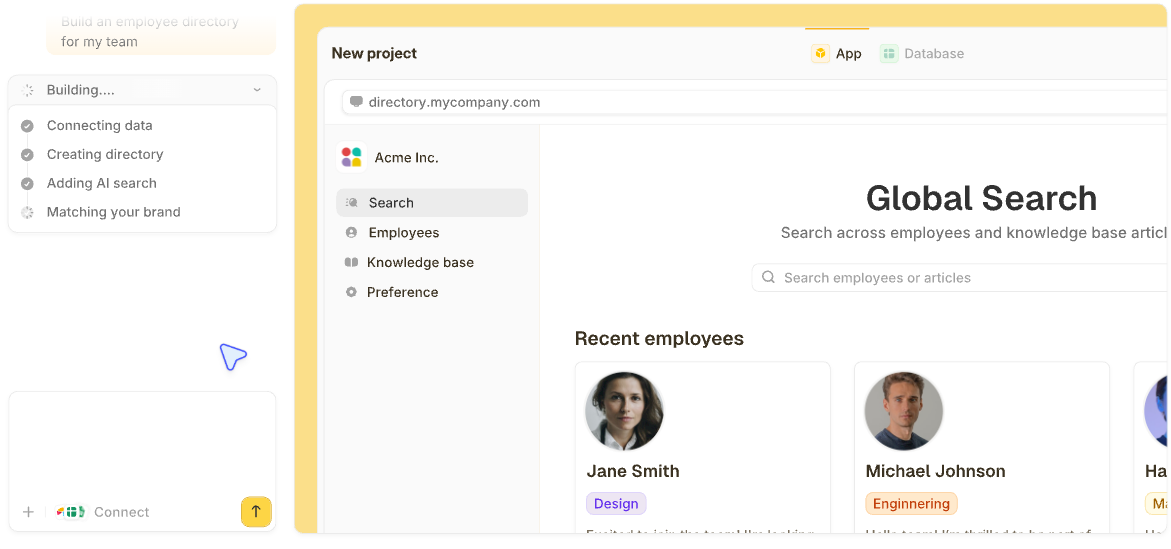
Platforms like Zite allow non-technical users to describe the app or business workflow they need, and Zite then generates the logic, forms, approvals, dashboards, and integrations as a custom app.
You can visually review and troubleshoot how everything fits together before going live. Organizations like The Athletic and Domino's already use tools from the same team behind Zite to power their business processes.
The point isn't to replace every BPM suite. Most processes don't need an expensive, months-long IT project when a platform like Zite lets anyone describe what they need and generate a working app.
Build Your First BPM Workflow With Zite
Every business process management example in this list follows the same playbook. Map the current mess, standardize intake, define who owns each step, and add visibility so nothing falls through the cracks.
You don't need to overhaul your entire operation at once. Pick the process that causes the most pain right now, score it using the prioritization framework above, and build a basic version to test for two weeks.
Traditional BPM platforms can take months to implement, but Zite lets you skip that cycle entirely. Describe the app or workflow you need, and Zite generates the forms, approval logic, dashboards, and integrations for you.
Here's what you can do with Zite:
- Build complete business apps from a description. Tell Zite what you need, and it generates the full app, including forms, workflows, and dashboards.
- Configure approval routing without code. Set up multi-tier approval chains that visually match your org structure.
- Launch client or vendor-facing portals. Add custom branding to portals for onboarding, intake, or status tracking.
- Connect to your existing tools. Integrate with Airtable, Google Sheets, CRMs, and more without developer support.
- Review and refine before going live. Inspect every piece of logic visually so you can troubleshoot before launch.
Ready to try Zite?
If you're curious how Zite works, the simplest way is to try it yourself. The free plan includes unlimited apps and users, no credit card required.
Frequently Asked Questions
What is a business process management example?
A business process management example is any repeatable workflow that has been analyzed, standardized, and improved using BPM methods. Common examples include invoice processing, employee onboarding, contract approvals, and customer support escalation.
What are the 5 stages of BPM?
The five stages of BPM are design, model, execute, monitor, and optimize. You analyze the current process and design improvements, then model different scenarios. Next, you execute the changes, track performance through metrics, and continuously optimize based on results.
What is the difference between BPM and workflow automation?
BPM is the broader discipline of analyzing, improving, and managing how work gets done. Workflow automation is one tool within BPM that runs specific steps without manual effort. Most businesses' BPM projects include automation because that’s where the biggest time and cost savings come from.
How much does BPM software cost for companies?
BPM software costs range from $100K to $500K+ for traditional suites, plus ongoing licensing. No-code platforms have significantly lowered the barrier, letting teams build functional BPM workflows for under $100/month.
What is the best business process to automate first?
Invoice processing, employee onboarding, and IT service requests are the three most common starting points. They are frequently repeated, involve multiple departments, and produce visible results quickly. Score your processes using the prioritization framework above, and start with whatever hits 15+.