

Is Coda the right tool for you? I’ve worked in Coda for months and dug through user reviews on G2 and Reddit to see which teams thrive on it and which give up after a few weeks. This Coda software review breaks down the strengths and the real limits, plus the alternative worth considering when Coda doesn’t fit your workflow.
Quick verdict: is Coda worth it?
Coda is one of the deepest workspace tools available, with a formula language and automation buttons that replace several other tools for the right team. The catch is a steep learning curve, a smaller ecosystem than Notion, and a Doc Maker pricing model that gets confusing fast.
Coda is the right pick for power users who want a doc that gets real work done, and the wrong pick for teams that need a place to write things down.
What is Coda?

Coda is a workspace tool that puts documents first and treats databases as something you embed inside them. The product is built for teams that need formula-driven logic, automation buttons, and connected data inside the same writing surface.
Coda competes most directly with Notion (for general workspace use), Airtable (for database functionality), and AI app builders like Zite for teams building business apps rather than docs.
Coda’s main features
The product covers a lot of ground, but the features that differentiate Coda from other workspace tools are:
- Formula language: Coda’s formulas work directly inside paragraphs and tables, with a spreadsheet-like syntax that scales further than Notion’s. The limitation is the learning curve. Most users say it takes weeks to become productive.
- Automation buttons: Buttons let users run multi-step actions from inside a doc with one click. They only run on user actions, not on schedules or external triggers.
- Connected tables and cross-doc sync: Tables can reference each other, and Team-tier users can sync data across multiple docs. The cross-doc feature is gated behind the $36/month-per-Doc Maker Team tier (monthly billing).
- Packs ecosystem: Coda Packs bring data from external tools like Jira, GitHub, Figma, and Intercom into a doc. The library is smaller than Notion’s integration marketplace but covers the main business tools.
- Coda AI: AI features are included across paid plans for content generation, table creation from descriptions, and analysis of connected data. Free users get a small credit allocation to try.
- Doc Maker pricing: Coda charges only for Doc Makers (creators). Viewers and editors are free across every plan. This model favors read-heavy teams but adds expense fast when everyone needs to build docs.
Coda reviews: what real users are saying
Reviews pulled from G2, Capterra, and the r/codaio community.
Pros (what users love)
Docs and databases combined: Users repeatedly say Coda's strength is pairing a real writing surface with a database in one place. One Capterra reviewer wrote, '[We] use it for quite a lot of things within our company.’
A Reddit user in r/codaio echoed the same point: "We build our docs there. We manage our backlog as tickets ... [we] have endless data [and] analytics in there."
Formula language and customization depth. Power users love that Coda's formulas can do real spreadsheet-style logic inside a doc. A G2 reviewer called it "[an] extremely powerful table tool with a huge amount of integrations and customization available."
Doc Maker pricing: Teams with many viewers and few creators rave about the cost savings. For read-heavy teams, this can mean paying for 3 to 5 seats instead of 40. The Doc Maker model is the clearest win for read-heavy teams and the clearest loss when most of the company needs to build.
Cons (where Coda falls short)
Learning curve is steep. Multiple users on G2 and Reddit say Coda takes weeks to become productive in. A G2 reviewer noted that "[Coda] is very challenging to learn and often ... difficult to [find] things ... across teams." The formula language and the doc structure both have meaningful ramp time.
Performance and browser issues on first setup. A Capterra reviewer flagged that "our team experienced performance issues ... the tool ... needs memory and some browsers were not supported." Teams on older hardware or less common browsers may hit friction early.
Mobile search is unreliable. A Reddit user described the experience: "[You] search for something on mobile, then from the 100s of unrelated results click one ... [and] it opens the parent page, not the one that has your search keyword." For teams that work from mobile, this is a real gap.
Overall, users appreciate Coda's depth and pricing model, but many flag the learning curve, early performance friction, and weak mobile search when listing frustrations.
My personal take on Coda
What impressed me most about Coda was the formula language. I rebuilt a small ops workflow in Coda that had previously lived across a Google Doc, a Google Sheet, and a Slack channel, and the result was cleaner than the original setup.
The buttons that ran multi-step actions inside the doc felt closer to a real app than to a document.
What frustrated me was the interface. Coda’s writing canvas mixes doc tools with table tools in a way that’s powerful but visually busy. Compared to Notion’s clean page-and-block model, Coda feels more layered and demands more attention.
The user feedback I read tracks with my experience. People who love Coda love it for its depth. People who give up on Coda do so because the interface is too dense to use day-to-day. Coda pays off if a team can spend weeks learning it. Most teams can't justify that time.
Is Coda right for you?
Who will love Coda
- Ops and finance teams running formula-driven workflows across docs and data.
- Teams where most people are viewers or editors and only a few are Doc Makers.
- Power users who’ll use the formula language and automation buttons.
- Companies that want one tool to replace separate doc and database subscriptions.
- Cross-functional teams that need connected docs syncing data across the company.
Who should avoid Coda
- Teams that primarily need a writing tool with light database features (Notion is friendlier).
- Companies building client-facing apps or portals (Coda’s doc-level sharing isn’t designed for that).
- Non-technical teams that need a tool the whole company can pick up in a day.
- Teams whose work centers on managing thousands of structured records (Airtable is built for that).
- Solo users on tight budgets who don’t need the Team tier’s cross-doc syncing.
The best Coda alternative: Zite
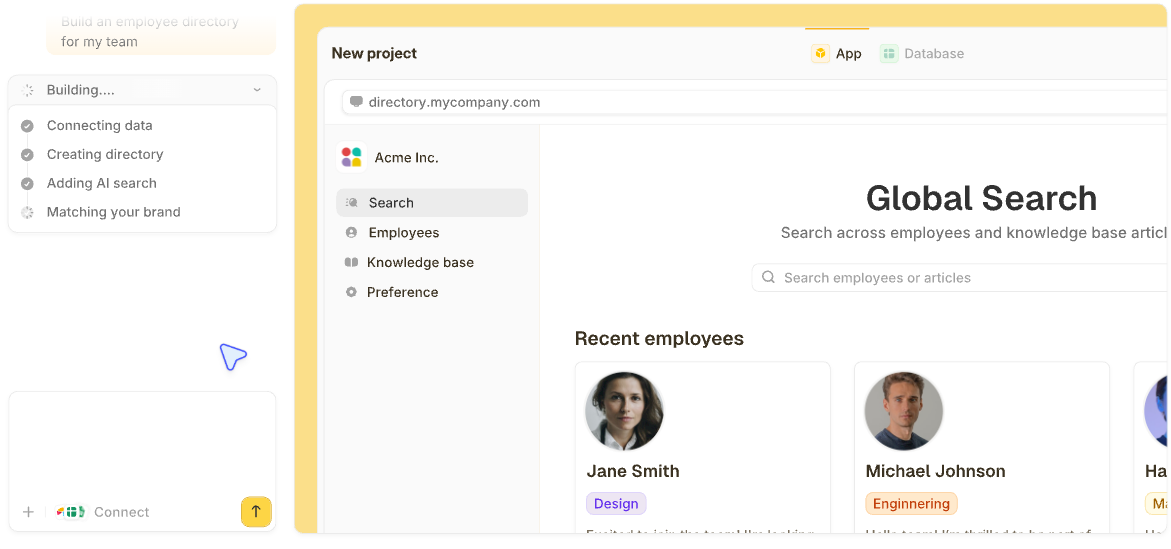
If you started looking at Coda because you want to build a real business app, a client portal, or an internal tool rather than another doc, Zite is the alternative worth knowing about. Where Coda is a document that can run logic, Zite is an AI-powered app builder with a built-in database and visual workflows you can inspect and troubleshoot without reading code.
Three specific advantages that matter for teams choosing between them:
- Zite generates apps from a prompt. Describe what you want, and Zite generates the database, app interface, and workflow logic from your description in one pass. Coda asks you to learn its formula language and assemble the doc yourself.
- Zite has real role-based portals. External users log in with their own credentials and see only their own data. Coda lets you share docs publicly or with specific people, which works for some use cases but isn’t a client portal experience.
- Zite charges a flat rate. Pro is $19/month with unlimited users and unlimited apps. A 30-person team on Zite Pro pays $19/month. The same team on Coda Team with 10 Doc Makers pays $360/month on monthly billing.
You can compare Zite directly with Airtable, Lovable, or Base44.
Start building with Zite if you need an app or portal rather than another doc tool.
Final verdict
If you need a doc that does real work and your team is read-heavy, Coda works. If you need a client-facing app, a custom portal, or a tool the whole company can pick up quickly, Zite is the better choice.
Frequently asked questions
Is Coda worth the money?
Coda is worth the money for read-heavy teams, where Doc Maker pricing results in a lower bill than per-user tools. A 30-person team with 5 Doc Makers pays $60/month on Pro versus $360/month on Notion Plus.
What are the main downsides of Coda?
The main downsides of Coda are its steep learning curve, a smaller ecosystem than Notion's, and the document lockout behavior when downgrading from a paid plan to Free.
Is Coda better than Notion?
Coda is better than Notion for formula-driven data work and read-heavy teams that benefit from Doc Maker pricing. Notion is better for general note-taking, wikis, and teams that value a friendly writing experience and a large template ecosystem.
Does Coda have a good free plan?
Coda has a good free plan for individuals and small teams testing the tool, with unlimited Doc Makers, free viewers and editors, and Coda AI available to try. The free plan’s doc size and automation limits push most teams to upgrade within a few weeks.
What’s the best alternative to Coda for building apps?
The best alternative to Coda for building apps is Zite, an AI-powered no-code builder that generates business apps, dashboards, and portals from a prompt with a built-in database, visual workflows, and flat pricing without per-user fees.
How does Coda handle external users and client sharing?
Coda handles external users through document-level sharing, letting you share docs publicly or with specific email addresses. There’s no native client portal experience with branded login or role-based access for external users.