

Coda vs Airtable looks like a close call until you use both. Airtable is the stronger database; Coda is the stronger document, and which one fits depends on whether your team thinks in tables or in pages.
Coda vs Airtable: what’s the difference?
Coda is a document-first tool with embedded tables, formulas, and AI features designed for collaborative work.
Airtable is a database-first tool with view types, relational records, and automations designed for structured data workflows.
Choose Coda if: Your team writes a lot, your docs contain your data, and most people view rather than create.
Choose Airtable if: Your team’s work revolves around structured records, multiple views of the same data, and connecting that data to other tools.
Meet Coda: features and highlights
Coda is a workspace tool that puts documents first and treats databases as something you embed inside them. Open a Coda doc, and you get a writing canvas with tables, buttons, formulas, and AI all native to the page.
The structure makes Coda feel familiar to anyone who has used Google Docs or Notion, with the depth that comes from a real formula language and connected tables. The Doc Maker pricing model means only the people creating docs pay, which can make Coda surprisingly cheap for read-heavy teams.
Standout features: formula-driven tables (Coda’s formulas are deep enough to replace some spreadsheets entirely), Packs for integrations, cross-doc syncing on the Team tier, and Coda AI built into the writing flow. See Coda’s pricing page for plan details.
Meet Airtable: features and highlights
Airtable is a database tool that looks like a spreadsheet but behaves like a relational database underneath. Open an Airtable base, and you get tables with linked records, multiple view types, and a structured field model that scales further than a typical spreadsheet.
The depth is in the data model. Airtable supports linked records across tables, lookup and rollup fields, view-specific filters, and a maturing automation engine. Interface Designer lets you build basic apps on top of your data without code, though it’s narrower than dedicated app builders.
Standout features: relational records that connect across tables, view types from grid to Kanban to Gantt, native automations and webhooks, Airtable AI (paid add-on), and the largest integration ecosystem in the no-code database space. See Airtable’s pricing page for plan details.
Coda vs Airtable: feature-by-feature comparison
Database depth
The depth of the database is where these tools split clearly. This is the area Airtable was built for and the area Coda has had to grow into.
Coda’s tables work well for the data that lives inside a doc. The formula language is deep, and you can do real spreadsheet-style calculations. Where Coda gets thinner is when you need to manage thousands of structured records, link them across multiple tables, and view the same data in different ways.
Airtable’s tables are the product. You get linked records, lookups, rollups, and a model that’s closer to a relational database than a spreadsheet. The view types (grid, Kanban, Gantt, calendar, gallery, form) all draw from the same underlying records.
Winner: Airtable. If structured data is your starting point, Airtable’s model is more capable.
Document and writing experience
Coda treats every doc as a real document. You can write pages, sub-pages, headers, and freeform content alongside your tables. For teams that produce a lot of written content (project briefs, wikis, decision logs, meeting notes with embedded action tables), Coda is one of the more capable options on the market.
Airtable doesn’t compete here. Interface Designer lets you build something that displays records, but it’s not a writing tool. Most teams that use Airtable for project work pair it with a separate doc tool, such as Notion or Google Docs.
Winner: Coda. Airtable isn’t trying to be a doc tool.
Workflows and automations
Both tools have automation engines with trigger and action libraries. The differences come down to how the automations integrate with the rest of the tool.
Coda’s automations live alongside the doc, with time-based triggers, record changes, and button clicks all available. Buttons are a unique feature that let you run multi-step actions from within a doc with one click.
Airtable's automations have a longer track record. Triggers include record updates, form submissions, scheduled times, and webhook receipts. The Team tier gives you 25,000 monthly automation runs, which sounds like a lot until a single high-volume base burns through them in a few weeks.
Winner: Tie. Coda’s automations feel more native to the doc experience; Airtable’s are better suited to integration-heavy work.
AI features
Coda AI is built into the writing flow. You can ask it to generate content, summarize a section, build a table from a description, or analyze data in a connected table. Coda AI is included on Pro and Team plans, with higher credit allocations on Team.
Airtable AI is included with each plan as a monthly credit allowance (Free 500 per editor, Team 15,000, Business 20,000), with paid credit packs if you need more. The standout features are AI field types (auto-generate summaries, classifications, or sentiment from existing record data) and AI automations that trigger actions when records change.
Winner: Tie. Coda AI is better for written content; Airtable AI is better for record enrichment and classification.
Pricing model
Both tools use per-seat pricing with free consumers, but the seat that triggers the bill is different. This is the single most important thing to understand before making a choice.
Coda charges per Doc Maker (anyone who creates or owns a doc). Editors and viewers are free across every plan. Pro is $12/Doc Maker/month (monthly billing). Team is $36/Doc Maker/month. This model makes Coda very affordable for read-heavy teams.
Airtable charges per editor (anyone who can edit records). Read-only viewers and commenters are free. Team is $24/seat/month (monthly billing); Business is $54/seat/month. Airtable also has add-on costs that escalate fast (Portals at $120/month, AI at $6/seat/month).
Winner: Coda. For most teams, Coda’s pricing model leads to a lower bill, especially when most users are consumers rather than creators.
External users and portals
Both tools have ways to share data with people outside your team, but neither is purpose-built for client-facing apps. This is where many teams find that both tools come up short.
Coda lets you share docs publicly or with specific email addresses, with viewer or editor permissions. There’s no native client portal experience with branded login, role-based access for external users, or per-client data filtering.
Airtable launched Portals as a paid add-on in 2024, starting at $120/month for 15 external guests on the Team plan. Portals give external users a curated view of a base with branding and access controls, but the add-on pricing adds up quickly once you cross 15 guests.
Winner: Airtable (narrowly). Portals are a real product; Coda’s sharing is at the doc level. Both have real gaps for purpose-built portal use cases.
What real users are saying
Reviews pulled from G2, Capterra, and Reddit communities for both tools.
Coda
Pros from users:
- “Coda does a very good job of building living, very flexible documents in a number of ways where you can actually get work done inside them.” Chris C, G2
- “The ease with which you can bring teammates in to collaborate live on knowledge base, software development, or sales enablement content has brought real buy-in on a knowledge system for the first time at our company.” Kyle P, Capterra
- “I think [Coda] is more flexible than Airtable and can do a better job of representing org workflows and encouraging collaboration.” Verified Reddit User
Cons from users:
- “I personally don't like the interface. It feels chaotic in terms of organizing documentation.” Deyan G, Capterra
- “Some technical acumen and Coda-specific training is required to make the most of Coda features.” Isabella C, Capterra
- “Coda also has a higher learning curve, and it's pretty easy to mess up and cause your docs to load super slowly (too big doc sizes, too complicated functions, etc) if you're not aware of that stuff early on.” Verified Reddit User
Airtable
Pros from users:
- “What I like most about Airtable is how easy it makes it to organize and manage information without needing any technical skills.” Muhammad O, G2
- “I like that I can sort and filter and organize data in Airtable, and I appreciate being able to share views with others so they can see the data that's relevant to them.” Gary B, G2
- “What I like most about Airtable is the user experience: the interface feels modern, clean, and very visual, so it’s easy to understand even for non‑technical users.” Cristiano F, Capterra
Cons from users:
- “The free version has some limitations for advanced automations and larger workspaces. Sometimes it also takes a little time to understand relationships between tables when setting things up for the first time.” Rehan A, G2
- “I think what I didn't like about Airtable is that the tools sometimes don't work due to technical issues, and I think it is understandable on their end.” Rex S, Capterra
How to make your choice
Airtable is the stronger database, and Coda is the stronger document. Most teams pick wrong because they default to the more familiar interface rather than thinking about what they actually need to manage.
Coda is better for:
- Knowledge bases, wikis, and project hubs that combine written content with embedded data.
- Teams with many viewers and few content creators (Doc Maker pricing favors this).
- Workflows where documents are the primary output (project briefs, decision logs, meeting notes).
- Teams that want one tool for both documents and light database needs.
Airtable is better for:
- Content calendars, CRMs, inventory trackers, and other structured-data workflows.
- Teams that need multiple view types on the same data set.
- Integration-heavy workflows that connect to Slack, Zapier, Make, or custom APIs.
- Use cases where data volume scales past a few thousand records.
My verdict
After using both, I’d pick Airtable for any project that starts with “we need to manage these records” and Coda for any project that starts with “we need to write this and share it.” The two tools have grown into the same competitive set, but they’re still solving different problems.
The frustration most teams have with both tools comes from trying to make them do something they weren’t built for. Coda struggles when forced into structured-data workflows; Airtable struggles when forced into document-heavy ones. Pick based on which side your team actually lives on.
Considering a third option for client-facing apps?
If your real goal is a client portal or a custom app with external user logins (something neither Coda’s doc sharing nor Airtable’s $120/month Portals add-on covers well), it’s worth looking outside this comparison.
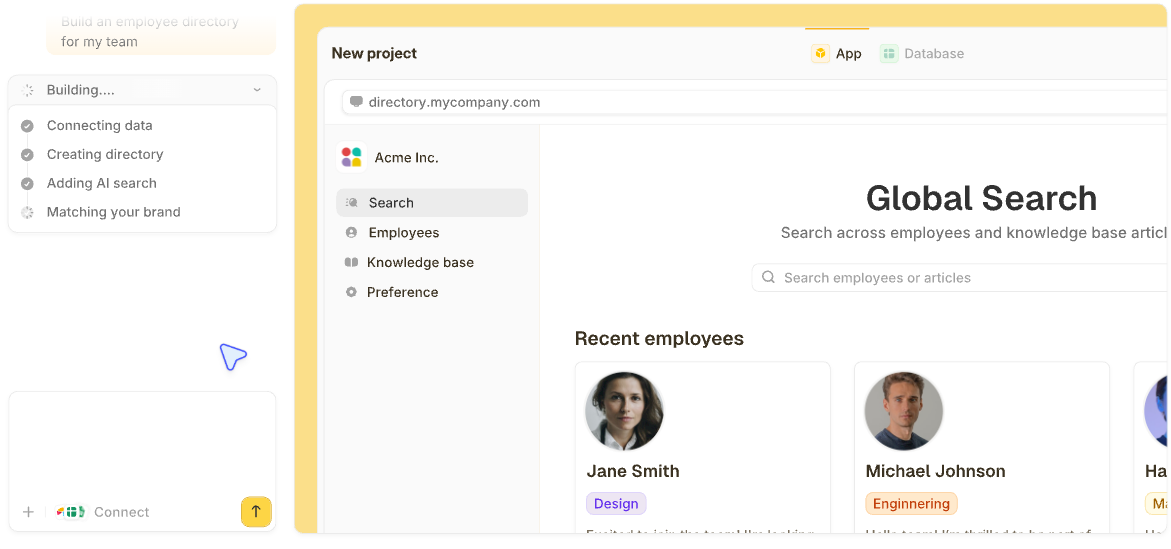
Zite is an AI-powered no-code app builder that generates business apps and portals from a prompt, with a real, built-in database that feels like a spreadsheet. It is the source of truth your app runs on, with linked records, lookups, and formula fields that scale well beyond a spreadsheet's limits, while staying easy to use.
Zite also gives you visual workflows you can inspect after the AI builds them. Pricing is a single rate of $19/month for Pro with unlimited users, which is the angle at which it beats both Coda and Airtable for client-facing use cases.
You can compare Zite vs Airtable directly to see the database-side comparison, or Zite vs Lovable and Zite vs Base44 to see how it stacks up against AI app builders.
Start building with Zite and see how the portal experience compares to what Coda and Airtable offer.
Frequently asked questions
Is Coda or Airtable better for project management?
Coda is better for project management when your work centers on documents with embedded task tracking. Airtable is better when your project management is structured around records, assignees, and dependencies that need multiple views.
How much does Coda cost compared to Airtable?
Coda costs less than Airtable for most teams due to its Doc Maker pricing model. Coda Pro is $12/Doc Maker per month; Airtable Team is $24/editor per month. A team of 10, with all editors, pays $240/month for Airtable versus $120/month for Coda Pro.
Can I use Coda and Airtable together?
Yes, you can use Coda and Airtable together by syncing data between them with Coda’s Airtable Pack or Airtable’s webhooks. Many teams use Airtable as the structured data source and Coda as the documentation layer.
Does Coda or Airtable have better AI features?
Coda offers better AI features for writing and content generation within docs, while Airtable offers better AI for analyzing and enriching structured records. Coda AI is included on Pro and Team plans (more credits on Team); Airtable AI is a paid add-on at $6 per seat per month.
Is there a better alternative to both Coda and Airtable?
Yes, there is a better alternative to both Coda and Airtable for client-facing apps and portals. Zite combines a built-in database, prompt-to-app generation, and a single rate of $19/month, with no per-seat costs.