

I ran Coda vs Notion side by side for three months. Coda is the deeper tool, and the right call if your team's docs need to run formulas and automations. Most teams don't, so Notion fits better.
Coda vs Notion: What’s the difference?
Coda is a doc tool built for teams that calculate inside their documents. The formula language, connected tables, and automation buttons turn a Coda doc into a tool that runs real logic.
Notion is a doc tool built for teams that write inside their documents. The page-and-block model, clean writing surface, and database support make Notion a friendlier place to capture notes, wikis, and project briefs.
Choose Coda if: Your team's docs need to do calculations, run automations, or pull data from connected tables.
Choose Notion if: Your team's docs need to capture writing, organize team knowledge, or track projects with a light structure.
Meet Coda: features and highlights
Coda is a document tool where the writing canvas treats tables, formulas, and buttons as native page elements. The result is a doc that can run real logic inside it.
Where Coda goes deeper than most workspace tools is the formula language, which is close to what you’d get in a spreadsheet but works directly inside paragraphs of text. Cross-doc syncing on the Team tier lets you treat multiple docs as a connected system.
Standout features: Formula-driven tables, automation buttons that run multi-step actions from inside a doc, cross-doc syncing, and Coda AI built into the writing flow. See Coda’s pricing page for plan details.
Meet Notion: features and highlights
Notion is a doc tool built for teams that write. The page-and-block model is the kind of interface most people understand within a few minutes of using it, and the biggest community in the workspace category fills in any gaps with templates and tutorials.
Notion's strength lies in its community, not the product itself. Notion has tens of millions of users, thousands of templates, and a robust marketplace of integrations. The AI feature set expanded significantly in 2025, with the addition of AI Agents and Ask Notion.
Standout features: The page-and-block writing model, simple databases with multiple view types, AI Agents (Business tier), unlimited file uploads on paid plans, and the largest template and community library in the category. See Notion’s pricing page for plan details.
Coda vs Notion: feature-by-feature comparison
Database depth
The depth of the database is where the two tools diverge most clearly. Both have come closer in the last year, but they started from opposite ends.
Coda’s tables behave more like spreadsheets with relational behavior. You get formula calculations native to the cell, cross-table lookups, and the ability to build buttons that act on filtered rows.
Notion’s databases are simpler. You get filtering, sorting, multiple view types (grid, board, timeline, calendar, gallery), and basic formulas. For most teams who use databases to track projects, tasks, or content, Notion’s depth is sufficient. For teams that need real calculation logic, the limits show up.
Winner: Coda. Notion’s databases are easier to learn; Coda’s go deeper.
Documents and writing experience
Notion’s page-and-block model feels natural to anyone who has used a modern doc tool. Blocks (text, headings, images, embeds, databases) snap into place, formatting is unobtrusive, and a finished Notion page looks polished by default. This is why Notion dominates personal knowledge bases, team wikis, and public-facing documentation.
Coda’s documents are functional but feel more layered. The interface mixes writing tools with table tools in a way that’s powerful but visually busier. For pure writing or wiki use cases, most teams prefer Notion’s aesthetic.
Winner: Notion. Coda can do documents, but Notion is built for them.
AI features
Coda AI is included for Doc Makers on the Team plan with additional credits, and available on Pro with a credit allocation. It works inside the writing flow for content generation, table creation from descriptions, and analysis of connected data.
Notion AI changed in May 2025. The standalone AI add-on was retired, and full AI access (including AI Agents and Ask Notion) was bundled into the Business plan. Free and Plus users keep basic AI writing but lose access to the agent features. See Notion's pricing page for current plan costs.
Winner: Notion (narrowly). The agent features are more capable, though the new pricing makes them expensive for solo users.
Pricing model
Both tools charge per seat. The difference is which seats count, and that's what drives most of the bill gap between them.
Coda charges per Doc Maker (anyone who creates or owns a doc). Editors and viewers are free across every plan. Pro is $12/Doc Maker/month (monthly billing); Team is $36/Doc Maker/month (monthly billing). A 30-person team with 5 Doc Makers and 25 viewers pays $60/month on Pro.
Notion charges per member (every full workspace member pays). Guests are free on paid plans up to a limit. Plus is $12/user/month (monthly billing); Business is $24/user/month (monthly billing). The same 30-person team, where everyone is a member, pays $360/month on Plus.
Winner: Coda. For read-heavy teams, Coda’s Doc Maker model is cheaper. For teams where every member is actively building, the difference narrows.
Ecosystem and ease of use
Notion's template library and tutorial coverage are the deepest in the category. If your team gets stuck, finding a fix for your exact problem is a near-certainty.
Coda’s ecosystem is smaller. The doc gallery has solid templates but not the variety Notion offers. The Packs marketplace covers most common integrations but has fewer third-party creators. The formula language also has a steeper learning curve, so new team members take longer to ramp up.
Winner: Notion. The ecosystem and the easier learning curve compound over time.
What real users are saying
Reviews and discussion pulled from G2 and Capterra.
Coda
Pros from users:
- “What I like best about Coda is how it combines documents, spreadsheets, and apps into one flexible workspace, making it easy to build customized workflows without needing multiple separate tools.” Osmely V, G2
- Extremely powerful table tool with a huge amount of integrations and customization available.” Mark T, G2

- “Great tool for knowledge sharing and project management.” Isabella C, Capterra
Cons from users:
- “Coda is very challenging to learn and often a little more difficult to place things [and] search for what I am looking for across teams.” Verified User, G2
- “What I would like to improve with Coda is to enhance its visual graphics and icons for a more user-friendly experience. The tool is limited [to] a table form view.” Michelle N, G2
Notion
Reviews from G2, r/notion, and Capterra.
Pros from users:
- “It offers great support for Markdown files. All files and pages are interconnected, which makes it a strong tool for building a knowledge base.” Mike I, G2
- “I love how easily I can get organized with Notion, especially with how much Notion AI can do, too. I never realized it could integrate with and automate workflows, and I honestly wish I’d known that years ago. That kind of setup is basically my love language, and I’m completely obsessed with it now.” Levi F, G2

Cons from users:
- “Sometimes it can slow down when working with a large workspace. And advanced setups require some time to learn.” Erica B, Capterra
- “Mobile app is terrible. You can't do anything on it but read your pages. I really considered it, but this was a huge dealbreaker for me.” Verified Reddit User
- “The biggest downside for me is that it can sometimes feel a bit overwhelming because there are so many ways to organize things.” Quentin B, G2
How to make your choice
The short version: Notion is better for writing and wikis, Coda is better for data and automation. Most teams pick based on what their primary work looks like, not on feature checklists.
Coda is better for:
- Ops and finance teams running formula-driven docs.
- Workflows where automation buttons run inside the doc save real time.
- Read-heavy teams where the Doc Maker pricing model leads to a lower bill.
- Cross-doc setups in which multiple connected docs act as a single system.
Notion is better for:
- Personal knowledge management, second-brain setups, and team wikis.
- Companies that want one tool for notes, project tracking, and light databases.
- Teams that value a clean writing experience and minimal visual clutter.
- Anyone who benefits from the largest template and tutorial ecosystem in the category.
My verdict: Notion for most teams, Coda for data-heavy work
After using both, I'd pick Notion for projects that start with 'we need to write things down,' and Coda for those that start with 'we need a doc that does real work.' Notion fits most teams because most teams primarily write.
The honest tiebreaker is your team's tolerance for complexity. Pick based on your team makeup: non-technical members will be happier in Notion, and power users who actually use formulas and buttons will get more out of Coda.
Considering a third option for client-facing apps?
If your real goal is a client portal or a custom app with external user logins, neither Coda nor Notion is purpose-built for that. Both let you share docs publicly or with guests, but neither offers role-based access, a branded login experience, or per-user data filtering that a real portal needs.
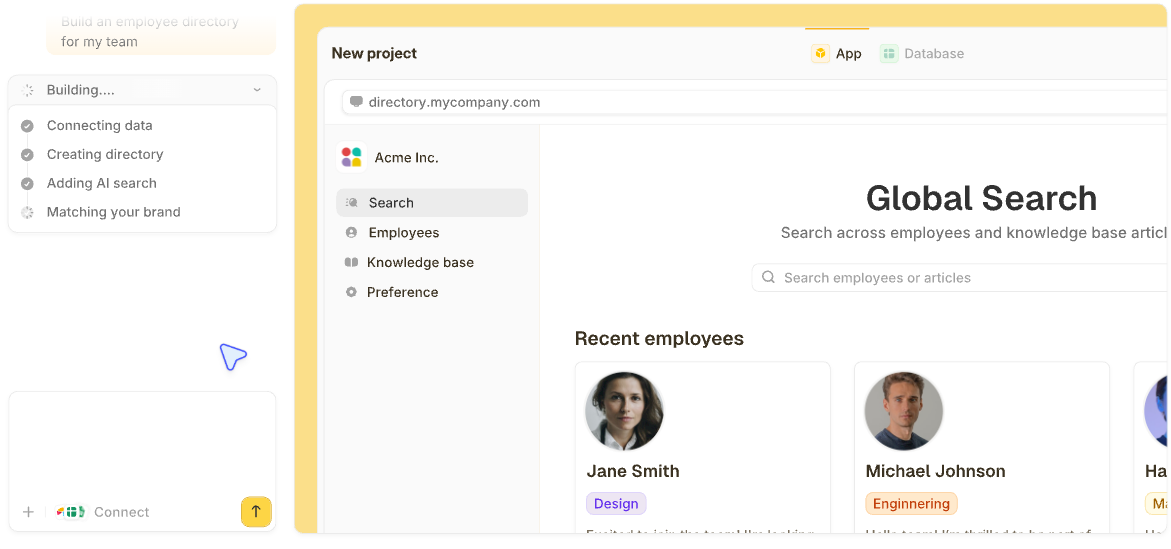
Zite is an AI-first, no-code app builder that generates custom apps from a prompt (including portals, dashboards, internal tools, and client-facing apps). Each app runs on a real, built-in database that feels like a spreadsheet. It is the source of truth, with linked records that scale well past what you would track in a doc, and it stays easy to use.
The workflow logic is visual and inspectable, and the platform ships with built-in logins and role-based permissions, with SOC 2 Type II compliance available on the Enterprise tier.
Pricing starts at a rate of $19/month for Pro with unlimited users and no per-seat pricing. That same 30-person team pays a total of $19/month.
You can compare Zite directly with Airtable for the database-first comparison, or with Lovable and Base44 for the AI app builder set.
Start building with Zite for free if you actually need a client portal or a custom app.
Frequently asked questions
Is Coda or Notion better for personal use?
Notion is better for personal use because of the friendlier writing experience, simpler interface, and massive template ecosystem for personal knowledge management. Coda can work for personal use if you specifically need formula-driven docs, but most solo users will be happier with Notion.
How much does Coda cost compared to Notion?
Coda costs less than Notion for teams with many viewers and few creators because Coda charges per Doc Maker, while Notion charges per member. A 30-person team with 5 Doc Makers pays $60/month for Coda Pro, versus $360/month for Notion Plus.
Does Coda or Notion have better AI features?
Notion has better AI features as of 2026, with AI Agents and Ask Notion capabilities bundled into the Business plan at $24/user/month. Coda AI works well inside the writing flow, but the agent capabilities are narrower than Notion’s.
Can I migrate from Notion to Coda or vice versa?
Yes, you can migrate from Notion to Coda or vice versa, though both directions involve manual cleanup. Notion exports to Markdown and HTML, which Coda can import. Databases and formulas typically don’t transfer cleanly and need to be rebuilt.
What’s a good alternative to both Coda and Notion?
A good alternative to both Coda and Notion depends on your use case. For client-facing apps or portals, Zite is a stronger fit due to its flat pricing and built-in portal features. For structured-data workflows, Airtable is the database-first alternative.