

I read dozens of Glide reviews and tried it myself to see how it works for business teams. It’s very easy to use, but it’s not suited for complex apps since you have to configure pre-built components. Here’s my honest breakdown of Glide’s pros and cons, and I’ll share a more powerful alternative for 2026.
Quick verdict
Glide excels at quickly turning spreadsheet data into functional apps. With the visual editor and the AI generator, you can build apps like contact lists, CRMs, and simple dashboards. However, if you want your app to handle complex logic, highly customized pages, or more users, there are better alternatives.
What is Glide?
Glide is a no-code platform that transforms spreadsheet data into web and mobile apps. You connect Google Sheets, Airtable, SQL, or Glide’s own tables, and it maps that data into screens, lists, and forms that you can customize visually.
Glide also recently added an AI app builder so you can upload a spreadsheet, describe your app, and Glide will create it.
You can use Glide to build inventory trackers, CRMs, project dashboards, and internal portals.
Key features
Glide’s key features cluster around data‑driven app building, AI, and a friendly visual editor.
They include:
- AI app builder: Describe what you want, and Glide generates the app automatically.
- Visual editor: Drag‑and‑drop layout editor for lists, forms, detail views, buttons, charts, and more, with live preview for mobile and desktop.
- Responsive web apps: Apps automatically adapt to phones, tablets, and desktops.
- Glide Tables: A spreadsheet-like database that's easy to edit and understand.
- Visual workflows: Build automations by dragging and dropping blocks onto a canvas.
- Integrations: Comes with pre-built integrations to tools like Google Sheets, Airtable, Excel, Stripe, and HubSpot.
- Glide AI automation: Generate text, summarize content, analyze sentiment, transcribe audio, and extract data from images or PDFs directly in your app logic.
Glide reviews: What real users are saying
I went through G2, Trustpilot, Product Hunt, and Reddit to see what other users have experienced with Glide.
Below are what they love and what frustrates them:
Pros
- Incredibly easy to learn: Glide's learning curve is minimal. The interface is simple, intuitive, and very user-friendly. You don’t need any coding experience.
- Fast from concept to live app: Users consistently report quickly iterating through design ideas. The initial setup is straightforward with built-in integrations and the no-code database.
- Ability to deploy as an app: You can install Glide apps to the home screen so they behave like native apps.
Cons
- Limited UI flexibility: Glide doesn’t let you change everything about how your app looks. It’s hard to match your brand exactly.
- No push alerts: It doesn't offer native push notifications for mobile experiences so you have to use external services like email or Slack.
- Performance issues: Sites load too slowly, especially for screens with a lot of media.
My personal take on Glide
I tested Glide's current AI app generator and visual editor by building an inventory manager.
What impressed me: The app it generated was ready to use right away. I used mock data, but you can also upload a real spreadsheet. It supports prompting, but you can use the visual editor to make direct changes.
What frustrated me: With Glide, you can only build a very specific type of app. Your data is central to everything, which is great for simple data apps on top of spreadsheets, but limiting for anything more complex.
The integration limits are frustrating. On individual plans, you only get Google Sheets and native tables as data sources. Access to data sources like Airtable, SQL, Stripe, or tools like HubSpot starts at the Business plan.
Is Glide right for you?
Glide is right for you if you’re building data-driven internal tools. You shouldn’t use it if you’re building consumer-facing apps like SaaS tools or regulated apps.
Who will love it
- Teams already living in spreadsheets who want to turn that data into functional apps without learning to code.
- Business teams creating internal tools like inventory trackers, CRMs, project dashboards, or employee portals for limited users.
- Rapid prototypers who need to test ideas fast and iterate based on feedback.
Who should avoid it
- Anyone building public-facing apps at scale, as the per-user pricing adds up fast and makes Glide cost-prohibitive.
- Teams building apps to sell on the app store, as it's not meant to scale to high usage.
- Use cases with highly sensitive or regulated data, Glide explicitly disallows protected health information and certain financial/credential data types.
If Glide’s limited ability to build custom apps is a dealbreaker for you, there are other tools worth considering.
The best Glide alternative: Zite
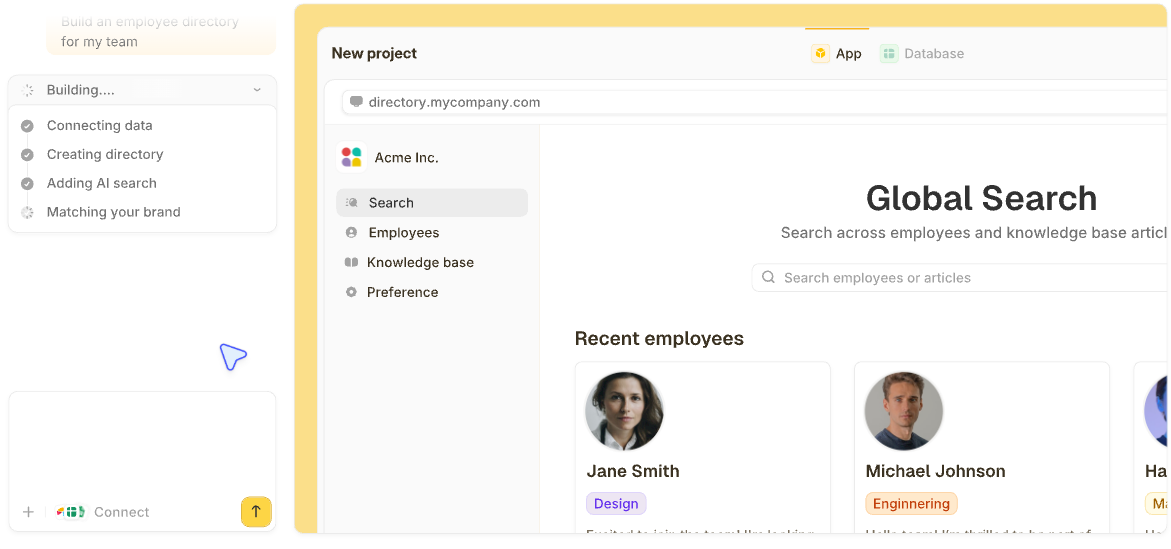
Zite takes a different approach than Glide. Instead of manually configuring pre-built components, you describe what you want, and Zite builds a working app in minutes, including the logic behind it, not just the screens.
It can handle multi‑step workflows, apps with role‑based conditional UIs, connect to AI models like OpenAI, and more, while still being accessible to non-technical users.
Here are the key features that make this possible:
- Can build spreadsheet-based apps and complex apps: Zite can handle simple spreadsheet-powered apps like Glide, while also supporting more complex business apps such as portals, dashboards, and AI-powered workflows.
- More AI builder modes: Glide’s AI builder only has a single build mode. Zite adds two more. It has a Plan mode, which creates a structured plan before building, and a Chat mode where you can ask questions and get suggestions without changing the app.
- Flexible ways to build: You can start with AI prompts and then refine everything visually. Workflows are shown as a flowchart you can inspect, adjust, and reprompt, so you can see exactly how your logic runs.
- Unlimited users and apps on all plans: Zite offers unlimited users on all plans, including free. No per-seat math, no surprise costs as your team grows. Glide, however, supports only 1 app and 100 users on the starting individual plan. You only get unlimited apps if you’re on the Enterprise plan.
- Data source support: Zite lets you connect to existing Airtable or Google Sheets data on every plan, including the free plan. In Glide, live connections to Google Sheets and Airtable are restricted on the free plan and only available on paid tiers.
- Built‑in no‑code database: Zite ships with a database that auto‑generates the tables and fields based on your app, so you don’t have to design tables and relationships by hand. You can still connect to external data sources like Airtable and Google Sheets when needed.
- API access on all plans: You don’t have to pay to gain access to Zite’s API. Glide reserves API access for Business‑level and higher plans.
Final verdict
If you're building simple internal tools on top of spreadsheet data for a small team, Glide works. The learning curve is minimal, and apps look professional.
But if you’re building complex apps for your business, Zite is the better choice. You'll get broader app-building capabilities and pricing that doesn't punish you for growing.
Ready to try Zite?
If you haven't already, sign up for Zite and start building your apps today. Most features are available on the free tier, so you can prototype your software without commitment.
Frequently asked questions
Is Glide truly no-code?
Yes, Glide is truly no-code. You build apps using AI prompts or the visual drag-and-drop interface. You don’t need to be a developer.
How much does Glide cost?
Glide starts at $19/month for individual users and $199/month (billed annually) for businesses. You also pay to sync changes from your data sources.
Can I publish Glide apps to app stores?
No, you can't publish directly to the Apple App Store or Google Play. Glide creates progressive web apps (PWAs) that users access through browsers and add to their home page as shortcuts.
Does Glide have AI features?
Yes, Glide includes an AI builder that generates apps from text descriptions and offers AI columns for tasks like text generation, data extraction, summarization, and sentiment analysis.