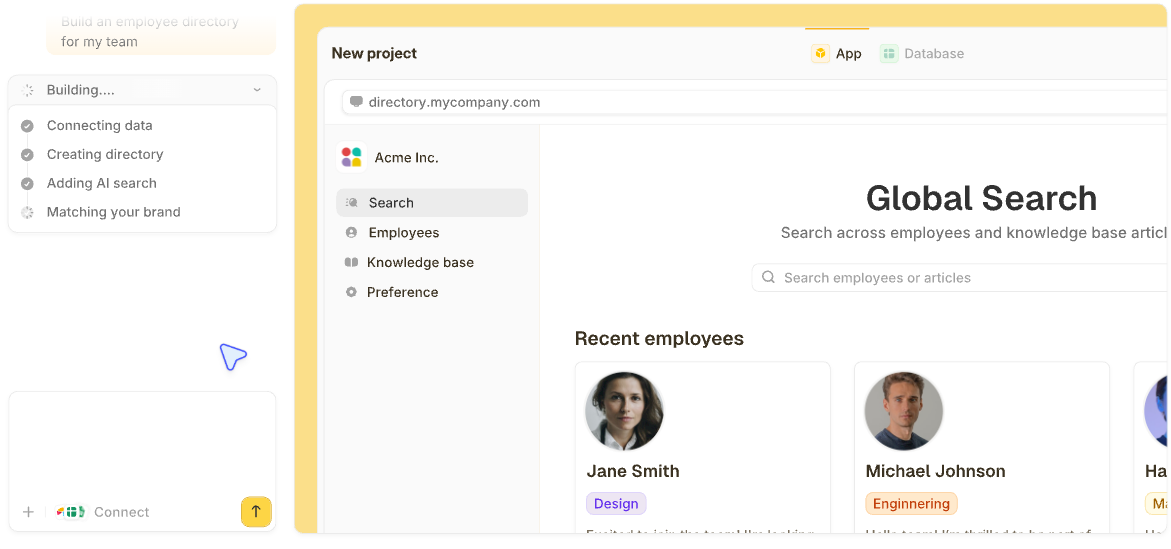


I tested Google Sheets, Airtable, and Zite side by side by building tools and automations across all three. Here’s a side-by-side comparison of their key features and use cases to help you choose the best one for your team in 2026.
Google Sheets vs. Airtable vs. Zite: What's the difference?
Google Sheets is a cloud-based spreadsheet for basic data analysis, charting, and collaboration.
Airtable is a no-code platform that combines a visual database with Omni, an AI assistant that builds and edits apps, automations, and data workflows from prompts.
Zite is an AI-powered no-code platform for building production-grade business software like portals, dashboards, and internal tools without writing code.
Choose Google Sheets if: You need an affordable tool for managing a small to medium-sized dataset in tables.
Choose Airtable if: You want a visual database plus richer fields (attachments, dropdowns, linked records), multiple views (like kanban or calendar), and built-in no‑code automations.
Choose Zite if: You want to build actual software (apps, forms, portals) on top of your database and other data sources, including Google Sheets and Airtable.
Here’s a side-by-side comparison:
Meet Google Sheets: Features & highlights
Google Sheets is basically a cloud version of Excel with rows, cells, and columns. It integrates with Drive, Gmail, and the rest of Google Workspace. It works for quick data entry, analytics, and reporting.
What stands out:
- Massive cell limit (up to 10M cells per spreadsheet)
- Built‑in functions and integrations with BigQuery and Looker for data analysis
- Real-time collaboration with simultaneous editors
- Free with 15GB storage
- Automation through macros, Apps Script, Gemini AI assistance, and a huge add‑on marketplace
- Directly convert Excel spreadsheets to Google Sheets
What it's actually good for: Google Sheets excels at budgets, expense tracking, quick data analysis, and situations where everyone needs to edit the same spreadsheet. The collaboration features are very useful for teams that want to work on the same sheet.
Where it falls short: Sheets is a spreadsheet. Full stop. You can't build a client portal. You can't create a customer-facing app. You can't even change the view from a grid to something else without significant workarounds. If your data management needs have outgrown rows and columns, Sheets will start to feel limiting.
Meet Airtable: Features & highlights
Airtable looks like a colorful spreadsheet at first glance, but under the hood, it’s a relational database where each row is a record. You can attach files, link to other tables, and view the same data as grids, Kanban boards, timelines, and more.
Airtable’s Omni AI assistant now helps generate custom apps, interfaces, automations, and summaries from natural language prompts.
What stands out:
- Multiple view options (Grid, Kanban, Calendar, Gallery, Timeline, Gantt, Form)
- Omni AI for creating custom internal tools, agents, and portals from prompts
- Built-in automation with visual workflow builder
- Rich field types (attachments, checkboxes, linked records, and formulas)
What it's actually good for: Airtable is great for content calendars, project tracking, and CRM-style workflows where you need to see the same data in different ways.
Where it falls short: As you scale, per-seat pricing, record limits, and automation caps can force expensive upgrades, especially when you add more editors or portals.
Meet Zite: Features & highlights
Zite is an AI no-code platform that uses AI to build actual business applications on top of your data. It’s not another spreadsheet-like tool. You describe what you want, and Zite generates a working app ready to deploy to real users.
What stands out:
- AI builds the entire app from a prompt, including pages, database, forms, workflows, and authentication
- Autogenerates your database, complete with tables and relationships, and shows it as a spreadsheet-like grid you can edit and update directly
- Unlimited users, apps, and databases on all plans
- Backend logic shows up as flowcharts you can inspect and debug
- Custom domains and full branding for external-facing apps
- Secure hosting, authentication, and role-based access so you can ship to real users with real data.
What it’s actually for: Zite is great for building real business apps like portals, CRMs, and dashboards that connect to your data. It's especially perfect for non-technical teams that want AI to assemble their apps and the database, but still need to understand how everything works.
Where it falls short: Zite is a new platform with a smaller community and template library.
Google Sheets vs. Airtable vs. Zite: Feature-by-feature comparison
Google Sheets, Airtable, and Zite all help you work with data, but they sit at different levels of the stack. Sheets is a traditional spreadsheet, Airtable is a visual database, and Zite is a no-code app platform that turns your data and ideas into full client-facing applications.
This section breaks down how they compare across key features:
Ease of use & learning curve
Google Sheets is easy to start with, but hard to master, especially if you move beyond simple data entry. As soon as you’re chaining formulas across sheets, building charts, or dashboards with filters and pivot tables, you’re effectively doing light programming. Most people find it hard to design, maintain, and debug their sheets, especially when they have lots of data.
Airtable’s AI assistant can create bases, automations, and UIs from prompts. However, to debug, you still need to understand Airtable’s core building blocks, like bases, records, views, and formulas, to fix it. In practice, even if you’re comfortable in spreadsheets, there’s a bit of a mindset shift in how you structure and troubleshoot your logic.
Zite is easier to use because you don’t have to learn a new mental model like bases and views. You describe the app in plain English, and Zite generates the UI, data structure, and workflows together.
You get a spreadsheet-like table for your data and a flowchart for your logic. So, instead of learning a new set of concepts, you can read the rows and inspect the flowchart steps to debug. You don’t have to dig through multiple Airtable views and formula fields to figure out what went wrong.
Winner: Zite, thanks to AI-generated app and database creation. There’s no need to learn new technical concepts or manually structure your data. Zite auto-generates everything, which drastically shortens the time from idea to production-ready app.
Data management & structure
Google Sheets handles data in the traditional spreadsheet model with cells, rows, and columns. The structure is table-like, and there's no built-in way to create relationships. You typically keep related data on separate sheets and link them using functions like VLOOKUP, INDEX/MATCH, or QUERY based on a shared key.
Airtable treats each row as a record that can contain multiple data types (text, attachments, checkboxes, linked records from other tables). You can link records, which means if you update a contact's email in one table, it automatically updates everywhere that contact is linked.
Zite gives you a full database engine that feels like a spreadsheet but behaves like a powerful SQL database. It scales to millions of rows, supports relationships, and lets non‑technical users scroll, filter, and edit data in a grid-style interface without writing queries.
When you describe your app, Zite automatically generates the database schema (tables, fields, and relationships) it needs. You can edit the schema later, either through natural‑language prompts or via the visual table editor.
You still get the kind of linked‑record behavior you’d expect from Airtable, but without having to do any manual schema design.
Winner: Zite because it runs on PostgreSQL, a battle‑tested SQL database that can handle millions of records, and auto‑generates the schemas your app needs while still giving you a simple, spreadsheet‑style interface.
App building experience
Google Sheets is a data layer, and you have to rely on other tools to turn that data into an actual app. You can plug it into AppSheet (Google’s no-code platform) or third-party tools like Glide or Zite, which use your sheet as the data source.
Airtable is no-code, with AI increasingly doing the heavy lifting of setup. Omni, their AI assistant, can generate interfaces and automations from prompts. Those interfaces are, however, rigid and use predefined building blocks so customization is very limited.
Zite is a complete app builder that generates full-stack apps where you can customize the UI, layout, and logic freely. You describe the tool you want, and Zite generates a production-ready application.
Every Zite app can use the built‑in no‑code database. If your data already lives elsewhere (Airtable, Google Sheets, etc.), you can connect those sources and build the app layer in Zite while keeping data where it is.
Winner: Zite, because it combines prompt-based generation, a built-in database, production-ready auth and security, and multiple editing modes (prompts, visual editor, code) into a single environment.
Building external-facing experiences
Google Sheets supports sharing via links, but creating a polished client-facing experience requires significant workarounds, like using AppSheet or custom development with another tool.
Airtable now offers customer and partner portals, but they are a paid add-on on top of Team or Business plans. Pricing that starts at a separate monthly fee for a limited number of external guests.
Zite was built for this use case. You can create branded customer portals, partner dashboards, and client-facing tools that live on your own custom domain. Zite doesn’t charge you extra for these portals.
Winner: Zite by a significant margin. If external stakeholders need to interact with your data, Zite is the most straightforward option.
Automation & workflows
Google Sheets offers macros, Google Apps Script, and basic triggers through add-ons. Setting up automation requires technical knowledge or reliance on third-party tools like Zapier.
Airtable has a visual automation builder, with triggers, conditions, and actions that span Airtable and external apps (Slack, email, etc.).
Zite builds workflows directly into applications. If you say your app should notify the sales team when a new lead comes in, Zite creates that logic as part of the app’s backend and can add integrations to tools like Slack if needed.
Those workflows are displayed as visual flowcharts, so you can see each step, inspect inputs and outputs, review run history, and troubleshoot issues without reading code. You can also wire automations through Zapier, Make, and n8n, or via the REST API.
Winner: Tie between Airtable and Zite because they both have visual workflows and let you hook into external tools like Slack when you need to go beyond the app.
Pricing & total cost of ownership
Google Sheets is free for personal use. For premium Sheets features, you’ll need the Google Workspace plans, which start at $8.40/user/month.
Airtable is free for up to 5 editors, 1,000 records per base, and 100 automation runs, but its paid plans use per‑seat pricing for editors and charge extra for portals. The Team plan starts at $24/seat per month, billed monthly, and the Portals add‑on starts at $120 per month for 15 external guests on top of that.
This means, a 20‑person team on the Team plan pays 20 × $24 = $480 per month just for internal editors, plus at least $120 per month for 15 external guests if they need portals. That puts their bill at $600 per month before they hit any higher tiers or AI add-ons.
Zite supports unlimited users and unlimited apps on every plan, including free, and charges a flat workspace price instead of per‑seat fees. Paid plans start at $19 per month, billed monthly, so that same 20‑person team (plus any number of external portal users) still pays $19 total instead of hundreds per month.
Winner: Zite because it has no per-seat charges or portal add-ons. Google Sheets wins for pure spreadsheet needs.
What real users are saying
I went through G2, Reddit, and other community forums to find out what other users have to say about Google Sheets, Airtable, and Zite:
Google Sheets
Pros:
- The accessibility on multiple devices, with a feeling that it is native for each of those devices.
- It's free and easy to use for basic data tracking tasks.
- Real-time collaboration helps when working with business teams, as everyone can view and comment on the same file.
Cons:
- Support is almost nonexistent and based on community fixes, so you have to search around to fix an issue you're having.
- Performance becomes slow with large data, and we need to move data to BI or database tools.
- You have to use macros or formulas for any complex analysis or linking.
Airtable
Pros:
- It's so easy to use and covers a lot of use cases, including CRMs, internal knowledge bases, project management dashboards, and task trackers.
- It makes locating information whenever you need it visual and easy.
- Airtable has powerful automations that you can set up without coding.
Cons:
- As your base grows, it can sometimes slow down or get a bit cluttered.
- It’s not compatible with mobile views, and some features won’t show when you access it from mobile.
- It’s expensive, especially when you need the Business plan or higher.
Zite
Pros:
- Zite is very fast to use, and users report that the results are as good as anything they’ve had with a web designer.
- Non-technical users can build, deploy, and maintain an app without help from developers.
- It doesn’t charge per user. You get unlimited users on all plans.
Cons:
- Newer platform with a smaller community compared to established tools.
- AI generation quality varies based on prompt clarity, like with most tools.
How to make your choice
All three tools can hold rows and columns of data, but they’re built for different jobs. Google Sheets is still the cheapest way to store flat data. If you want to light interfaces on your relational data, use Airtable.
If your team needs to build actual applications like customer portals, branded internal tools, dashboards, or even AI-powered apps, Zite is your best bet.
Google Sheets is better for:
- Analysts creating simple dashboards and reports
- Situations where everyone is comfortable with spreadsheets
- Budget-conscious teams with simple data tracking needs
Airtable is better for:
- Tracking the same records in pre-defined views like Grid, Kanban, Calendar, Gallery, etc
- Collaborating directly in the database, with comments on records, @mentions for teammates, and record‑level revision history so everyone can see who changed what and when
Zite is better for:
- Building completely custom business software like CRMs, portals, project trackers, and content calendars on top of your database without touching code
- Organizations that want to roll out internal tools and portals to many users (staff, contractors, clients) without worrying about seat licenses
My verdict
Airtable is great if you just want a database with rigid interface blocks on top of your data. Zite is the better option if you want a powerful, user-friendly database plus a completely flexible app builder on top, without per-seat pricing.
Google Sheets remains unbeatable for spreadsheets.
Try Zite for free
Sign up for Zite to build custom business software on top of your database without code. The free plan supports unlimited users and comes with enough credits to build your app and make several rounds of changes. No credit card needed!
Frequently asked questions
Can I use Google Sheets as a database?
No, Google Sheets lacks the relational links and advanced schema management of traditional databases. While it can manage simple data types, performance slows with very large datasets (hundreds of thousands to millions of rows).
What makes Zite different from Airtable?
Zite gives your team a powerful database and allows you to build fully custom production-grade apps on top of it, while Airtable gives you predefined views of your data in rigid interfaces.
Can Zite connect to my existing Google Sheets or Airtable data?
Yes. Zite can connect to your existing Google Sheets or Airtable data with native integrations. You can build applications that pull from your existing data without migrating everything.
Which tool is best for customer portals?
The best tool for customer portals is Zite, because it’s specifically designed for external-facing, branded portals on your own domain with proper authentication and no per-seat pricing.