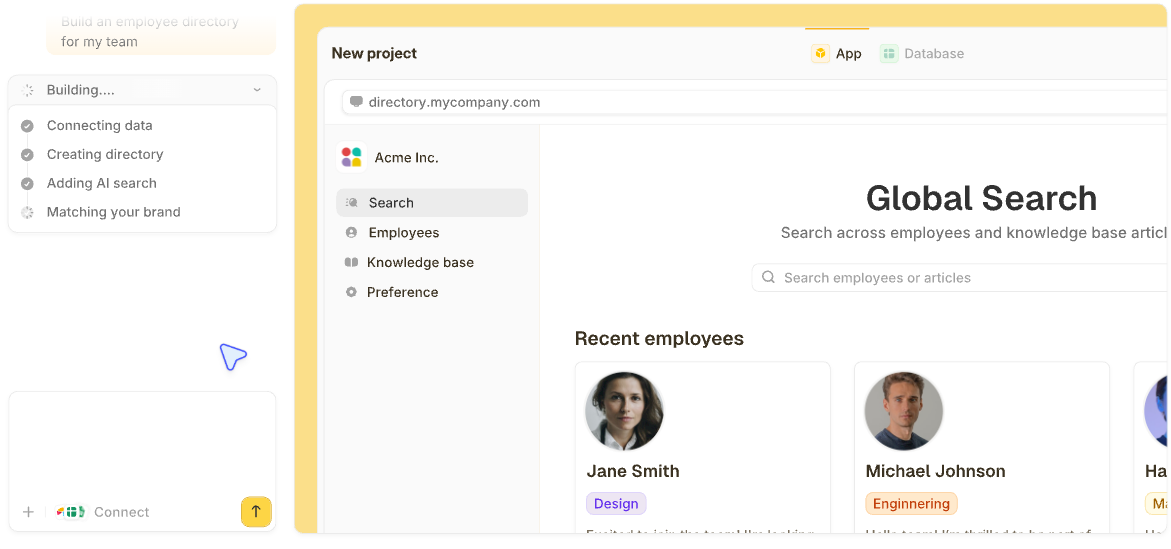


I tested dozens of no-code AI app builders to see which ones actually hold up once you move past demos. This guide breaks down the top 10 platforms worth using in 2026, based on your use case.
10 best no-code AI app builders: At a glance
Some no-code AI app builders are meant for business apps, while others are better suited for prototypes, consumer apps, or mobile experiences.
Before we get into the details, here’s a quick overview:
1. Zite: Best for custom business software
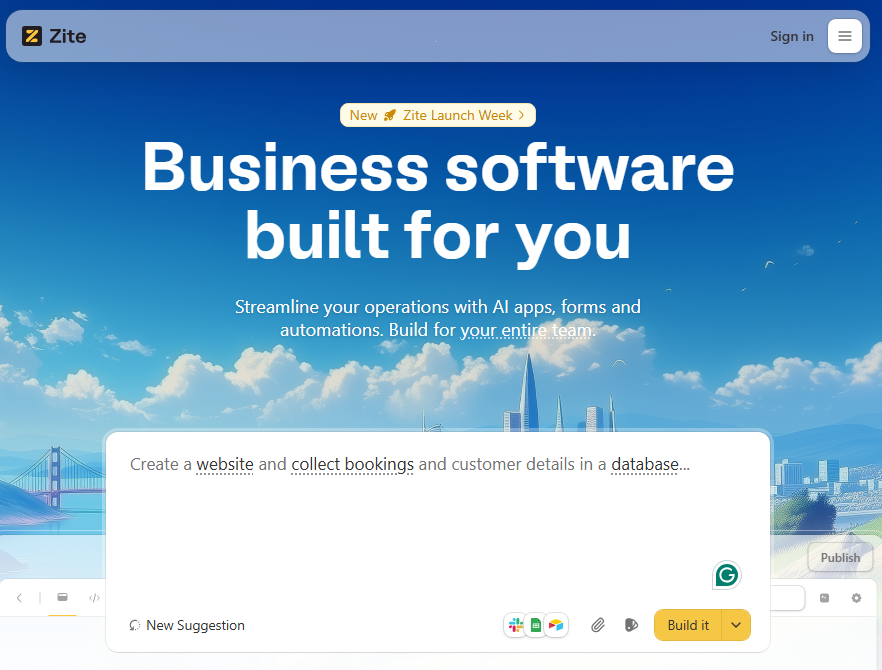
What it does: Zite is a no-code AI app builder that generates production-ready business software from plain English descriptions. These apps include data intake forms, inventory trackers, and portals.
Who it's for: Operations teams, support managers, SMBs, and anyone building business software.
You describe what you want, and Zite generates a functional app. You can refine the app with follow-up prompts, but you also have the option to make direct changes visually.
On the front end, you click a component to resize or restyle it. On the back end, workflows appear as a flowchart, so you can see the logic and fix issues without re-prompting or touching code.
I tested Zite by asking it to build an employee onboarding portal with task checklists, document uploads, and manager approvals. Within 15 minutes, I had a working app with login screens, role-based access, and a database already connected.
What surprised me was how little cleanup the AI-generated version needed. I made a few tweaks to the form labels, and it was ready to share.
Key features
- AI-first app generation: Type what you want, and Zite builds your apps. It generates the UI, forms, workflows, and logic. You can immediately preview and test the app.
- Visual workflows and editing: Backend logic appears as flowcharts (like n8n/Zapier) you can inspect, test, and reprompt. It’s not hidden code. You can also edit the UI by restyling it or resizing it directly if prompts aren’t working. And the built-in database works like a spreadsheet, so you can see and fix data without writing queries.
- Built-in no-code database: Includes a native, no-code database that auto-generates tables and relationships. No need to set up external storage or write SQL.
- Unlimited users and apps, even on the free plan: Deploy apps to unlimited team members without per-seat fees eating into your budget.
- Production-ready apps: Includes built-in auth, user permissions, and SSO. It also securely hosts your app and is SOC 2 Type II compliant.
- Integrations: Comes with prebuilt connections to tools like Airtable, Google Sheets, and Salesforce.
Pros
- No per-user fees mean predictable costs as your team scales.
- SOC 2 Type II compliant with enterprise security features baked in.
- Visual editor and direct code access are available when you want more control than AI prompts.
Cons
- It doesn’t support code export, so your apps stay on Zite.
- Less granular design control compared to traditional drag-and-drop builders.
Pricing
Every plan, including Free, supports unlimited users and apps. The free plan comes with 50 AI credits, which is enough to build a complete app and make several rounds of changes. Paid plans start at $19/month, billed monthly for 100 AI credits.
Bottom line
Zite is the best option if you want to build and maintain production business apps without writing or understanding code. You can use AI prompts but you also have the option to tweak apps visually. You can inspect workflows in a flowchart-style interface, edit UIs directly, and modify the database as you would a spreadsheet.
2. Emergent: Best for prompt-to-production apps you own

What it does: Emergent is an AI app builder that turns a plain-English description into a working web or mobile app. You chat with a system of specialized AI agents that design the interface, build the logic and data, test the result, and deploy it to a live URL. The code stays yours: connect GitHub, edit it, or export it.
Who it's for: Founders, operators, and small teams who want a real, deployable product from a prompt, with the option to take the code further later.
You describe what you want, and Emergent plans the build before it writes anything, then works through design, logic, data, and testing as it goes. Because different agents handle different parts of the build, it can take on more complete apps than single-pass generators, including ones with sign-in, stored data, and outside integrations.
I asked Emergent to build the same employee onboarding portal I used to test the other tools, with task checklists, document uploads, and a simple admin view. It scoped the app, generated a working version, and deployed it to a live URL I could share right away. A few details needed follow-up prompts to get right, but the app held together, and I could open the code instead of being limited to re-prompting.
Key features
- Multi-agent build system: A coordinated set of specialized agents handles design, logic, integrations, testing, and deployment, so more of the app is built and checked before you see it.
- Web and mobile output: Build web apps or mobile apps with React Native and Expo, and publish them to the App Store and Google Play.
- Code you own: Connect GitHub, edit in a built-in VS Code environment, and export the code whenever you want.
- Managed hosting and deployment: Apps go live on a hosted URL by default, with custom domains, analytics, traffic monitoring, health checks, and logs included.
- Integrations and sign-in: Add payments, Google sign-in, and other services without setting up the infrastructure yourself.
Pros
- Turns a single prompt into a working app, with specialized agents handling design, data, and testing so there is less to clean up.
- You keep the code: export it, connect GitHub, or edit it in the built-in VS Code environment.
- Builds for web and mobile, with App Store and Google Play publishing on the mobile side.
- Carries SOC 2 Type II and ISO 27001 certification, with SSO and audit logs on higher tiers.
Cons
- Pricing runs on credits, so a large or frequently rebuilt app can get expensive.
- After repeated deploys, the data can drift from what you asked for and needs a manual check.
- It is not the right fit for polished document output or games.
Pricing
Emergent has a free plan with 10 credits. Paid plans start at $20/month for 100 credits, with a Pro plan at $200/month for 750 credits, billed monthly. Enterprise pricing is custom. Because pricing is credit-based, your real cost depends on what you build: a simple landing page and a data-heavy app can cost very differently.
Bottom line
Emergent is the strongest pick if you want to go from a prompt to a real, deployable web or mobile app and keep full access to the code. It is more capable than quick prototyping tools and easier for non-developers than code-first platforms, though credit costs and data drift mean it rewards a careful, iterative approach.
3. Bubble: Best for complex web applications

What it does: Bubble is a visual programming platform for building fully functional web apps without code. It handles frontend design, backend logic, databases, and workflows in one environment.
Who it's for: Founders, technical product managers, and teams building complex web applications like marketplaces, SaaS products, or custom CRMs.
Bubble has been popular in the no-code space for over a decade. The platform recently added AI features to help generate pages and suggest workflows. However, it remains primarily a visual builder. You have to use the drag-and-drop builder to modify your apps after the first AI draft.
When I used it, the AI generated a decent starting point, but I spent the next couple of hours in the visual editor connecting workflows manually. There’s a real learning curve, which explains why many business owners end up hiring Bubble developers to get apps over the finish line.
Key features
- AI app generation: Generate full apps or pages from prompts. Then, refine layouts, data, and workflows in the visual editor instead of starting from scratch every time.
- Massive plugin ecosystem: Extend apps with plugins or connect any external service via the API connector.
- Built-in database: Define data types, relationships, and privacy rules in Bubble’s own database.
- Managed hosting and scaling: Bubble manages deployment on AWS. It has dedicated pricing options for higher reliability and isolation.
Pros
- Largest no-code community with extensive learning resources, including agencies and tutorials.
- Supports both web and mobile apps.
- The plugin library covers a lot of integration needs.
Cons
- Steep learning curve.
- You're locked into Bubble's ecosystem.
Pricing
Bubble uses a usage-based system called workload units. It can get more expensive as your app gets more complex or more users visit it. The free plan gives you 50,000 WUs but no live deployment. Paid plans start at $69/month (web + mobile) for 175000 WUs, a live website, and 3 live mobile app versions. Web only starts at $32/month, while mobile only starts at $49/month.
Bottom line
Bubble is the right choice if you’re building customer-facing web apps, such as a two-sided marketplace. Just make sure you have the time to learn the tool or the budget to pay a dev.
4. FlutterFlow: Best for cross-platform mobile apps

What it does: FlutterFlow is a visual builder for cross‑platform apps (iOS, Android, and web). It now includes AI features to generate screens, components, and even full apps from prompts or Figma designs.
Who it's for: Startups, solo developers, and teams building mobile apps who want the option to export code later.
In FlutterFlow, you describe the app or page you want and use FlutterFlow AI to generate it. The platform will create screens, widget trees, and database schemas. These will then appear as editable components in the visual editor.
I asked FlutterFlow to generate a mobile version of my onboarding portal. The AI created clean screens with proper mobile navigation patterns, including bottom tabs and slide-out drawers. The generated UI looked native, not like a web app crammed into a phone screen. One tradeoff is that I had to set up Firebase separately for authentication and data storage.
Key features
- True native apps: Build once and deploy to iOS, Android, and web. It supports animations, responsive layouts, and common mobile patterns like drawers and tabs.
- Figma import with AI mapping: Turn Figma designs into FlutterFlow components, with colors, fonts, and assets mapped to FlutterFlow themes and widget hierarchies.
- Full code export: Download your complete codebase anytime. Hand it to developers, modify it yourself, or host it anywhere.
- Backend integrations: Deep Firebase support for authentication, database, and storage, plus options for other backends.
Pros
- Supports full code export, so no lock-in.
- Great for mobile-first MVPs.
- AI assistance for code generation and troubleshooting.
Cons
- Bigger or more complex apps still benefit from Flutter knowledge.
- Very large apps with many pages or complex animations can feel slower and harder to maintain.
- Backend hosting costs extra.
Pricing
FlutterFlow has a free plan that supports 2 projects. This plan is enough to experiment with and see what the platform is capable of. Paid plans start at $39/month and unlock code export, unlimited projects, and custom domains.
Bottom line
FlutterFlow is the best pick when you want an AI‑assisted path to real mobile apps with the option to export Flutter code later.
5. Figma Make: Best for design-to-app workflows
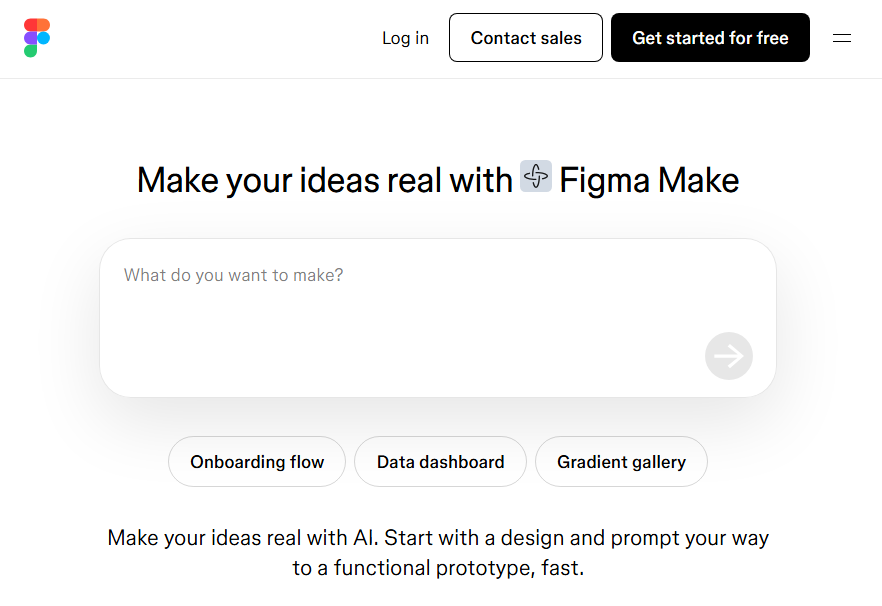
What it does: Figma Make is Figma’s AI-powered, no-code app builder. It turns prompts, designs, or screenshots into interactive web app prototypes.
Who it's for: Designers, product managers, and teams who work in Figma and want to build working prototypes or MVPs without switching tools or waiting for developers.
You can start from a text prompt, an existing Figma design, or even a screenshot. Make generates layouts, components, and basic logic as a working prototype. The killer feature is design system integration. Your Figma components, tokens, and styles automatically apply to generated apps.
I tested Figma Make by uploading a Figma design file I had for a landing page. Within minutes, it generated a clickable prototype that matched my wireframe's structure. The downside of Figma is that the apps are mainly frontends. It struggles with backend workflows like sending approval notifications.
Key features
- Visual, conversational editing: Combine Figma’s normal editing tools with an AI chat. You can adjust copy, spacing, colors, and layout in plain language and see changes instantly.
- Supabase integration for real data: Connect to Supabase to add login, user profiles, and data storage, and to call private APIs.
- Built for collaboration: Designers, PMs, and stakeholders can all work together in the same file while co-creating with AI.
- Real code output: Generates structured React code you can export, extend, and deploy.
Pros
- Designers never have to leave Figma or learn a separate builder.
- Real-time preview as you build.
- Supabase support means you can validate ideas with real logins and data.
Cons
- Best for prototypes and MVPs, not production-scale apps.
- Limited backend capabilities.
Pricing
Figma Make is included with Figma subscriptions. The free plan comes with 150 AI credits/day (up to 500 AI credits/month). Paid plans are priced per-seat and differ for collab, dev, and full seats. You’ll need the full seat, which starts at $20 per seat per month, to access Figma Make.
Bottom line
If your team already uses Figma, Make is the fastest path from design to working prototype. It's perfect for validating ideas before investing in full development.
6. Base44: Best for rapid web app prototyping

What it does: Base44 is a no‑code AI app builder that builds web apps from plain English instructions.
Who it's for: Solo founders, indie developers, and teams who want to build and ship apps as fast as possible with minimal manual configuration.
The platform provides backend services like authentication, database, role‑based permissions, and hosting. It also gives you a visual editor and code access, so you don’t always have to use AI prompts.
I have used Base44 in the past to prototype websites. It’s very fast, and the AI is very aggressive about adding features you haven’t explicitly asked for. That's a double-edged sword. On one hand, the app felt more complete out of the box. On the other hand, I spent time removing features I didn't need. The credits also run out quickly if you're iterating a lot.
Key features
- Built‑in backend: Automatically sets up user accounts, data storage, and role‑based permissions.
- Hosted deployment: Apps run on Base44’s infrastructure with domains and analytics included.
- Payment integrations: Connect external APIs to add Stripe payments and subscriptions for SaaS monetization.
Pros
- Fast to build apps with the built-in backend and automatic hosting.
- Supports user accounts, roles, and Stripe‑based payments.
- Visual and code editing options after the first AI draft.
Cons
- Locked into Base44 environment.
- Charges for messaging AI and integrating with tools can get expensive.
Pricing
Base44 uses credit-based tiers. It consumes message credits when you instruct the AI to build or modify the app and integration credits when your app talks to other tools. The free plan comes with 25 message credits and 100 integration credits per month. Paid plans start at $20/month, billed monthly for 100 message credits and 2000 integration credits.
Bottom line
Base44 is best for non-technical founders and small teams who want to launch web apps quickly without connecting to their own backend.
7. Softr: Best for client portals
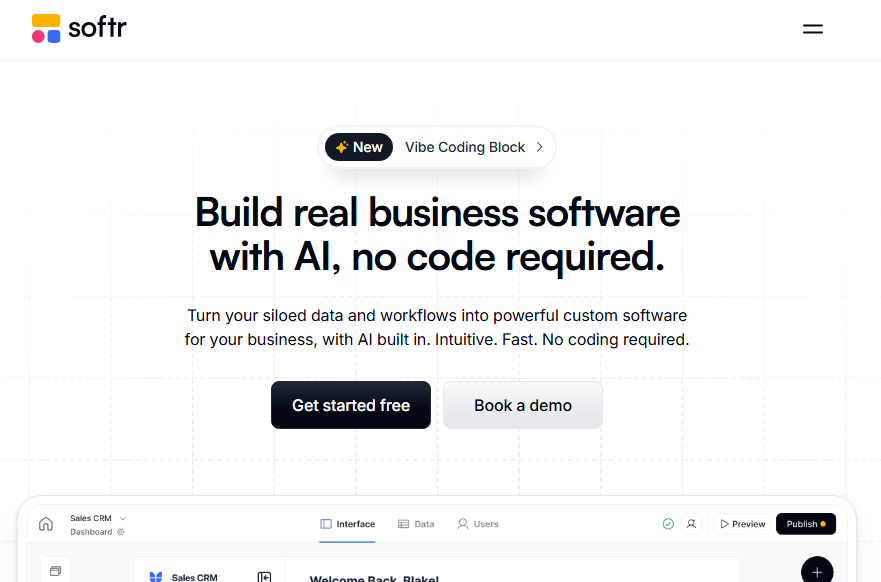
What it does: Softr is a no-code platform for building portals and lightweight business apps on top of data. You can use data from external platforms like Airtable or Softr’s own database.
Who it’s for: Operations, customer success, and project teams that need client portals on top of their data.
Softr’s AI builder can scaffold an app by asking what you want to build, then proposing pages, layouts, and connections to a chosen data source. After this, you still work in the normal Softr editor. The AI doesn’t run the whole lifecycle. It only helps with the first version.
The first thing I noticed is that the generated app looks blocky. This is because Softr assembles everything using its drag-and-drop components, so the output feels more like stacked blocks than a cohesive interface.
The AI-generated version also had a lot of missing features and wasn't ready to use out of the box. I spent time manually tweaking components, adjusting layouts, and setting up the database connections.
Key features
- Data-connected apps: Connects directly to Airtable, Google Sheets, Notion, HubSpot, SQL, and Softr’s own database.
- Block-based UI builder: Use drag-and-drop blocks to assemble the app. It also has pre-built templates you can customize.
- User auth, and permissions: Comes with built-in authentication, roles, and row-level access control for the database. It’s also SOC 2 Type II compliant.
- Workflows and automations: Has a built-in workflows builder and also integrates with tools like Make and Zapier. You can trigger emails, updates, or external calls when records or user actions change.
Pros
- Block-based UI and templates are easier for non-technical users.
- Built-in access control lets ops and client teams safely expose data to customers.
- Great for portals and internal tools on existing data.
Cons
- Tied to underlying data platforms like Airtable limits.
- AI builder is scoped to what Softr’s visual builder can do and doesn’t generate custom apps.
Pricing
Softr has a free tier and then three main paid plans starting at $59/month, billed monthly. The free plan supports 1 published app with 10 users and includes 500 AI credits. Higher tiers increase app/user limits, data quotas, and add features like custom domains and API support.
Bottom line
Softr is a strong fit when you want data-connected portals and internal tools on top of tools like Airtable and Google Sheets. It is not the best option if you prefer building primarily through AI prompts instead of a drag-and-drop visual editor.
8. Appy Pie: Best for simple small-business apps

What it does: Appy Pie is a no-code AI app builder that turns plain-language prompts into mobile apps and websites, which you then refine in a visual editor.
Who it's for: Local businesses, solo entrepreneurs, and non-technical users who need a simple branded app (menus, bookings, contact pages, basic e‑commerce) without managing infrastructure or writing code.
In testing, I built a booking app for a salon. The builder looks very bare bones. It’s just a chat box and a panel that holds the visual builder. The generated website works, but the designs are very plain. You can't customize with follow-up prompts, but you can select a component and make changes directly.
Key features
- Business-focused templates: AI generates apps from simple business category prompts like "restaurant menu app" or "fitness trainer booking app," then applies the right features automatically (menus, appointments, contact forms).
- Visual editor: Directly make changes to the generated app via the visual editor.
- App store submission support: Appy Pie guides you through publishing to Google Play and Apple App Store.
Pros
- Very fast from idea to functional draft app for common small-business patterns.
- Designed for complete non-technical users, with a simple wizard-style setup.
- Handles deployment and app analytics for you.
Cons
- Apps can feel template-like, with less control over design and logic.
- Can't iterate with follow-up prompts. You must edit components directly.
Pricing
Appy Pie offers a 7-day free trial. Paid plans start at $16/app/month for web and Android apps. The Platinum plan at $60/app/month adds iOS publishing.
Bottom line
Appy Pie is a good fit when you want a straightforward mobile app or website for a small business and care more about speed and simplicity than deep customization. It falls short when you need richer workflows, custom databases, or production-grade internal tools.
9. ToolJet: Best if you want to self-host

What it does: ToolJet is an AI-powered internal app builder that turns prompts into full-stack business apps. Instead of generating everything at once, it walks you through each step and waits for approval.
Who it's for: Ops and internal tooling teams that want AI to handle most of the scaffolding while still keeping tight control over the final UX, data model, and logic.
When I tested ToolJet, it started by outlining the pages, data, and main workflows. I reviewed and edited that plan before approving it. Next, it generated the screen layout, which I could adjust before moving on. Then it set up a database and built the app.
This step-by-step flow helped me catch mistakes in the prompt early.
Key features
- Checkpoint-based generation: The AI builds in stages (PRD → design → database → app), letting you review and adjust at each step before moving forward.
- Open-source with self-hosting: Run ToolJet on your own infrastructure for complete data control. Full source code is available to fork and modify.
- Visual + code hybrid: Build UIs visually or add JavaScript and Python for custom logic and data transformations.
- Enterprise security: Includes SSO, RBAC, audit logs, and granular permissions.
Pros
- Structured checkpoints reduce rework compared to one-shot AI builders.
- True self-hosting means no vendor lock-in and full data control.
- Open-source gives transparency and customization options.
Cons
- More steps than simpler AI builders. You have to review each stage.
- Self-hosting requires infrastructure maintenance.
Pricing
ToolJet offers both self-hosted and cloud options. Cloud plans start at $24 per builder/month for 50 end users and 2 apps. Self-hosting starts at $99 per builder/month.
Bottom line
ToolJet is the right choice if you want AI assistance but need to stay in control by self-hosting it or catching mistakes early in the build process.
10. Glide: Best for spreadsheet-powered apps
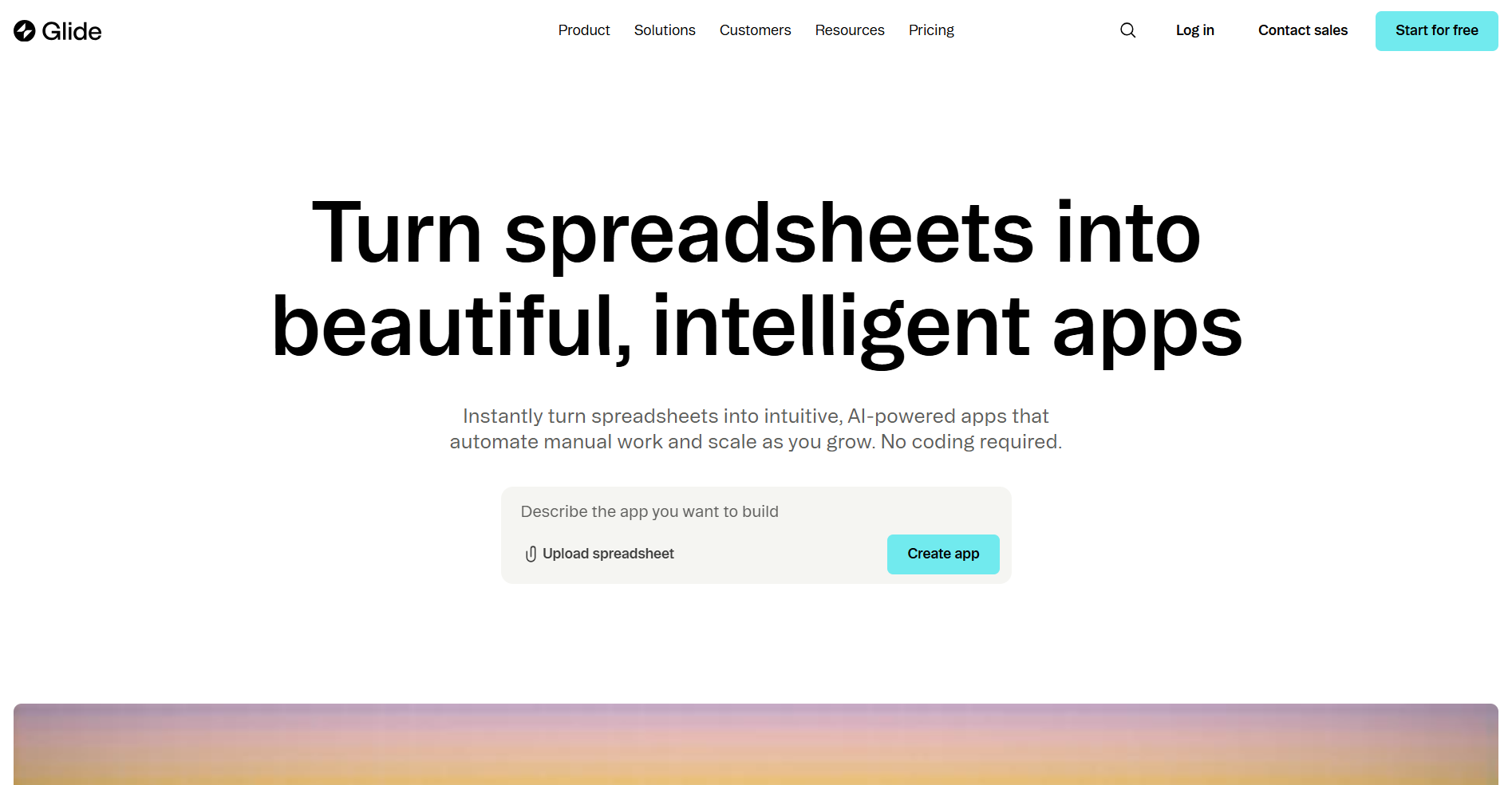
What it does: Glide is a no-code platform that turns spreadsheets and databases into responsive, AI-powered business apps. It connects to sources like Google Sheets, Airtable, and SQL, then lets you design interfaces and workflows visually.
Who it's for: Operations, field teams, and SMBs that live in spreadsheets today and want mobile-friendly apps for inventory, CRM, field data capture, and portals without hiring developers.
I tested Glide by connecting a Google Sheet with inventory data. I had to do this visually because the Glide doesn’t have a prompt to the app builder. I could, however, use AI actions to perform tasks like text summarization or OCR, so you get more than just a static interface.
Key features
- Spreadsheet-to-app: Connect Google Sheets, Excel, Airtable, or SQL databases and build apps on top of them. Edits in the spreadsheet sync to the app in real-time.
- Glide AI: AI features for generating computed fields, text summarization, and OCR.
- Workflow automation: Build multi-step automations triggered by time, webhooks, or user actions.
- Role-based access: Control who can view or edit data with user roles and permissions.
Pros
- Fast path from spreadsheet to working app.
- AI features help with data processing and automation.
- Strong security features, including SOC 2 and GDPR compliance on eligible plans.
Cons
- Can't publish to app stores directly.
- Complex data relationships require careful setup in the editor.
Pricing
Glide has a free plan for personal use with limited features. You can’t publish apps on this plan. The paid plans for individuals start at $25 per month (billed monthly) and support 1 app and 100 app users. The business plans start at $249/month (billed monthly) for unlimited apps and 30 app users ($6 per additional user).
Bottom line
Glide is ideal if your data already lives in spreadsheets and you want apps without migrating to a new system.
How I tested these no-code AI app builders
I spent a few hours building apps with each builder. I evaluated both the building experience and the quality of the output.
What I looked for:
- AI capabilities: I checked how well prompt-based building works. How much editing does the generated workflow need?
- Real-world usability: Are the apps production-ready, or do they need extensive changes?
- Integration ecosystem: Can the platform connect to the tools teams already use?
- Deployment options: How easy was publishing after the AI generated the app, and what were the ongoing hosting costs?
- Security and governance: Does it have security features like SSO, audit logs, and compliance support?
- Pricing: Does pricing scale predictably with the number of users and apps?
Which no-code AI app builder should you choose?
You should choose the AI app builder that matches the type of app you’re building and how much control you want over data, logic, and UI.
Choose Zite if you:
- Need business apps (dashboards, portals, websites, client-facing apps) that work in production fast
- Want the flexibility to refine apps visually, with prompts, or code. Avoid being locked into re-prompting or editing code.
Choose Bubble if you:
- Want to build SaaS products, marketplaces, or custom CRMs.
- Have time to invest in learning how the platform works.
Choose FlutterFlow if you:
- Need native mobile apps for iOS and Android.
- Want the option to work at the code level with generated Flutter code.
Choose Emergent if you:
- Want a prompt to become a deployable web or mobile app you can ship.
- Want to keep and edit the underlying code, or hand it to a developer later.
Avoid these platforms if you:
- Need strict control over your app’s infrastructure. Consider AI-assisted custom development.
The best no-code AI app builder for business apps
If you’re building client portals, dashboards, forms, workflows, or other business software, Zite is the strongest no-code AI app builder to consider. It strikes the right balance between fast AI generation and apps that actually hold up once teams start using them.
Zite’s visual editing support for both the UI and the backend also makes it easy for non-technical users to maintain the apps over time.
That said, each platform has its place. Bubble works better for SaaS-style products, while FlutterFlow is a stronger fit for mobile-first apps, and Emergent is a strong choice when you want a prompt to become a deployable app with code you own.
Build your first no-code AI app with Zite
Ready to build your first app? Zite's free tier includes unlimited apps and users. No credit card required.
Frequently asked questions
What is the best no-code AI app builder for businesses?
The best no-code AI app builder for most businesses is Zite. It combines AI-powered app generation with built-in databases and enterprise security. Your business apps are production-ready by nature.
Can I build mobile apps with no-code platforms?
Yes, you can build mobile apps with no-code platforms like FlutterFlow. It creates true native iOS and Android apps with full code export.
Do I need coding experience to use no-code app builders?
No, you don’t need coding experience to use no-code app builders. You'll describe what you want in plain language or arrange pre-built blocks visually.
Can no-code apps scale for enterprise use?
Yes, no-code apps can scale for enterprise use with the right platform. Zite, for example, handles enterprise requirements out of the box. It includes a built-in database, authentication, user permissions, secure hosting, and SOC 2 Type II compliance.