

Not every tool built for no-code workflow automation for business operations survives real production use. I tested 20+ to find out which ones do, and these are the 12 that made the cut.
12 Best No-Code Workflow Automation Tools for Business Operations at a Glance
If you're short on time, this table breaks down the 12 best tools:
1. Zite: Best no-code app builder for workflow automation

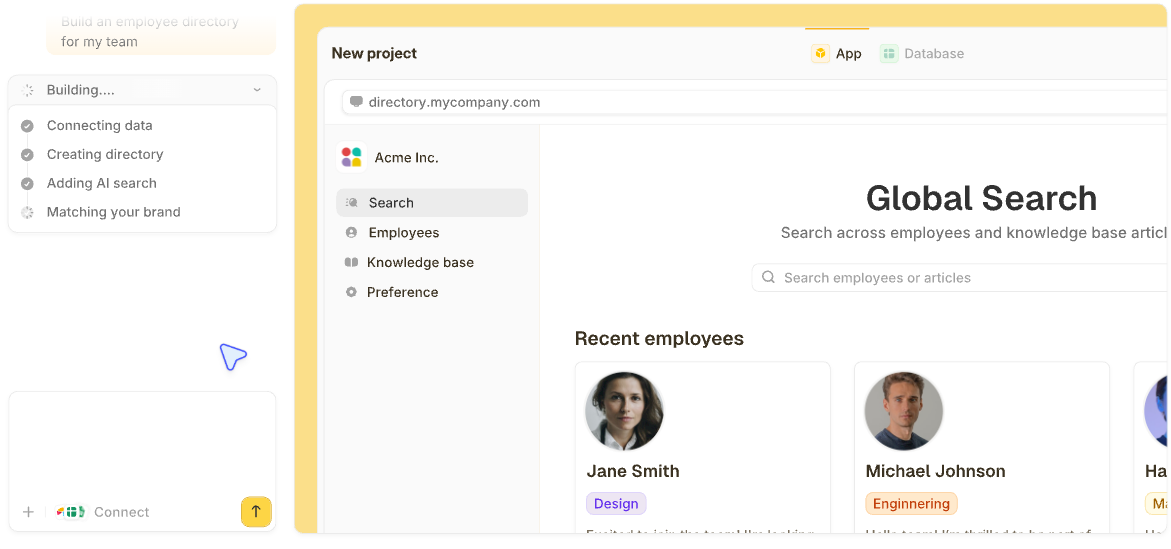
- What it does: Zite lets non-technical teams build custom business apps from plain English instructions. You describe what you need and it generates the forms, database tables, dashboards, and logic automatically.
- Who it's for: Non-technical teams who want to build apps with real workflows baked in. Describe what you need, and the approvals, routing, and data logic get generated for you. They remain visible as editable flowcharts.
I tested Zite by building a client intake app that connected to Slack and our CRM. I described what I needed, and it generated the forms, notification triggers, and database updates automatically. The only manual step was configuring permissions for each tool.
Zite displayed the app logic as a visual flowchart. I could see how data moved between steps and go back to the prompt whenever something didn't work.
Unlike Zapier or Make, Zite’s workflows aren't background automations running between separate tools. They’re the logic of the app itself, triggered when users submit a form, click a button, or change a record, and able to update your database, run AI models, send Slack messages, or call external services.
Because Zite’s logic lives inside the app and is visible as flowcharts, it's much easier for non-technical teams to maintain than stitching together external automations.
Key Features
- AI-generated app logic with visual inspection: Describe what you need, and Zite builds it with forms, logic, and database tables. You can inspect the workflow visually, review run history, and troubleshoot issues by going back to the prompt, no code needed.
- Built-in database with auto-generated tables and fields: Zite automatically creates database tables and relationships based on your automation needs. No SQL knowledge or separate database setup required.
- Ships ready to publish: Comes with built-in authentication, user permissions, and secure hosting, so apps are published directly without additional security work.
- Pre-built integrations: Connect to Airtable, Google Sheets, Slack, and Zapier with native support for core tools and flexible ways to connect the rest of your stack.
Pros
- Visual editor makes adjustments easy for non-technical users.
- Flat pricing with unlimited users as you scale.
- Build workflows from plain descriptions instead of designing logic from scratch.
Cons
- Zite triggers only from activity inside the app, so scheduled runs and external webhooks that fire independently aren't supported yet.
- AI credits are limited on free and lower-tier plans. Small edits and fixes don't consume credits, but generating or substantially changing workflows does.
Pricing
Zite's free plan includes unlimited apps and unlimited users with 50 AI credits. The Pro plan costs $19/month and includes 100 credits, custom domain support, and branding removal.
Bottom line
Zite is the right choice if your workflows need to live inside custom apps with user access controls, not just connect external tools. For teams with stricter security requirements, SSO and SOC 2 Type II compliance are also available.
2. Kissflow: Best for enterprise workflow automation with governance controls

- What it does: Kissflow is a low-code platform for building enterprise workflows with drag-and-drop tools and AI generation that include built-in audit trails and governance controls.
- Who it's for: Operations, finance, HR, and IT teams in mid-to-large organizations that need complex workflow automation with audit trails, compliance controls, and minimal IT dependency.
I tested Kissflow by building a procurement workflow across three departments. The AI set up a purchase-to-pay approval system with department views and spending thresholds already in place. I adjusted the stages and set role permissions through the visual interface without having to code.
The governance layer tracked every approval, rejection, and edit automatically. No more manual audit trails in spreadsheets. I could see who changed what and when without running reports or asking IT.
Key Features
- Low-code workflow builder with AI generation: Drag-and-drop interface for building approval chains, conditional logic, and multi-stage processes. AI can generate complete workflow structures that you refine through the visual editor.
- Enterprise governance controls: Role-based permissions, granular access control, complete audit logs, and compliance tracking built into every workflow without additional configuration.
- Industry-specific templates: Pre-built workflows for procurement, incident management, inventory tracking, and field operations across sectors like oil and gas, retail, and manufacturing.
Pros
- Non-technical users can build and manage workflows without IT involvement
- Strong governance layer for regulated industries that require audit trails
- High customization for complex processes while keeping basic workflows simple
Cons
- Analytics and reporting options are limited compared to dedicated BI tools.
- Performance issues with occasional slowdowns that disrupt workflows
Pricing
The Basic plan runs $2,500/month with unlimited processes and applications.
Bottom Line
Kissflow bridges the gap between technical automation platforms and spreadsheets by combining visual building with enterprise governance features. Best for mid-sized companies running complex approval workflows.
3. Pipefy: Best for end-to-end process orchestration with AI agents

- What it does: Pipefy is an AI-powered platform for building enterprise workflows and automated processes using no-code tools and natural language that orchestrate multi-department operations.
- Who it's for: Operations, finance, HR, and shared services teams in mid-to-large companies that need to orchestrate complex, multi-department processes with governance controls.
I used Pipefy to build an accounts payable process. It covered invoice submission, approval routing, and payment processing. I described what I needed in plain language. Pipefy generated the structure with approval stages and notification triggers already set up. From there, cards moved through each phase automatically based on my rules.
The real-time dashboard showed exactly where invoices were in the pipeline, which made it easy to spot bottlenecks and adjust the flow before they piled up. Seeing where every invoice stood in real time is what made it useful. Without that, it's just automation running in the background.
Key Features
- Natural language process generation: Describe your process in plain language and Pipefy builds the structure, forms, and automation rules. You refine everything with drag-and-drop tools without writing code.
- Enterprise orchestration capabilities: Native integrations with messaging platforms like WhatsApp, Teams, and Slack, plus custom portals for external users and iPaaS capabilities for connecting business systems.
- Industry-specific templates: Pre-built processes for AP automation, employee onboarding, KYC/KYB, insurance claims, and HR operations across finance, legal, logistics, and insurance sectors.
Pros
- Process owners can automate without IT dependency.
- Strong end-to-end orchestration with cards, phases, and real-time dashboards.
- Forrester TEI study shows 260% ROI and 40% time savings.
Cons
- Mobile app and analytics lack depth compared to specialized tools.
- Advanced automation features require paid add-ons that increase costs.
Pricing
Custom pricing for the Business tier with unlimited processes and generation credits.
Bottom Line
Pipefy works best for companies automating multi-department processes that need natural language generation, custom portals, and governance controls in one platform.
4. Vellum: Best for building production AI workflows with evaluation tools

- What it does: Vellum combines visual building with code-level control to create, test, and deploy AI agents that include evaluation frameworks and observability for production environments.
- Who it's for: Technical teams and dev/ops groups building production AI systems. Especially useful if you need to iterate fast, test before shipping, and deploy reliably.
I set up Vellum for document review workflows that connected to Notion, Salesforce, and Slack. I described what the agents needed to do in plain English, and Vellum generated the structures with tool connections already mapped. The visual workflow graph showed exactly how data flowed between prompts, APIs, and conditional logic.
When runs failed, the Vellum’s trace view let me step through each node to see where things broke. That made debugging faster than digging through error logs trying to reconstruct what happened.
Key Features
- Visual builder with SDK support: Build AI agents with drag-and-drop tools, then export to Python or JavaScript when you need code-level control for custom logic or deployment.
- Plain English agent generation: Describe your agent's purpose, such as fraud detection or customer success automation, and Vellum generates the structure with relevant tool connections already configured.
- Evaluation and testing infrastructure: Test against real datasets. Compare models side by side. Set up routing and fallback logic so your deployments stay stable in production.
Pros
- Non-technical team members can test and iterate on prompts independently.
- Combines orchestration, evaluation, observability, and deployment in one platform.
- Strong fit for complex use cases like fraud detection and legal review.
Cons
- Pricing requires sales calls with no public costs for estimation.
- Requires technical understanding of graphs and model testing to maximize value.
Pricing
Vellum runs on a prepaid credit model. Add funds as needed and pay for what you use.
Bottom Line
Vellum works best when you need production-grade AI systems with testing and observability included, not simple automations.
5. Lindy: Best for email and communication workflow automation

- What it does: Lindy builds automation workflows by describing tasks in plain language. It connects email, CRM, calendars, and 4,000+ apps without building visual flows node by node.
- Who it's for: Support, sales, and marketing teams drowning in repetitive communication tasks. If you're manually sending follow-ups, scheduling meetings, or updating your CRM, Lindy handles that without any technical setup.
I built an email follow-up agent in Lindy that waited three days after initial outreach, checked for replies, and drafted personalized follow-ups based on the original email context. Setup took five minutes. I described what I needed in plain language, and the agent ran for two weeks across 50 outbound emails with only two manual reviews.
The reliability stood out more than the speed. Most no-code automation breaks when edge cases appear, but Lindy handled variations in email responses without constant supervision.
Key Features
- Natural language agent configuration: Describe your automation in plain English and Lindy builds the structure, selecting triggers and actions without requiring you to design visual flows.
- 100+ pre-built templates: Ready-made agents for email sequences, customer feedback collection, web research, content generation, and CRM data entry across common business scenarios.
- Enterprise governance controls: Granular access permissions, agent performance metrics, integrated knowledge base, and human-in-the-loop escalation when automation hits edge cases.
Pros
- Point-and-click interface makes automation accessible to non-technical users.
- Thousands of app integrations without API configuration.
- Reliable for communication tasks like email and meeting notes.
Cons
- Credit-based pricing gets expensive on high-volume operations.
- Inconsistent results on complex logic that requires manual supervision.
Pricing
The Plus plan starts at $49.99/month and includes inbox management, meeting scheduling, and hundreds of integrations. Enterprise pricing is available on request.
Bottom Line
Lindy gets communication workflows running faster than platforms that require visual building, making it ideal for teams automating email and meetings without technical resources.
6. Cflow: Best for centralizing approval workflows in growing companies

- What it does: Cflow is a workflow platform that manages approval processes, internal requests, and form-based workflows using visual drag-and-drop design to replace email-based approvals and spreadsheet tracking.
- Who it's for: SMBs and growing companies that need to replace email-based approvals and spreadsheet processes with centralized workflow management.
I connected our purchase approval process across three departments through Cflow. The visual designer let me map out multi-stage approval chains with conditional routing based on amount thresholds. I imported our existing Excel tracking sheets directly.
The system tracked every approval, rejection, and bottleneck automatically. No more chasing status updates over email and Slack.
Key Features
- Visual workflow designer: Drag-and-drop builder for creating approval chains, conditional logic, email notifications, and automated task assignments without writing code.
- Excel import and data management: Import existing workbooks and convert spreadsheet-based processes into tracked workflows with accountability and audit trails.
- Flexible approval routing: Configure multi-level approvals with conditional rules, parallel approvals, and escalation logic for complex business processes.
Pros
- Interface works well for both admins and end users without extensive training.
- High flexibility for customizing workflows from simple to complex multi-department processes.
- Strong value for money compared to enterprise platforms.
Cons
- Advanced customization requires learning time beyond basic no-code setup.
- Analytics features offer limited options for extracting deep insights.
Pricing
Plans start at $16/user/month for the Standard tier with unlimited workflows and basic automation.
Bottom Line
Cflow works best for SMBs replacing email approvals and spreadsheets with centralized tracking, not enterprises needing deep analytics or complex integrations.
7. Pulpstream: Best for digitizing paper-based HR and compliance processes

- What it does: Pulpstream is a workflow platform that transforms paper and spreadsheet processes into digital workflows using drag-and-drop builders.
- Who it's for: HR and compliance teams still running incident tracking, workers' compensation, and onboarding on paper. If your processes live in spreadsheets or printed forms, this is built for you.
I ran Pulpstream on workplace safety workflows that replaced our Excel-based incident tracking. The platform captured data from field workers on mobile devices, routed reports to safety managers automatically, and tracked corrective actions in real time. Offline mode worked.
Field workers logged incidents at job sites without connectivity, and everything synced when they reconnected. This eliminated the delays we used to have when workers waited until they got back to their desks to fill out forms.
Key Features
- No-code workflow builder: Drag-and-drop interface for creating multi-stage processes with triggers, conditional logic, and automated notifications without programming knowledge or IT support.
- Mobile-first data capture with offline mode: Field workers can capture incidents, safety observations, and claim details on any device. Offline mode syncs data automatically when workers reconnect to the network.
- Pre-configured HR and compliance solutions: Ready-made workflows for employee onboarding, workers' compensation, incident management, and workplace safety tailored to regulated industries like construction and manufacturing.
Pros
- Replaces paper and spreadsheet chaos with structured tracking for KPIs and corrective actions.
- Business teams can build complex solutions without IT development resources.
- Stable platform with strong uptime for enterprise deployments.
Cons
- Building complex reports requires multiple training sessions to master.
- Some users report software glitches and slow support response across time zones.
Pricing
Custom pricing based on users, workflows, and deployment requirements. Contact Pulpstream sales for enterprise quotes with implementation support.
Bottom Line
Pulpstream works best for digitizing paper-heavy HR and compliance processes with mobile access for field workers, not for teams needing sophisticated analytics beyond basic process tracking.
8. Zapier: Best for connecting apps without custom integration work

- What it does: Zapier connects business applications through automated workflows that trigger actions across platforms, with capabilities for building chatbots and intelligent routing without custom integration work.
- Who it's for: Operations, marketing, support, and sales teams that need to move data between apps automatically without building custom integrations or involving engineering.
I used Zapier to route leads by connecting our form to Salesforce, Slack, and a Google Sheet. New leads created CRM records, fired team notifications, and logged to the spreadsheet at the same time. I described what I needed and the AI suggested the triggers and actions. I refined the rest through field mappings.
The entire setup took 15 minutes instead of the hours custom integrations would require. I ran 500 leads through the workflow over three weeks with only two failures, which the error log explained clearly.
Key Features
- 8,000+ app integrations: Pre-built connections to virtually every business application for triggering workflows based on new data, updated records, scheduled times, or webhook events.
- AI-powered workflow building: Describe your automation in plain language and Zapier suggests apps, triggers, and actions. Includes capabilities for intelligent routing and decision-making.
- Zapier Tables and Forms: Built-in database and form builder for storing automation data and collecting information without connecting external tools.
Pros
- The largest integration ecosystem eliminates custom API work for common business tools.
- Mature interface with step-by-step testing, detailed error logs, and AI assistance.
- Proven ROI with documented cases saving thousands of hours.
Cons
- Task-based pricing scales quickly on high-volume or multi-step automations.
- Debugging complex workflows with branching logic requires experience.
Pricing
Free tier includes 100 tasks/month with single-step workflows. Paid plans start at $29.99/month for 750 tasks and multi-step workflows.
Bottom Line
Zapier works best for teams needing proven app-to-app automation with the broadest integration library, not for high-volume workflows where per-task costs add up.
9. Make: Best for visual workflow building with complex logic

- What it does: Make gives you a visual canvas where you can see your entire automation running in real time. It handles branching logic, parallel execution, and custom API connections across 3,000+ integrations.
- Who it's for: Business, IT, and operations teams that need to build complex integrations with branching logic, parallel execution, and detailed error handling beyond simple trigger-action chains.
I used Make for marketing attribution across HubSpot, Google Analytics, and Facebook Ads. The visual canvas showed every data step, API call, and branch. I pulled campaign data, enriched it with CRM info, scored attribution, and updated dashboards. Everything ran in parallel.
When errors occurred, the visual map pinpointed exactly which node failed. This made it much faster to spot and fix issues than piecing together what went wrong from text logs.
Key Features
- Visual-first workflow canvas: See your entire automation as a connected graph with nodes for apps, logic, transformations, and operations running in real-time with full execution visibility.
- Advanced logic and parallel execution: Build workflows with conditional branching, loops, error handling routes, and parallel processing that runs multiple actions simultaneously.
- 3,000+ integrations plus custom APIs: Pre-built connectors for common apps and tools for building custom HTTP requests, webhooks, and JSON transformations for proprietary systems.
Pros
- Visual interface makes it easier to spot issues and understand flow than linear builders.
- Strong balance between no-code accessibility and advanced features for technical users.
- More affordable than Zapier for workflows with multiple parallel paths.
Cons
- Operations-based pricing gets expensive on high-volume or poorly optimized workflows.
- Integrating custom APIs with dynamic JSON schemas requires manual testing.
Pricing
Paid plans start at $10.59/month for 10,000 operations.
Bottom Line
Make works best for teams orchestrating multi-step processes with branching logic and parallel execution, not for simple trigger-action workflows where visual complexity adds unnecessary overhead.
10. Workato: Best for enterprise iPaaS with AI orchestration

- What it does: Workato connects the enterprise systems your business runs on, from ERP and CRM to HCM. It orchestrates workflows and deploys AI agents on top of those connections.
- Who it's for: Mid-to-large organizations with multiple core systems that need scalable integration infrastructure, advanced workflow logic, and AI capabilities managed by IT and business teams together.
I used Workato to build end-to-end order processing workflows that connected Salesforce, NetSuite, and Shopify. The platform handled real-time triggers, data transformations, conditional routing, and error recovery automatically. I built 15 integration recipes in two weeks.
The enterprise-grade infrastructure showed its value when one client's order volume tripled during a product launch. The platform scaled without manual intervention, maintaining performance while processing triple the usual load.
Key Features
- Enterprise iPaaS foundation: Connects applications, databases, and APIs with pre-built connectors, real-time triggers, advanced error handling, and support for custom integrations when standard connectors aren't available.
- Low-code recipe builder: Visual workflow designer for creating integration recipes with conditional logic, data transformations, human approval steps, and parallel execution paths.
- AI copilots and agentic workflows: Build AI agents on top of existing business processes for intelligent routing, decisions powered by organizational knowledge, and automated actions across integrated systems.
Pros
- Robust enough to replace multiple less-capable integration tools as business grows.
- Built for enterprise-grade scalability that handles workload surges reliably.
- Strong customer success support with training and workshops for enterprise clients.
Cons
- Expensive pricing positioned for mid-market and enterprise buyers, not SMBs.
- Steep learning curve for formulas and advanced patterns requires expert support.
Pricing
Custom pricing based on recipes, transactions, and support requirements. Contact Workato sales for enterprise quotes.
Bottom Line
Workato works best for managing dozens of integrations across enterprise systems with elastic scaling and AI orchestration, not for budget-conscious teams needing basic trigger-action automation.
11. Unito: Best for two-way sync between project management tools
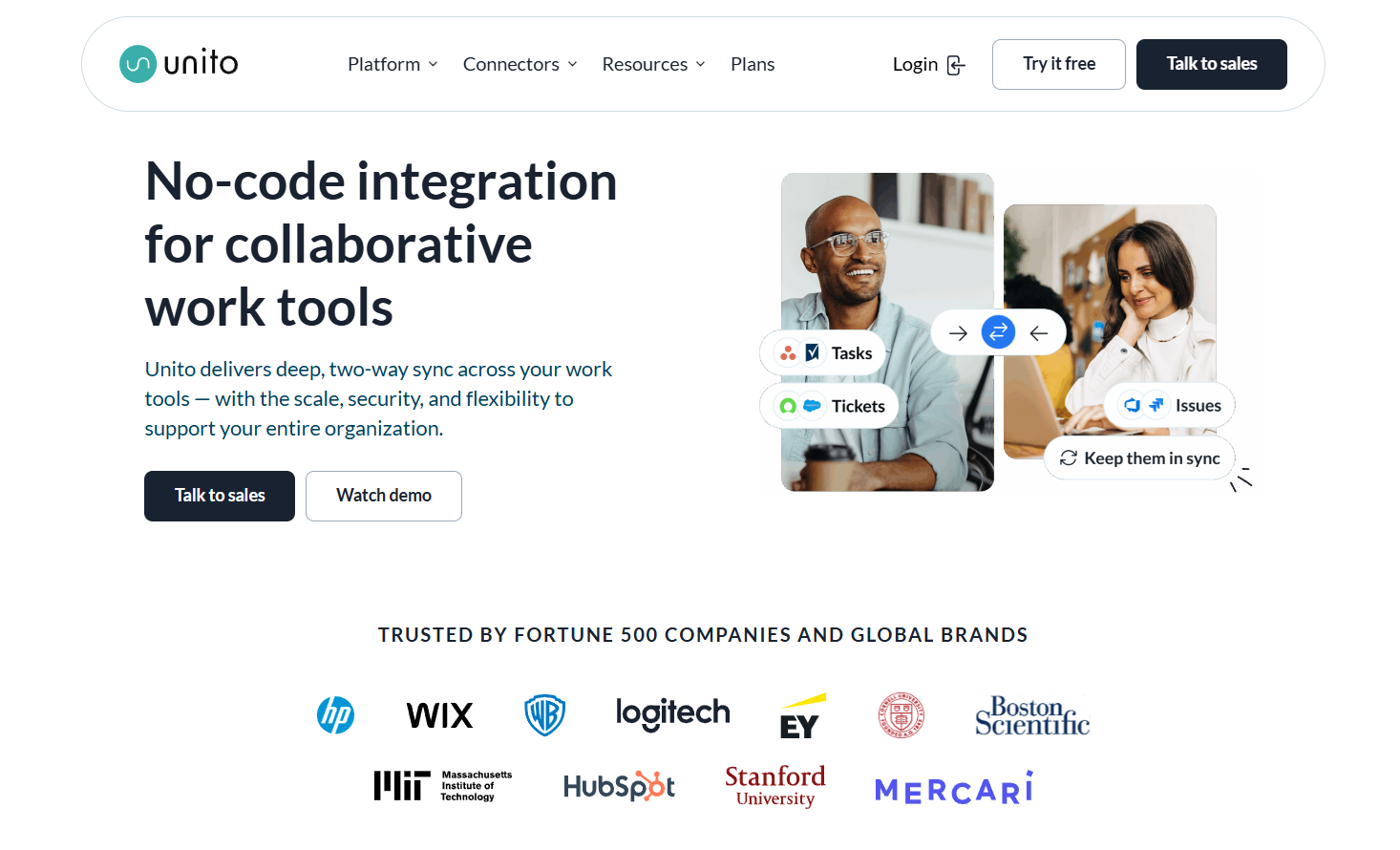
- What it does: Unito keeps data in sync between work tools in both directions. When something changes in one platform, it updates in the other automatically, down to comments, attachments, and custom fields.
- Who it's for: Cross-functional teams using multiple project management and CRM tools that need data consistency without manual copying or custom integration development.
I used Unito to sync Jira and Asana. Engineering updates showed up in Asana on their own. Marketing feedback went back to Jira the same way. Nobody had to switch tools or ask which version was current. The field mappings handled everything that mattered, from status and assignees to due dates and comments.
Teams stayed aligned without manual copying, which eliminated the version control issues we used to have when people worked in different tools. No more asking "which version is correct?" in Slack.
Key Features
- Deep two-way synchronization: Real-time bidirectional sync that handles not just basic fields but also comments, attachments, subtasks, and custom fields across 60+ business applications.
- No-code field mapping: Visual interface for mapping fields between tools, setting sync direction per field as one-way or two-way, and creating filter rules without writing code.
- Set-and-forget architecture: Enterprise-grade integrations that launch in days with minimal maintenance, avoiding complex scripting or continuous error handling.
Pros
- Purpose-built for bidirectional sync and handles data alignment better than general automation platforms.
- No-code interface lets business teams configure integrations without API knowledge.
- Documented ROI of 40+ hours saved weekly by eliminating manual data transfer.
Cons
- Learning curve for understanding filters and mapping options before setup clicks.
- Sync timing occasionally lags unpredictably on some workflows.
Pricing
Custom pricing based on connected tools and team size. Enterprise pricing adds multi-tool workflows, advanced security, and dedicated support.
Bottom Line
Unito works best for teams coordinating across multiple project management tools and needing automatic synchronization, not for general workflow automation beyond tool syncing.
12. Gumloop: Best for AI-powered data extraction and analysis workflows
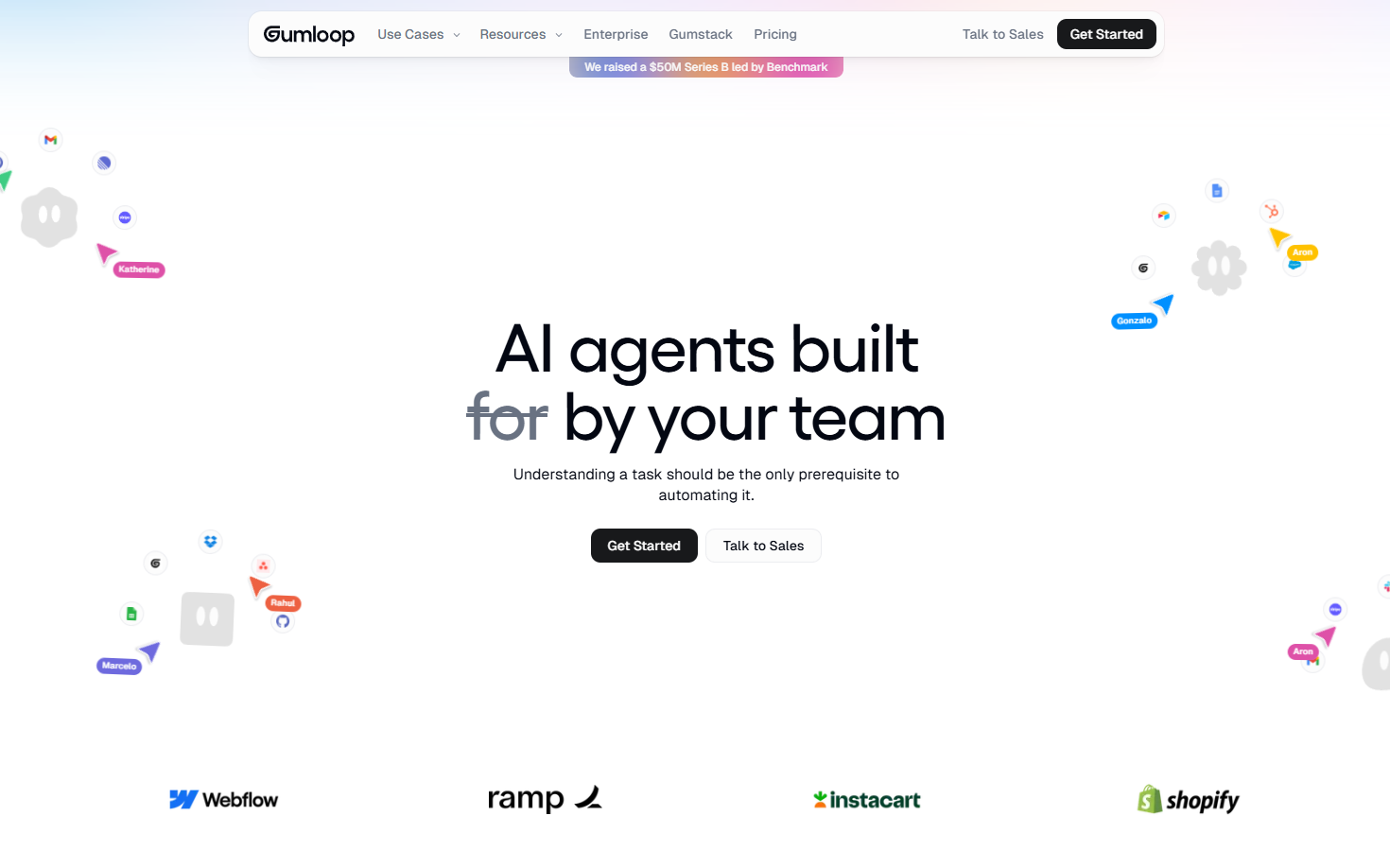
- What it does: Gumloop builds AI workflows for scraping and analyzing data from the web. You drag and drop the components, and it handles the scoring, routing, and structured output automatically.
- Who it's for: Teams in marketing, operations, and product that need to automate scraping, lead scoring, and content analysis without writing a single line of code.
The AI assistant stood out more than the features themselves. I built a lead scoring workflow that scraped Product Hunt, analyzed founder profiles, scored startup potential, and exported structured JSON. The AI assistant (Gummie) rebuilt the entire flow when my logic broke, fixing routing issues I couldn't spot.
I ran it across 200 startups over two weeks with consistent results. Gummie actively debugged issues instead of leaving me to figure out what went wrong, which is rare for no-code AI tools.
Key Features
- 125+ native automation nodes: Pre-built components for apps, AI operations, logic branching, and data transformations that connect visually without code.
- AI Router for intelligent decisions: Routes cases automatically and generates structured outputs in JSON or documents based on workflow context, with decisions explained in the execution logs.
- Advanced scraping and analysis: Purpose-built for web scraping, sentiment analysis, lead scoring, content generation, and multi-step orchestration across data sources.
Pros
- Superior interface design compared to most no-code AI automation tools.
- Gummie actively helps build and debug workflows, often rebuilding flows to fix errors.
- Excellent for scraping and AI analysis use cases with sophisticated subflows.
Cons
- No affordable tier for solo users with pricing targeting teams.
- Steep learning curve for non-technical users that takes weeks to reach proficiency.
Pricing
Plans start at $37/month for the Pro tier with 10,000 credits and team collaboration features.
Bottom Line
Gumloop works best for teams running AI-powered data extraction and analysis workflows that need sophisticated scraping and intelligent routing, not for simple trigger-action automations.
How I tested these no-code workflow automation tools for business operations
I tested each tool by building workflows that matched its core use case. Some connected CRMs and Slack. Others handled approval chains, data syncs, or AI pipelines. This let me evaluate each platform on the tasks it was actually built for, and see how it held up under real production conditions.
Here's what I focused on:
- Execution reliability: I tracked failure rates over three weeks and whether errors recovered automatically or required manual fixes.
- Setup speed: I timed how long building a five-step approval chain with conditional logic actually took, not what marketing claimed.
- Integration stability: I tested whether connections stayed authenticated after two weeks and how platforms handled API timeouts and missing data fields.
- Error visibility: When automations failed, I checked whether error messages explained what broke or just showed generic alerts.
- Cost at scale: I calculated pricing when running 1,000 automations monthly across 10 team members to see where costs became prohibitive.
Which no-code workflow automation for business operations tool should you choose?
Choose the platform that fits your automation complexity and team structure. Consider these factors:
- Choose Zite if you need production-ready apps with enterprise security, native data integrations, a custom domain, and no per-seat pricing.
- Choose Kissflow if you need enterprise-grade workflow automation with built-in compliance tracking and want business teams to build processes without constant IT involvement.
- Choose Pipefy if you're orchestrating multi-department processes with AI agents and need governance controls for regulated industries.
- Choose Vellum if you're building production AI workflows that require test-driven development, model evaluation, and detailed observability.
- Choose Lindy if you're automating email sequences, meeting follow-ups, and CRM updates without technical setup or complex workflow design.
- Choose Cflow if you're replacing email-based approvals with centralized workflow tracking and need affordable pricing for growing teams.
- Choose Pulpstream if you're digitizing paper-heavy HR and compliance processes with mobile access for field workers.
- Choose Zapier if you need the broadest integration library available and want proven reliability for connecting common business tools.
- Choose Make if you're building complex automations with branching logic and parallel execution that need visual debugging capabilities.
- Choose Workato if you're managing dozens of enterprise integrations across core systems and need elastic scaling plus AI orchestration.
- Choose Unito if you're coordinating across multiple project management tools and need deep bidirectional sync without manual copying.
- Choose Gumloop if you're building AI-powered scraping and analysis workflows with sophisticated data transformations and scoring logic.
My final verdict
Zite makes the most sense when you need to build apps that are ready for real users fast. It includes authentication, auto-generated tables and fields, custom domains, and SOC 2 Type II compliance, with flat pricing instead of a per-seat fee.
If you're connecting external tools rather than building apps, the choice depends on complexity. Make handles visual workflows with branching logic. Workato manages dozens of enterprise integrations with elastic scaling. Lindy automates email and communication tasks with the fastest setup.
Ready to try Zite?
If you're ready to automate approvals, onboarding, or internal request tracking, the simplest way is to try it yourself. The free plan includes unlimited apps and users, no credit card required.
Frequently asked questions
What is the best no-code workflow automation for business operations?
Zite is a top pick for no-code workflow automation for business operations. It works best for teams that need production-ready apps with built-in security and user management. Describe what you need, and Zite builds it. Authentication, access controls, and unlimited users are all included.
Can I build complex approval workflows without coding?
Yes, you can build complex approval workflows without coding. Kissflow, Pipefy, and Cflow have visual builders for multi-stage approvals. For more complex logic, Zite lets AI generate the app and workflow for you. You can then inspect and fix issues visually without touching code.
What's the difference between workflow automation and integration platforms?
Workflow automation tools are designed to orchestrate business processes and manage tasks, while integration platforms connect different apps and move data between them. Some platforms like Make and Workato combine both capabilities.
Are no-code automation tools secure enough for business operations?
Yes, no-code automation tools can be secure enough for business operations, especially those with enterprise-grade features like SOC 2 Type II compliance, SSO, access controls, and audit logs. Platforms like Zite, Kissflow, and Workato include these security features for handling sensitive data and regulated operations.