

I tested Replit, Bolt, and Zite to build employee portals, CRMs, and inventory trackers. Zite is the clear winner for non-technical teams that need production-ready custom apps, from portals and dashboards to CRMs and internal tools.
Replit vs Bolt vs Zite: How do they compare at a glance?
Replit vs Bolt is one of the most common comparisons in the AI app builder space. But both tools assume you know how to code. Zite takes a different approach entirely.
Here’s how all three stack up:
Choose Replit if you are a developer who wants a full coding environment with AI assistance and built-in publishing.
Choose Bolt if you’re a developer who needs fast prototypes and plans to refine the code yourself.
Choose Zite if you’re an ops person or team lead who needs working business apps without writing code.
Meet the contenders
Replit: The developer’s all-in-one cloud IDE
Replit is a browser-based coding environment that supports over 50 programming languages. Its AI Agent generates apps from plain-language prompts, and you can code, test, and ship from the same workspace.
What stands out about Replit is how it guides you through the build process. When something breaks, the Agent fixes one issue at a time instead of trying to tackle everything at once. That sequential approach keeps projects on track, especially for complex builds.
Replit also includes a built-in database, user sign-in, and one-click publishing through Google Cloud. In February 2026, Replit launched a new Pro plan at $100/mo for up to 15 builders, replacing the old Teams tier.
The catch? It’s still a coding environment at its core. When the AI Agent gets stuck, you need to understand the code to move forward.
Replit's own learning resources (like their 100 Days of Code challenge) make that clear: you will eventually need programming knowledge to build anything serious.
Bolt: The fast prototype generator
Bolt (officially called Bolt.new) is a browser-based AI app builder made by StackBlitz. You describe what you want, and Bolt generates a full-stack application using frameworks like React and Node.js, powered by Claude and other large language models.
Bolt’s biggest strength is speed. It produces clean, polished UIs on the first try, especially for simple apps. In a head-to-head test building the same to-do app, one YouTube reviewer noted that Bolt’s initial output was “much cleaner” and “visually appealing” compared to Replit’s first attempt.
Bolt also introduced agentic editing with its v2 update. The AI now plans, iterates, and fixes errors on its own. If a build fails, it reads the error and attempts a fix before you even ask.
The problems show up with consistency and cost. In Bubble's hands-on comparison, testers found that Bolt sometimes failed to load previews or generated errors it couldn't resolve. The token-based pricing (10M tokens on the $25/mo Pro plan) can drain fast.
One pricing analysis found that 10M tokens can be depleted in about 3 days of active development. And since Bolt uses Supabase for databases (a separate product starting at $25/mo for production), your real minimum cost for a live app is closer to $50/mo.
Bolt also doesn’t guide you after the initial build. It hands you a finished prototype and leaves you to figure out what’s next. If you want to add features, you’re on your own, or you’ll need to export the code to another tool like Cursor.
Zite: The custom app builder for non-technical teams
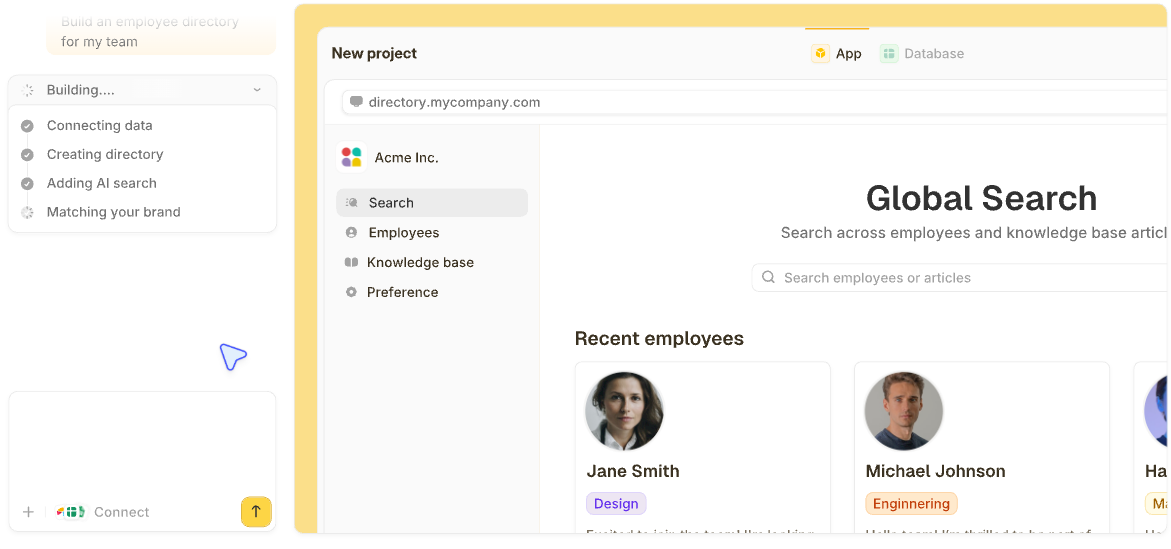
Zite lets you review every workflow, approval chain, and database connection through a visual flowchart, so you never have to touch code. Describe what you need in plain language, and Zite builds the full application.
The key difference is what Zite builds. While Replit and Bolt generate code that you then need to refine and ship, Zite delivers a fully functional app with the database, forms, dashboards, workflows, and permissions already wired together.
Zite is built for ops people, support teams, and SMB owners at companies with 10-250 employees. Think customer portals, internal tools, employee dashboards, CRMs, inventory trackers, and scheduling systems. Companies like The Athletic, Bombas, and Domino's already use it.
Permissions and access control are built into the product, not something you bolt on later. Roles, sharing rules, and who-sees-what live alongside the app itself, so you can control access without writing code.
Every plan includes unlimited users and apps with no per-user fees, even on the free tier, and custom domains are built in.
Zite is not the right fit if you are building a consumer app or an MVP for a startup. It is built for teams that need custom apps and internal tools running reliably from day one.
Which tool is easiest for non-technical users?
Zite is the easiest option here for non-technical users because there is no code involved at any stage, from building to editing to publishing.
Replit offers the most hand-holding of the code-based tools. Its Agent asks follow-up questions, suggests features you might want, and fixes problems sequentially. But when the AI can’t solve something, you’re looking at a code editor, a terminal, and a database that needs configuring.
Bolt is fast but assumes technical knowledge. Bolt’s own team recommends learning the basics of coding before you start building. When the AI generates buggy code (which happens), you need to understand the output to troubleshoot it.
Multiple reviewers have described getting “trapped in prompt loops,” endlessly rephrasing requests when Bolt can’t deliver what they want.
Zite skips all of that. You describe the app you need. Zite builds it. There's no code to read, no terminal to open, and no database to set up yourself. If you’ve used Google Sheets and Google Forms, you already have the technical skills Zite requires.
Fillout form users who try Zite are often surprised by how much it can do, since forms are a natural gateway to more complex app building.
Winner: Zite. If you’re not an engineer and don’t want to become one, Zite is the only option here that won’t eventually force you into code.
How does app output quality compare?
Bolt produces the most polished initial UI, but Zite delivers more complete, production-ready business apps out of the box.
Replit’s first output tends to be functional but not the most visually refined. In a YouTube comparison building identical to-do apps, Replit’s interface “probably isn’t as nice as what Bolt gave us initially.” Replit’s strength is iterative improvement.
It walks you through adding features and fixing issues over multiple conversations, so the app gets better with each pass.
Bolt wins on first impressions. The same YouTube test showed Bolt’s output was “much cleaner, visually appealing, everything seems to work.” For simple apps, Bolt delivers a polished result fast. But consistency is a real problem.
The Bubble team noted in their comparison that Bolt sometimes generates “more bugs that require more troubleshooting.” Previews occasionally won’t load. Complex business logic trips it up.
Zite generates the complete app in one go, including the interface, database, workflows, and permissions all wired together.
You will not get a prettier prototype from Zite than from Bolt, but you will get a working business tool with built-in data storage, user access controls, and branding from the start.
That matters when your customers or employees will use what you build.
Winner: It depends on what you need. Bolt for visual prototypes you will hand off to developers. Zite for production business apps your team will use tomorrow.
How do databases and backends compare?
All three tools offer built-in databases, but Zite’s is the only one that requires zero technical setup.
Replit includes a database with every project, but built-in doesn't mean simple. One YouTube reviewer watched Replit spend time configuring and coding the database before anything else happened. And if you ever want to move your app off Replit, you'll need to rebuild the database from scratch.
Bolt uses Supabase as its default database option, though you can connect to other databases too. Either way, it's a separate product with its own pricing.
The free tier caps storage at 500MB (fine for testing, not for production). A production-ready Supabase plan starts at $25/mo. That means your real cost for a Bolt app with a database isn’t $25/mo. It’s at least $50/mo.
Zite includes a built-in no-code database that is ready the moment your app is built. No SQL. No separate accounts. No extra cost.
The free plan supports 5,000 records. Pro bumps that to 100,000 records, and Business gives you 250,000. You can also connect existing tools like Airtable and Google Sheets if you want to keep your data where it already lives.
One caveat: the Airtable integration syncs 1,000 records at a time, which can cause confusion with larger datasets.
Winner: Zite. For non-technical teams, Zite is the only option that just works, with no setup or extra charges.
How fast can you go from idea to live app?
All three platforms support one-click publishing. The real question is, how fast can you go from idea to a live app your team actually uses?
Replit publishes through Google Cloud with a single click. If you build and ship inside Replit, the process is fast.
The friction starts when you want to move your code elsewhere. One YouTube reviewer described a typical workflow: build in Bolt, export to Cursor, ship to Firebase. That is three tools before anything goes live.
Replit avoids that if you stay on their platform, but always-on hosting costs $5-20+/mo on top of your subscription.
Bolt offers one-click publishing with a free .bolt.host domain, plus Netlify integration for custom hosting. But most serious users do not keep their apps on Bolt's hosting.
The typical path is: prototype in Bolt, export the code, refine in a traditional IDE, then go live elsewhere. That workflow adds days (or weeks) between "it looks good in Bolt" and "it is live for our team."
Zite skips the export step entirely. What you build is what goes live. Custom domains are included on Pro and above, and every plan supports unlimited users with no per-user fees.
Version control lets you restore previous versions if something goes wrong. There is no second tool, no code to transfer, no hosting to configure separately.
Winner: Zite. Fastest path from "I need this app" to "my team is using it."
How does pricing really work?
Replit and Bolt both advertise low starting prices, but hidden costs push real expenses much higher. Zite offers the most predictable pricing of the three, regardless of what you're building.
Replit pricing
- Starter: Free (public projects only, limited AI Agent trial)
- Core: $20/mo, billed monthly
- Pro: $100/mo, billed monthly (up to 15 builders, credit rollover, priority support)
- Enterprise: Custom pricing (SSO, SAML, advanced privacy controls)
Source: replit.com/pricing
The sticker price looks reasonable. The reality is different. Replit uses an effort-based pricing model where you’re charged based on how much work the AI Agent performs. Active builders report spending $100–300/mo beyond their base subscription.
Credits do not roll over on Core plans. Always-on hosting, database usage, and autoscale charges stack up fast.
The community pushed back hard when Replit introduced effort-based billing in 2025. Users reported getting charged for AI mistakes and failed attempts. One reviewer described spending $1.15 for the Agent to suggest a method that doesn’t exist.
Bolt pricing
- Free: 1M tokens/mo (300K daily cap), Bolt branding on sites
- Pro: $$25/mo billed monthly (10M tokens, no daily limit, token rollover, custom domains)
- Teams: $30/member/mo (everything in Pro plus collaboration features)
- Enterprise: Custom pricing
Source: bolt.new/pricing
Bolt’s token system is equally unpredictable. Every prompt, response, and code generation eats tokens. Users have reported burning through 10M tokens in about 3 days of normal development. One Trustpilot reviewer spent $25 worth of tokens in just a few hours, making “simple, limited language edits.”
Add Supabase for your database ($25/mo minimum), and your real baseline for a production Bolt app doubles to $50/mo. Bolt hasn’t published clear overage policies, so you won’t know what happens when your tokens run out until it happens.
Zite pricing
- Free: $0 (limited credits, 5,000 database records, unlimited users and apps)
- Pro: $19/mo, billed monthly (100 credits/mo, 100,000 records, 1 custom domain, remove branding)
- Business: $69/mo, billed monthly (200 credits/mo, 250,000 records, unlimited custom domains, advanced AI models)
- Team / Enterprise: Custom pricing (higher limits, bundled access, priority support, advanced security)
Source: zite.com/pricing
What sets Zite apart isn’t the lowest price point. It’s the most predictable total cost. The database is included on every plan. There are no per-user fees, even on the free tier. Visual edits are free (they don’t consume credits), and fixing AI errors doesn’t cost you credits either. You won’t get a surprise bill because the AI made a mistake and charged you for it.
The cheapest plan doesn’t matter if hidden costs triple your bill.
Winner: Zite. Most predictable total cost of ownership for business teams.
Which tool offers better security and access control?
Zite leads with built-in access control that comes with the product, so you can decide who sees what without writing a single line of code.
Replit is SOC 2 compliant at the platform level. But app-specific security (user permissions, data access rules, and encryption inside your app) must be coded manually. Enterprise plans add SSO and advanced controls, but that is custom pricing you will need to negotiate.
Bolt offers pre-launch scanning and secure-by-default settings. Data encryption is included in managed hosting and database services. Permissions and roles inside the app you build are still your job to wire up.
Enterprise SSO and audit logs are available, but only on custom-priced Enterprise plans, with no published compliance certifications for standard plans.
Zite ships with permissions, roles, and sharing rules built in. You decide who can view, edit, or comment on each part of an app, and the rules live alongside the app itself rather than buried in code you have to manage.
That matters most for customer-facing portals where access has to be tight by default. Your customers' data flows through the apps you build, and Zite treats that as a setting rather than a coding project.
For teams that need it, Zite is also SOC 2 Type II compliant with SSO and audit logs available on higher-tier plans for security review requirements.
Winner: Zite. The only option here where access control is built in instead of something you write code for.
What do real users say?
Here’s what actual users are saying across G2, Reddit, Trustpilot, Capterra, and YouTube reviews.
Replit
What users love:
- “I can come up with an idea and tell Replit in plain English what I want, and it builds it for me” (Capterra review)
- Strong for learning and rapid prototyping
- The all-in-one environment means no jumping between tools
What users struggle with:
- “I’m finding Replit AI unreliable for multi-file refactors and dependency changes, where it tends to modify unintended files, break builds, and loop through expensive fix attempts.” (Capterra review)
- Effort-based pricing causes unpredictable monthly bills
- Users report the Agent getting stuck in loops and charging for failed attempts
Bolt
What users love:
- Fast initial prototype generation with clean UIs
- 5M+ users and $40M ARR show strong market adoption
- The v2 update lets Bolt plan, fix, and improve apps on its own
What users struggle with:
- Token consumption is hard to predict (10M tokens gone in 3 days)
- Inconsistent output on complex projects
- “I've literally lost thousands on their hosting outages. We make marketing sales pages and host them on Bolt. Several times in the middle of a $10,000 campaign, the site just crashes, and you cannot get a hold of anyone.” (Trustpilot review)
Zite
What users love:
- Fillout form users are often surprised by the app-building capabilities.
- The simple, uncluttered UI is a major selling point.
- AI generates the full app, including the database and permissions, so non-coders can actually own what they build.
What users should know:
- Newer product compared to Replit and Bolt.
- Airtable integration is limited to 1,000 records at a time.
- Not designed for consumer apps or SaaS startups.
Which tool should you choose?
The right tool depends on who you are and what you’re building.
Choose Replit if you:
- Are a developer (or want to learn to code)
- Need a full IDE with 50+ language support
- Want to stay in one platform from code to publishing.
- Are building complex, multi-language projects
Choose Bolt if you:
- Are a developer who needs fast frontend prototypes
- Plan to export code to another IDE (like Cursor or VS Code) for production
- Are building MVPs or hackathon projects
- Don’t mind managing token budgets and separate database costs
Choose Zite if you:
- Are an ops person, support team lead, or SMB owner
- Need production-ready business apps (portals, CRMs, dashboards, internal tools)
- Want a built-in database without SQL or separate services
- Need SOC 2 compliance and enterprise security out of the box
- Want predictable pricing with unlimited users on every plan
My final verdict
For the Replit vs Bolt question specifically: Replit is the stronger all-around development platform. Bolt is faster for prototypes, but Replit offers a more complete environment for developers who want to build, iterate, and ship in one place.
But if you’re a non-technical team trying to build business apps? Neither Replit nor Bolt is built for you. Both will eventually leave you staring at code you didn’t ask for.
Zite wins for business teams because it skips the steps Replit and Bolt still require. No exporting code. No configuring databases.
No troubleshooting generated code you don’t understand. You describe what you need, and Zite builds a production-ready app with a database, hosting, and security included.
Ready to try Zite?
Zite lets you build production-ready business apps by describing what you need. No code, no database setup, no surprise bills. Every plan includes unlimited users.
Frequently asked questions
Is Replit or Bolt better for beginners?
Replit guides beginners more effectively. Its Agent asks follow-up questions and fixes problems one at a time. Bolt generates faster initial output, but expects you to troubleshoot code when things break. Neither tool removes the need for some technical knowledge.
Can you build production apps with Bolt?
Bolt works well for prototypes and MVPs. Most users move to a traditional IDE for production-level work because token costs and inconsistent output quality make Bolt less reliable for apps that need to run 24/7.
How much does Replit cost per month?
Replit's Core plan starts at $20/mo ($18/mo billed annually), but real costs depend on AI Agent usage, hosting, and database storage. Active builders report spending $100-300/mo beyond their base subscription. The Pro plan costs $100/mo for up to 15 team members.
What is Zite best used for?
Zite builds business applications like customer portals, internal tools, CRMs, dashboards, and inventory trackers. It works best for non-technical teams at companies with 10-250 employees who need production-ready apps without writing code.
Can Zite replace Airtable?
Zite handles many Airtable use cases, especially when you need a custom app interface on top of your data. It connects directly to Airtable and Google Sheets, so you can keep your existing data while building better tools on top of it. The Airtable integration syncs 1,000 records at a time.