

Stacker pivoted to an AI-first client portal builder, and pricing now ranges from $12/mo (Personal) to $249/mo (Pro), with customer counts capped at each tier. Here is what each plan includes, where the limits hit, and how it compares to a broader alternative.
Stacker Pricing at a Glance
Stacker is now a single product at stacker.ai (stackerhq.com redirects to the same place). The pitch is that you describe the portal you need in a sentence or two, and Stacker's AI builds it. Pricing is based on AI and cloud credits, as well as the number of customers using your portal.
Stacker App Builder Pricing
Annual billing saves 20% or more on every self-serve tier. Stacker does not offer a permanent free plan, but you can try any plan for 30 days free, and there is a 30-day money-back guarantee on all paid plans.
Stacker Plans Explained
These are Stacker's self-serve plans for building AI-generated client portals.
Personal Plan ($12/mo)
The Personal plan is the lowest entry point. It includes 25 AI credits per month, 100 cloud credits, up to 20 customers on your portal, 1 admin user, and Stacker branding on your portal. Support is through the community only.
Best for: Solo operators testing the platform or running a small portal for a handful of clients.
Pros:
- Lowest entry point at $12/mo.
- Enough AI credits to build a first portal and iterate on it.
- Up to 20 customers is workable for very small service businesses.
Cons:
- Stacker branding stays on your portal, which can undermine credibility for client-facing use.
- 25 AI credits per month is tight once you start iterating.
- Community support only, with no direct response path when something breaks.
Starter Plan ($65/mo)
Starter unlocks 100 AI credits per month, 1,000 cloud credits, up to 100 customers, custom branding (Stacker branding removed), data integrations, and email support.
Best for: Small service businesses running a single client portal that needs to look professional.
Pros:
- Branding removed, so the portal looks like yours.
- Data integrations are included at this tier, not gated to higher plans.
- 100 customer cap fits most small service operations.
Cons:
- The jump from $12 to $65 is over 5x, largely to remove Stacker branding.
- 100 AI credits are still modest for a team that iterates heavily.
- Custom domain is not included (that requires Plus).
Plus Plan ($129/mo)
Plus includes 250 AI credits per month, 2,500 cloud credits, up to 200 customers, a custom domain, on-demand credit top-ups, and chat plus email support. Workflows are listed as "coming soon."
Best for: Growing teams that need a branded portal on their own domain.
Pros:
- Custom domain means the portal URL looks like yours, not stacker.ai/yourcompany.
- Credit top-ups let you buy more AI credits mid-cycle if you are iterating heavily.
- 250 customers work for mid-sized service operations.
Cons:
- Workflows are marked "coming soon," so this tier is not yet the full feature set that it eventually will be.
- 200 customer cap is still a ceiling for larger service businesses.
- No white labeling, which is reserved for Pro.
Pro Plan ($249/mo)
Pro includes 1,000 AI credits per month, 10,000 cloud credits, up to 1,000 customers, full white labeling, backup and restore, and priority support.
Best for: Agencies and established service businesses running a high-volume portal for many customers.
Pros:
- Full white labeling means the portal can look like it was built in-house.
- 1,000 customers cover most non-enterprise use cases.
- Priority support is included.
Cons:
- $249/mo is a significant commitment for small teams.
- If you need more than 1,000 customers, you are prompted to upgrade to custom Business pricing.
Business Plan (Custom pricing)
Business is Stacker's enterprise tier with custom pricing. It adds single sign-on, audit trail, "bring your own LLM" support, a dedicated customer success manager, and custom AI credit and user allocations.
Best for: Large organizations with security review requirements or that want to use their own large language model.
Pros:
- SSO and audit trail cover the standard enterprise checklist.
- "Bring your own LLM" is unusual for portal builders and may matter for teams with data-handling requirements.
- Dedicated CSM for implementation support.
Cons:
- No public pricing, so budgeting requires a sales conversation.
- Likely overkill for teams that just need more customers or more AI credits.
What Are AI Credits and Cloud Credits?
Stacker's pricing is based on two types of credits. AI credits are consumed when you use Stacker's AI to build or change your portal, such as generating new pages, editing layouts, or updating logic. Cloud credits are consumed when your portal runs, covering hosting and computing behind the scenes.
The pricing page does not publish exact credit costs per action, which makes it hard to predict monthly usage before you commit. A simple page generation might use a few AI credits, while a complex multi-page build could use significantly more. If you are evaluating Stacker, use the 30-day trial to track your actual credit consumption before choosing a plan.
On the Plus tier and above, you can buy on-demand credit top-ups if you run out mid-cycle. Lower tiers do not have this option, so you either wait for the next cycle or upgrade.
Which Stacker Plan Should You Choose?
Choose Personal ($12/mo) if you:
- Run a small service business with fewer than 20 clients.
- Do not mind Stacker branding on the portal.
- Mostly need a single, simple portal for testing.
Choose Starter ($65/mo) if you:
- Need up to 100 customers on a branded portal.
- Run client work where the portal reflects your brand, not Stacker's.
- Want data integrations without jumping to Plus.
Choose Plus ($129/mo) if you:
- Need a custom domain for your portal.
- Work with up to 200 customers.
- Expect to iterate enough that on-demand credit top-ups matter.
Choose Pro ($249/mo) if you:
- Run a portal for up to 1,000 customers.
- Need full white labeling and backup/restore.
- Want priority support for production use.
Choose Business if you:
- Need SSO, audit logs, or a custom LLM.
- Require a dedicated account manager.
- Have customer counts or AI credit needs that exceed Pro.
Stacker Hidden Costs and Limitations
Stacker's pricing page looks clean, but a few structural details are worth knowing before you commit. Here are the ones that are not obvious.
- Pricing is gated by customer count, not features. Every tier is tied to a hard customer cap (20, 100, 200, or 1,000). If your portal has 105 customers, you are on Plus, whether you need Plus features or not. Teams with fluctuating customer counts need to build headroom into their plan choice.
- Customization is chat-only, with no visual builder. Stacker's own FAQ confirms there is no drag-and-drop designer. Every change to the portal, whether colors, layouts, or new pages, happens by describing the change to the AI. Teams that prefer a visual editor will not find one here.
- The underlying output is React and TypeScript code. Every Stacker portal is real code under the hood. For non-technical teams, this means that when something does not look or work right, you are limited to what you can describe to the AI. If the AI cannot fix it, a developer has to read and edit the code directly.
- AI credits and cloud credits are separate meters. You can run out of one without running out of the other. Teams that iterate heavily on design will burn through AI credits fast, while teams with high-traffic portals will burn through cloud credits. Both need to be monitored.
- No permanent free plan. The 30-day free trial and 30-day money-back guarantee are generous, but unlike platforms with a free tier, you cannot stay free indefinitely.
- Web portals only, no mobile. Stacker builds responsive web portals that work on mobile browsers, but there is no native iOS or Android app output.
- Branding removal happens at Starter. The $12 Personal tier shows Stacker branding on your portal. For client-facing work, that typically means upgrading to Starter at $65/mo just for branding control.
Is Stacker Worth It?
Stacker delivers real value in a few places:
- AI-built portals in minutes. Describing a portal in plain language and getting a working result in seconds is a genuine shift compared to traditional drag-and-drop portal builders. For small service businesses, this can compress a multi-day setup into an afternoon.
- Purpose-built for client portals. Stacker is focused on one thing, and that focus shows in the generated output. Service businesses in home services, real estate, legal, and marketing (Stacker's listed solution areas) get templates and flows that match their use case.
- Enterprise features at Business. SSO, audit trails, and "bring your own LLM" are unusual in this category and are covered in most enterprise security reviews.
Where it falls short:
- Narrow product scope. Stacker builds client portals. If you also need internal dashboards, CRMs, or operational tools, you will need a different platform for those.
- Customer-count gating. The customer caps (20, 100, 200, 1,000) force tier upgrades even when the feature set on your current plan is fine. Teams with flexible customer counts can find this frustrating.
- No visual editor. Customization happens through chat only. Teams that expect a drag-and-drop builder will be surprised to find there is not one.
- Code output. The generated React and TypeScript are fine for teams with developer access, but can be a wall for ops teams that need to own and change the portal themselves without engineering support.
Stacker is a strong fit for service businesses that want one AI-built client portal and do not need a broader app platform. If you need more than portals or unlimited customers without per-tier caps, other platforms deliver more for less.
Stacker Pricing vs. Zite Pricing: Which Is The Better Value?
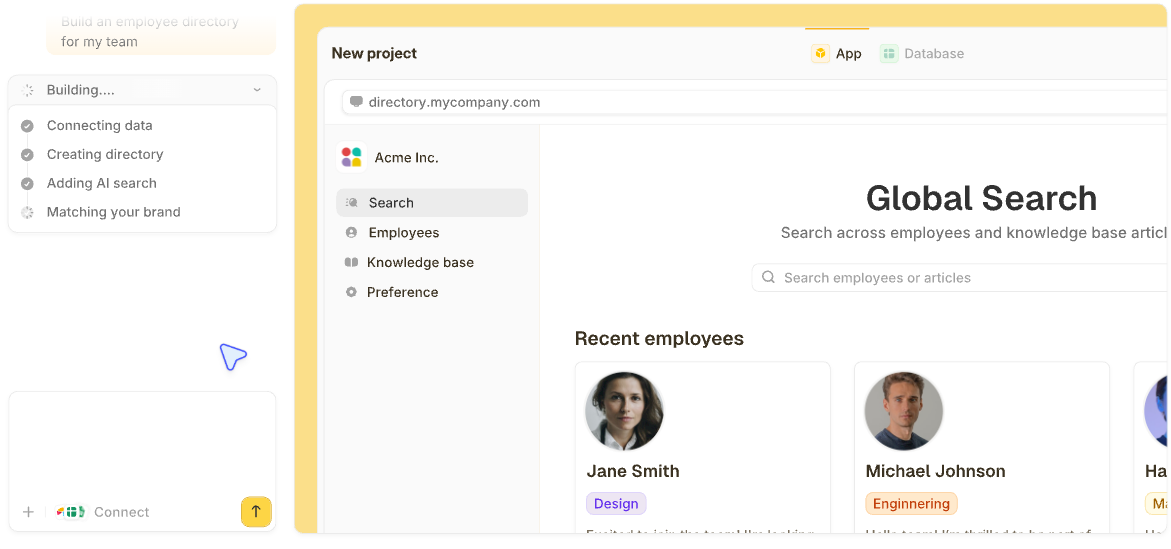
Both Stacker and Zite are AI-first builders that let you describe what you need in plain language. The structural difference is scope. Stacker is a narrow product built for AI-generated client portals, with pricing tied to customer count.
Zite is a broader AI app builder that uses the same describe-what-you-need workflow to produce portals, dashboards, CRMs, internal tools, forms, and more. However, you can have unlimited users on every plan.
Here is how the two compare on pricing and scope:
Zite vs. Stacker: Which Should You Choose?
Zite is better for teams that:
- Need more than a client portal (dashboards, CRMs, internal tools, forms).
- Want unlimited users on every plan, including free, with no customer count caps.
- Prefer to visually inspect and edit their app's logic and data rather than rely on chat-only customization.
- Want to remove platform branding at a lower price point ($19/mo vs $65/mo).
- Want SOC 2 Type II compliance at a flat rate rather than on custom enterprise pricing.
Stacker is better for teams that:
- Only need a client portal and will not expand into other app types.
- Run a service business that fits cleanly into one of Stacker's solution templates (home services, real estate, legal, marketing).
- Do not mind customer-count-based pricing.
- Are comfortable with chat-only customization and code-level editing as the only two paths for changes.
Ready to try Zite?
If you’re curious how Zite works for client portals, the simplest way is to try it yourself. The free plan includes unlimited apps and users, no credit card required.
Frequently Asked Questions
Does Stacker have a free plan?
No. Stacker does not offer a permanent free plan. You can try any plan free for 30 days, and every paid plan includes a 30-day money-back guarantee, but continued use requires a paid subscription after the trial.
What’s the cheapest Stacker plan?
The cheapest Stacker plan is Personal at $12/mo. It includes 25 AI credits per month, 100 cloud credits, up to 20 customers on your portal, 1 admin user, and Stacker branding. For most client-facing use, teams move up to Starter at $65/mo to remove Stacker branding.
How does Stacker pricing actually work?
Stacker pricing runs on three caps. Customer count is capped at 20, 100, 200, or 1,000 by tier. Monthly AI credits cover building the portal, and monthly cloud credits cover running it. Annual billing saves 20% or more.
Can you build mobile apps with Stacker?
No, Stacker cannot build native mobile apps. It creates responsive web portals that work on mobile browsers, but there is no option to publish to iOS or Android app stores.
What is the difference between Stacker and Zite?
Stacker builds only client portals, with prices capped by customer count (20-1,000 per tier). Zite builds portals, dashboards, CRMs, and internal tools with unlimited users on flat pricing ($19/mo Pro, $69/mo Business). Stacker customizes only through chat; Zite has a visual editor.
Is Stacker good for building client portals?
Yes, Stacker is good at creating client portals; it’s their entire focus. The AI builds from a plain-language description and handles customer sign-in, customer-specific views, and branded access. The main trade-offs are customer-count caps by tier and chat-only customization.