

I tested over a dozen ToolJet alternatives across real projects. These seven held up. The mix splits into developer-leaning low-code tools (Retool, Appsmith, UI Bakery, Budibase) and broader app builders aimed at non-technical teams (Zite, Bubble, Glide).
7 best ToolJet alternatives: at a glance
Pricing correct as of June 2026. Verify with the vendor.
Why look for ToolJet alternatives?
ToolJet is a capable open-source tool for building internal apps. It includes a free self-hosted version, AI-assisted building, and a generous Free tier. For engineering teams shipping internal tools, it’s a legitimate option. The reasons people end up looking for alternatives usually come down to a few specific pain points.
Per-builder pricing climbs fast: ToolJet Cloud’s Pro tier is $99/builder/month, and Team is $249/builder/month. A 5-builder team on Pro pays $495/month, and end-user caps often push teams to higher tiers before their builder count would suggest.
ToolJet expects a developer: Even with the AI app builder, getting real value from ToolJet requires someone who can write JavaScript, configure data sources, and understand database concepts. Non-technical teams that adopted ToolJet hoping the AI would carry them often realize they still need an engineer.
The Starter tier is Cloud-only: Self-hosted users skip directly from Free ($0) to Pro ($99/builder), losing the gentler $24/builder Starter step. This creates a price cliff that pushes teams to either stay on Free longer than they should or commit to Pro before they’re ready.
Smaller community than competitors: ToolJet’s template library, tutorial ecosystem, and community size are smaller than those of Retool or Appsmith. Teams looking for ready-made templates or active forums for troubleshooting sometimes find the gap noticeable.
Which ToolJet alternative should you choose?
- Choose Retool if you’re an engineering team that needs the most mature direct alternative with the broadest integration library.
- Choose Appsmith if you’re a code-first developer team that wants the simplest pricing model.
- Choose UI Bakery if you want strong AI generation with the option to self-host.
- Choose Budibase if you want a simpler open-source builder with action-based pricing starting at $23/month.
- Choose Zite if you’re a non-technical team building business apps and client portals with AI from a prompt.
- Choose Bubble if you’re building a customer-facing app or a SaaS prototype, not an internal tool.
- Choose Glide if you want a fast, mobile-friendly app for spreadsheet data (Glide Tables on Free; Google Sheets on Maker; Airtable on Business).
- Stick with ToolJet if you have many end users and few builders, and you want open-source self-hosting with broad integrations.
1. Retool
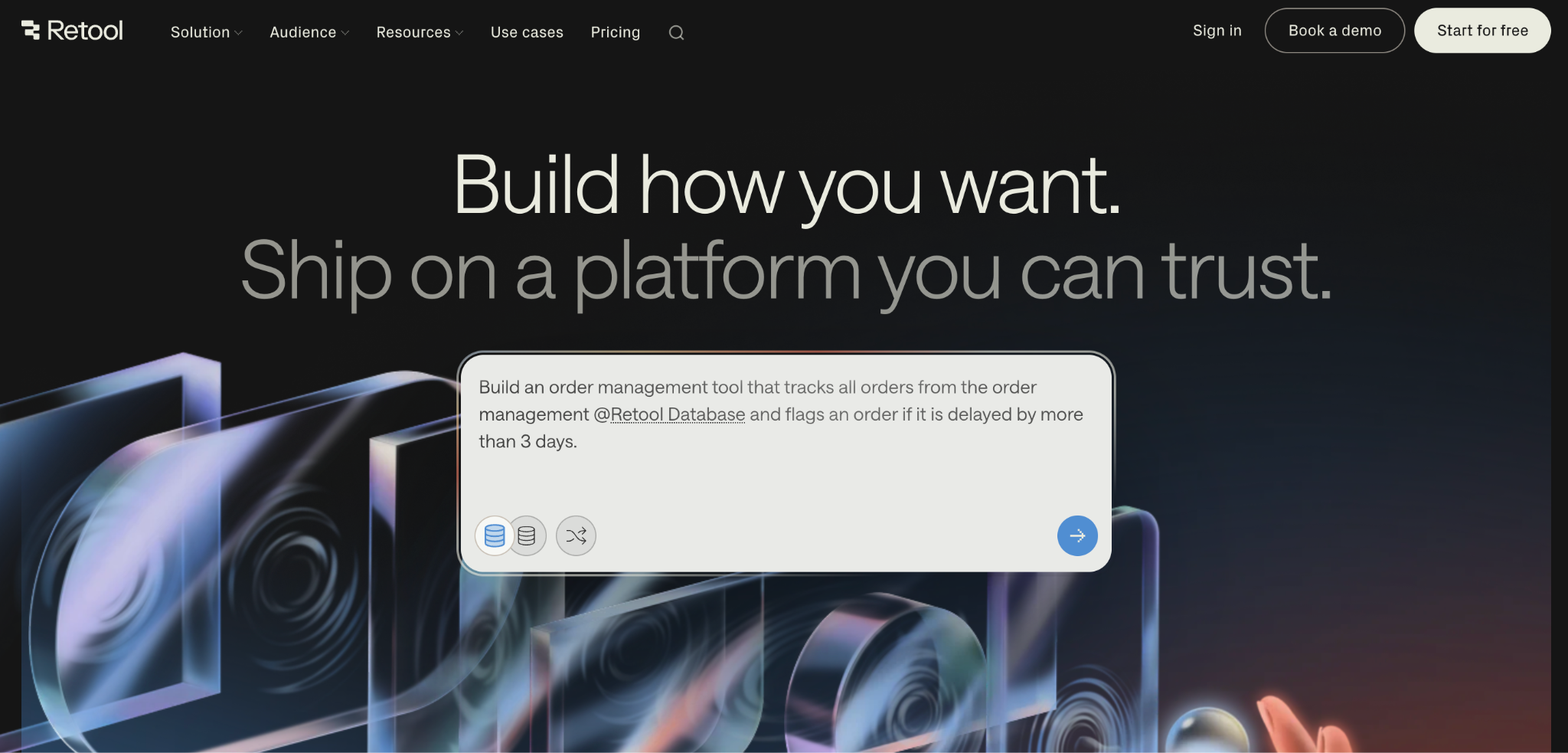
Retool is the most mature direct alternative to ToolJet for engineering teams building internal tools. Used by companies including Brex, DoorDash, and Amazon, Retool has the largest integration library in the low-code category.
The trade-off is pricing: The per-builder + per-internal-user model means costs can climb quickly as your team grows.
Key features
- AI Action and assistant: Generate app drafts and write queries with AI inside the editor.
- 130+ integrations: Wider than ToolJet’s 50+ for connecting to databases, APIs, and SaaS tools.
- Granular permissions: Control access by role, environment, and resource at a fine-grained level.
Pros
- Most mature product in the category with a strong customer base and active development.
- Larger integration library than ToolJet, especially for compliance-heavy data sources.
- Free tier supports up to 5 users with unlimited apps.
Cons
- Per-builder plus per-internal-user pricing makes forecasting hard at scale.
- The self-hosted version requires Business or Enterprise pricing; there's no free self-hosted plan like ToolJet.
Best for
- Engineering teams at scaled startups and mid-market companies.
- Teams that need the broadest integration library available.
- Companies that have outgrown ToolJet’s Pro tier and need more polished governance.
Pricing
Starts free for 5 users. Paid plans use a per-builder ($12/month) plus per-internal-user ($7/month) model on Team. Self-hosting requires Business or Enterprise pricing.
2. Appsmith
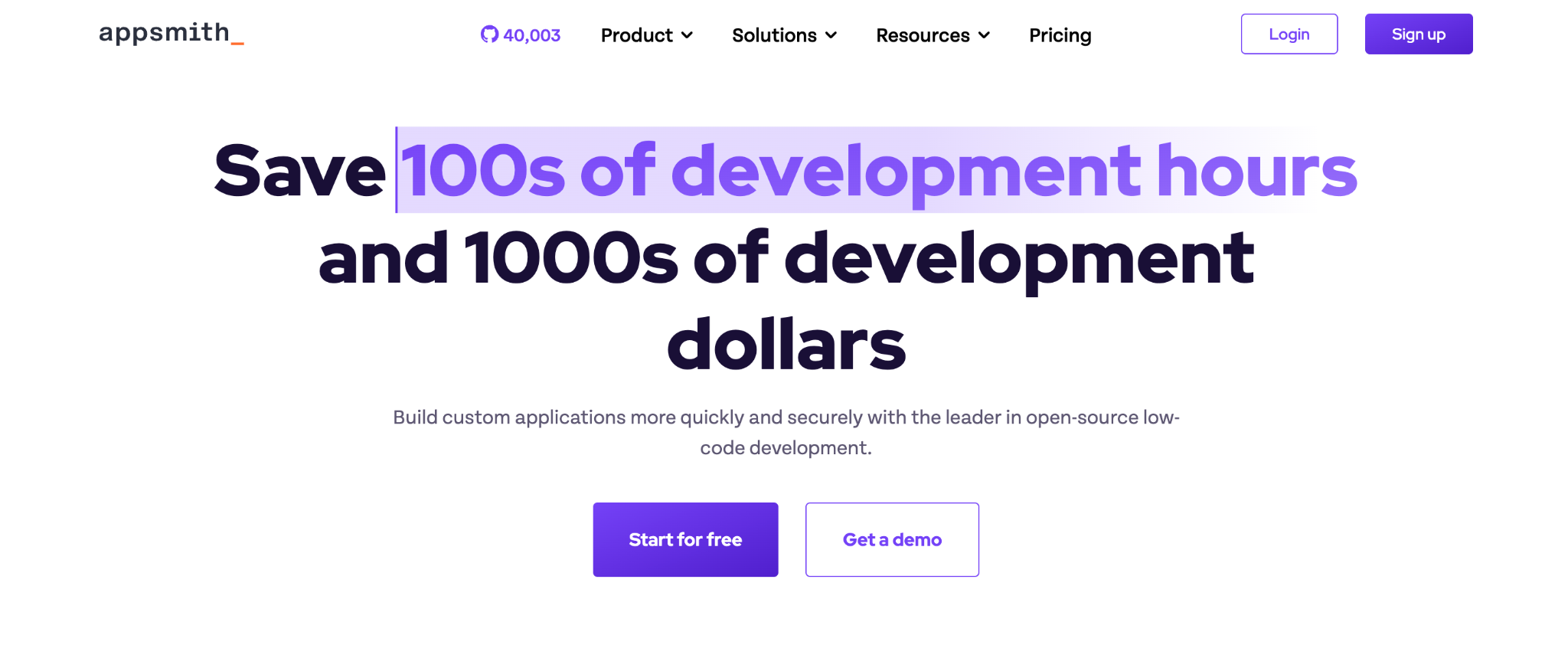
Appsmith is the open-source direct competitor to ToolJet with the simplest pricing model in the category. Where ToolJet uses tiered per-builder pricing with end-user caps, Appsmith charges a flat $15/user/month on Business.
Building leans more on code than ToolJet’s drag-and-drop approach does, which is a win for developers and a hurdle for everyone else.
Key features
- Flat per-user pricing: No builder versus end-user split, $15/user/month for everyone.
- Code-first builder: Write JavaScript inside component properties for deep customization.
- Open source under Apache 2.0: More permissive license than ToolJet’s AGPL for self-hosted use.
Pros
- Simplest pricing model in the category, easy to forecast costs.
- Strong custom logic support through JavaScript bindings everywhere.
- Free cloud tier (up to 5 users) and free self-hosted under open source.
Cons
- Steeper learning curve than ToolJet because code-first means more upfront training.
- Less visual than ToolJet; drag-and-drop fans will prefer ToolJet’s builder.
Best for
- Engineering teams with JavaScript-comfortable developers.
- Teams that want flat per-user pricing for easier forecasting.
- Open-source advocates who prefer the Apache 2.0 license.
Pricing
Starts free for up to 5 users. Business is a flat $15/user/month, the simplest pricing model in the category.
3. UI Bakery
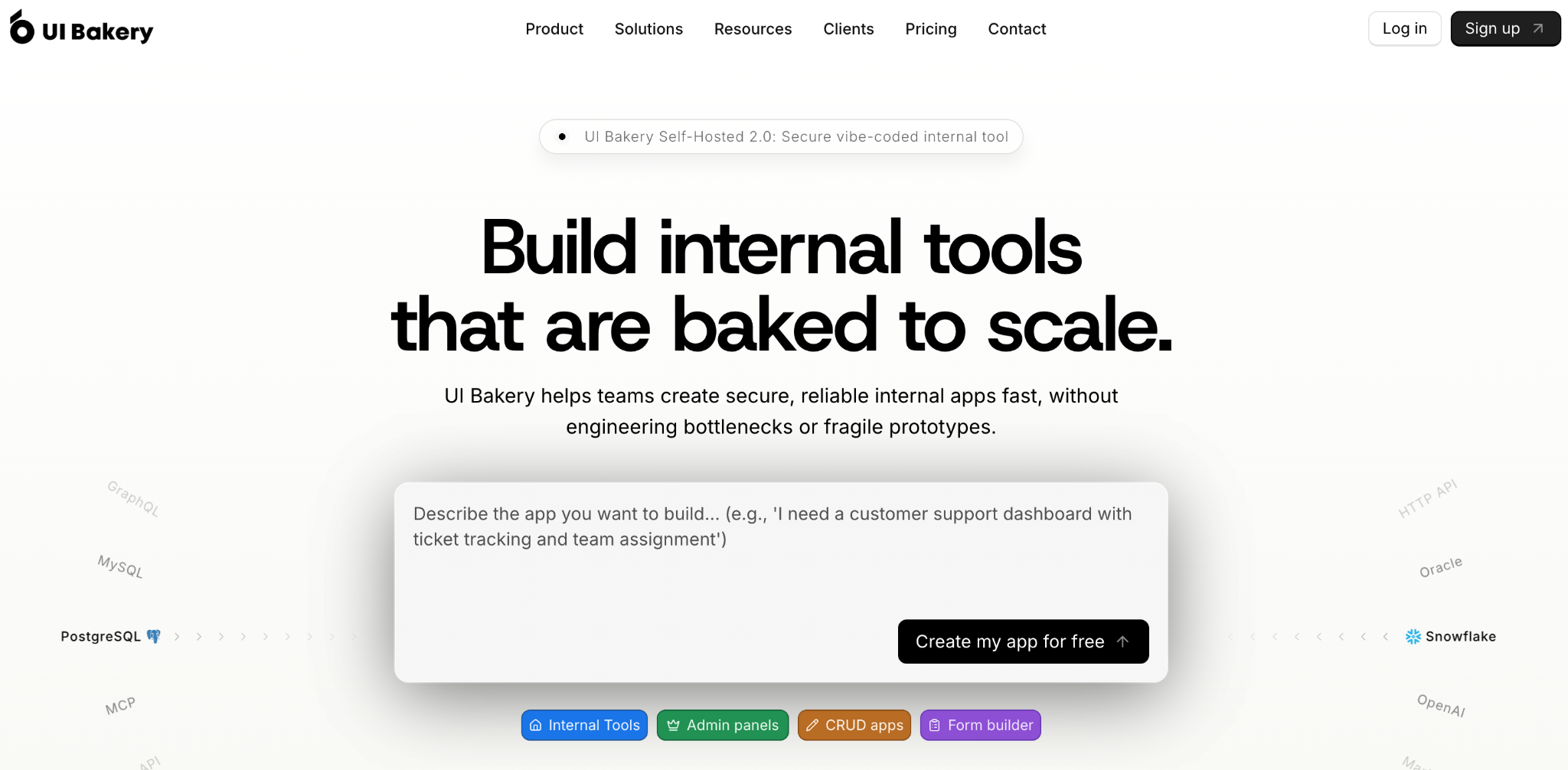
UI Bakery is a direct competitor to ToolJet, with stronger AI generation and per-developer pricing. The AI builder lets you describe what you want, and UI Bakery generates a working app with database, UI, and logic.
Like ToolJet, UI Bakery supports both cloud and self-hosting, targeting teams that need to keep data on their own infrastructure.
Key features
- AI Builder with live build logs: Watch UI Bakery construct components and write code in real time.
- Per-developer pricing: Workspace viewers don’t add cost.
- Cloud and self-hosting: Same product across both deployment options.
Pros
- AI generation produces working apps faster than ToolJet’s first-draft AI.
- Unlimited apps and data sources, even on the Free tier.
- Per-developer pricing means viewers are free, similar to ToolJet’s structure.
Cons
- Smaller community and template library than ToolJet or Retool.
- AI generation can produce complex apps that are harder to edit visually afterward.
Best for
- Teams that want AI to do the heavy lifting on app generation.
- Companies needing self-hosting with stronger AI than ToolJet’s.
- Workspaces with many viewers and few developers.
Pricing
Starts free with unlimited apps and data sources. Builder is $25/user/month for developers; workspace viewers don't add cost.
4. Budibase

Budibase is an open-source low-code tool with action-based pricing starting at $23/month, simpler in scope than ToolJet. The builder focuses more on form-driven business apps than on complex internal tools.
Self-hosting is free, and the visual builder is approachable for less technical developers who’d find Appsmith’s code-first approach too steep.
Key features
- Action-based pricing: Pro at $23/month (5K actions, 1 creator), Premium at $59/month (20K actions), Business at $359/month (250K actions, 3 creators).
- Visual form-driven builder: Faster for simple business apps than ToolJet’s component builder.
- Built-in authentication and permissions: Manage users and roles without writing code.
Pros
- Simpler than ToolJet for straightforward business apps and forms.
- Open-source self-hosting at zero license cost.
- Strong form and database features for non-developer-led tools.
Cons
- Smaller component library than ToolJet for complex dashboards.
- Cloud plans do not have unlimited users, so you’ll pay $6/user/month for everyone who uses the app.
Best for
- Small teams building simple business apps and forms.
- Open-source advocates who want affordable action-based pricing.
- Companies that have outgrown spreadsheets but don’t need ToolJet’s full toolkit.
Pricing
Free to self-host. Cloud Pro starts at $23/month with action-based pricing, plus per-creator and per-end-user add-ons that scale with your team's growth.
5. Zite

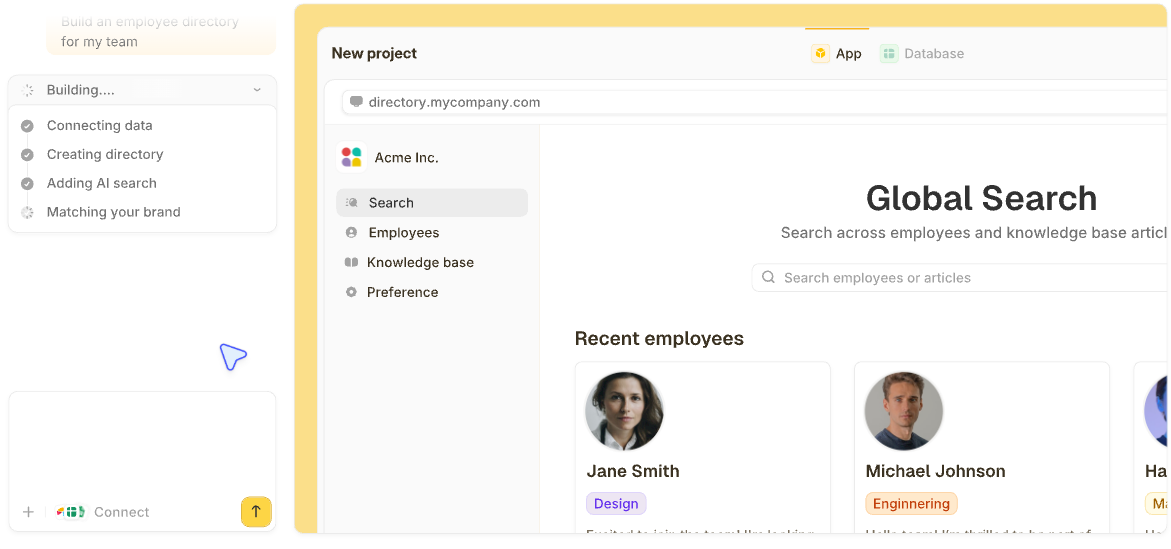
Zite is the AI-native alternative for non-technical teams that looked at ToolJet and realized it expects a developer. Where ToolJet asks you to drag components and write JavaScript, Zite generates the entire app, database, UI, and workflows from a plain-language prompt.
The workflow logic is shown as a flowchart you can inspect to understand exactly what the AI built, and pricing is a single rate with unlimited users on every plan.
Key features
- AI prompt-to-app generation: Describe what you want, and Zite builds it in one pass.
- Real built-in database: Linked records, AI Fields, and room to scale as you grow, that just happens to feel as easy as a spreadsheet.
- Single-rate pricing with unlimited users: $19/month Pro covers your whole team.
Pros
- Non-technical users can build apps without learning a developer interface.
- Visual workflow view shows AI-generated logic as a flowchart you can read and trace.
- Flat pricing means no per-builder or per-end-user math to forecast.
Cons
- Not open-source and not self-hostable; cloud-only.
- Smaller template library than ToolJet or Retool; you’ll often start from scratch.
Best for
- Non-technical teams building business apps from a prompt.
- Companies needing client portals with branded login and role-based access.
- Teams that want predictable flat pricing as their user count grows.
- If you're also weighing Airtable, Lovable, Base44, or Replit, Zite has side-by-side comparison pages for each.
Pricing
Free with limited AI credits and unlimited users. Pro is $19/month; every plan includes unlimited users across all tiers.
6. Bubble
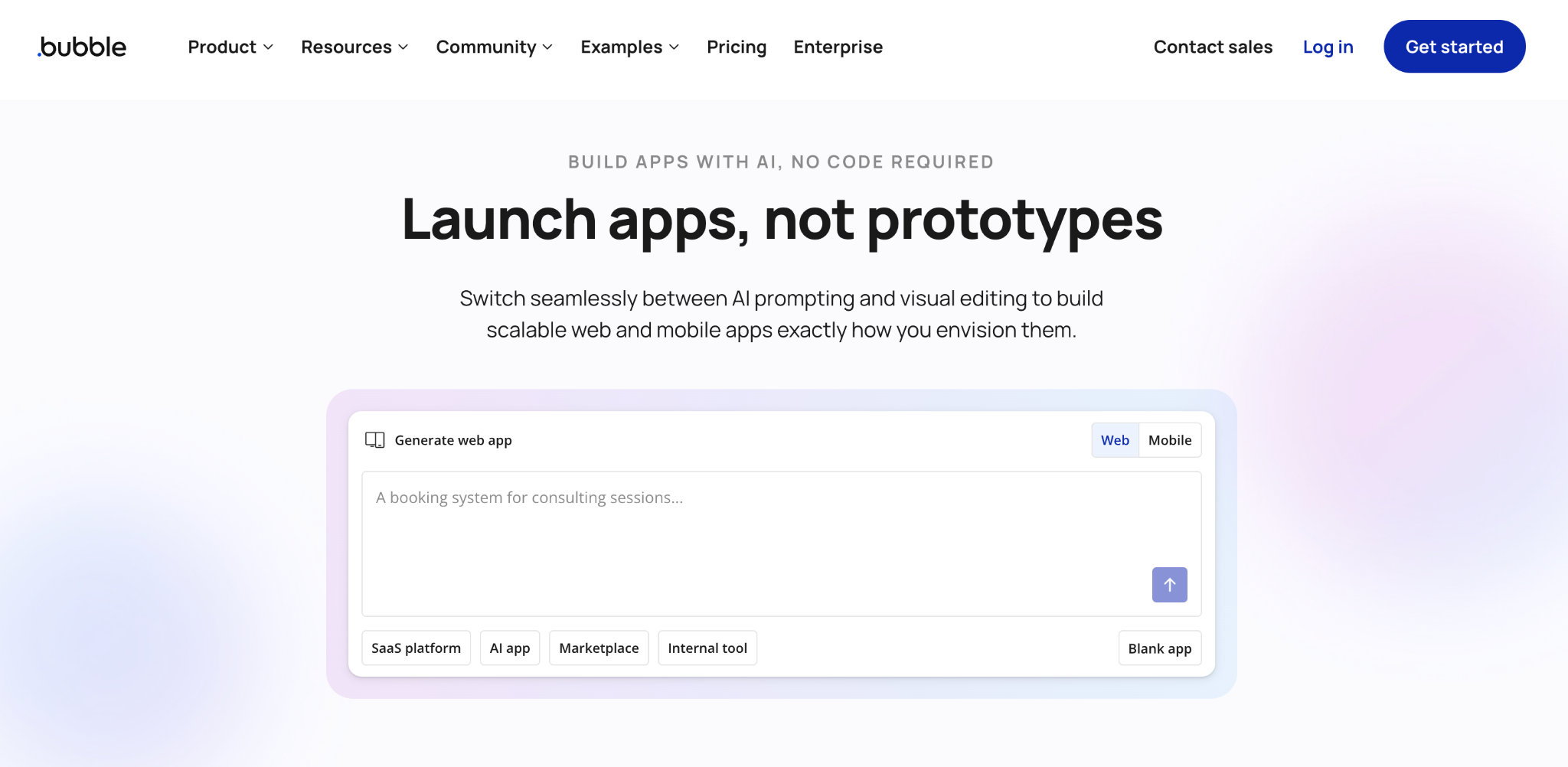
Bubble is a broader no-code app builder that covers full SaaS apps and prototypes, not internal tools. While ToolJet focuses on internal dashboards, Bubble lets you build customer-facing apps with their own users, authentication, and payment processing.
The trade-off: a steeper learning curve and pricing that splits across three platform types (Web & Mobile, Web only, Mobile only), each with different price points and workload unit allowances.
Key features
- Full app building beyond internal tools: Custom user authentication, payments, and external apps.
- Platform-split pricing: Separate tiers for Web & Mobile ($69/month Starter), Web-only ($32/month), and Mobile-only ($49/month).
- Marketplace of plugins: Add functionality from third-party developers.
Pros
- Builds true customer-facing apps, not internal dashboards.
- Large community and template library for learning.
- Strong for building SaaS prototypes and MVPs.
Cons
- Steeper learning curve than ToolJet; Bubble’s logic editor takes weeks to master.
- Workload unit allowances vary by tier (50K on Free, up to 500K on Team), and overages can lead to unpredictable costs as your app scales.
Best for
- Founders building SaaS MVPs and customer-facing apps.
- Teams that need an external-facing product.
- Companies willing to invest in learning Bubble’s logic system.
Pricing
Starts free. Paid plans are split across three platform types (Web & Mobile, Web only, Mobile only), starting at $32/month for Web only. Workload-unit allowances vary by tier.
7. Glide

Glide is the spreadsheet-to-app tool that turns Glide Tables (Google Sheets on Maker, Airtable on Business) into mobile-friendly apps in minutes. Where ToolJet expects you to build component by component, Glide reads your existing data and generates a working app you can customize visually.
The simplicity is the appeal and the limitation. Glide handles simple use cases well but lacks the depth of ToolJet for complex internal tools.
Key features
- Spreadsheet-driven: Built on Glide Tables. Google Sheets connects on the Maker plan ($60/month), and Airtable connects on Business.
- Mobile-first design: Apps work great on phones without extra configuration.
- AI Tables: Glide’s database with AI columns for data enrichment.
Pros
- Fastest setup of any tool on this list, minutes to first working app.
- Strong mobile UX without separate mobile development.
- Business users can build without IT involvement.
Cons
- Limited customization compared to ToolJet; you’re working within Glide’s templates.
- Pricing scales with app usage (Updates and rows), not user count.
Best for
- Operations teams turning Google Sheets into team apps.
- Field service or sales teams needing simple mobile apps.
- Companies prioritizing speed-to-launch over deep customization.
Pricing
Starts free for one app with limited updates and rows. Paid plans unlock more updates, larger teams, and broader data source options.
How to evaluate ToolJet alternatives
Here’s the framework I’d use to narrow down the seven options above:
- Who’s building the app? If your team has a developer, look at Retool, Appsmith, UI Bakery, or Budibase. If you’re non-technical, Zite or Glide is a much better starting point.
- What’s your end-user count? Per-builder pricing tools get expensive fast when there are many app users. Flat per-user tools (Appsmith) and flat per-month tools (Zite) get more predictable as you scale.
- Do you need self-hosting? ToolJet, Appsmith, Budibase, and UI Bakery all offer self-hosted versions. Retool’s self-host requires Business pricing. Zite and Glide are cloud-only.
- How fast do you need to ship? AI-native tools (Zite, UI Bakery, Glide) get you to a working app fastest. Component-based builders (Retool, ToolJet, Appsmith) require more time to build but offer greater control.
- Internal tools or customer-facing apps? Most ToolJet alternatives focus on internal tools. If you need a customer-facing app or portal, Zite (for business apps) or Bubble (for full SaaS apps) is the better starting point.
The ToolJet alternative that fits how your team actually builds
Most ToolJet alternatives target the same developer audience that ToolJet does. Retool, Appsmith, UI Bakery, and Budibase are all worth considering if you have an engineer who’ll write JavaScript and configure data sources. They’re not worth considering if you don’t.
For non-technical teams, Zite handles the AI prompt-to-app workflow that ToolJet and most of its direct alternatives don’t. You describe what you want, see the database and workflow logic that gets built, and ship without writing code. The flat $19/month pricing means no per-builder math to forecast.
Start building with Zite if your team is non-technical and needs an app or portal.
Frequently asked questions
What is the best alternative to ToolJet?
The best alternative to ToolJet depends on your team. For engineering teams, Retool is the most mature option. For non-technical teams, Zite handles the AI prompt-to-app workflow with flat pricing. For simple per-user pricing, Appsmith offers a $15/user/month flat rate.
Is Retool better than ToolJet?
Retool is better than ToolJet for engineering teams that need the broadest integration library and the most mature product. ToolJet is better for teams that want open-source self-hosting at zero license cost.
Is there a free alternative to ToolJet?
Yes, several ToolJet alternatives have permanent free tiers. Appsmith, Budibase, and UI Bakery all offer free cloud tiers, and Budibase and UI Bakery are free under an open-source license for self-hosting. Zite has a free plan with limited AI credits and unlimited users.
What’s the cheapest ToolJet alternative?
The cheapest ToolJet alternative for teams of any size is Zite at $19/month for Pro with unlimited users and no per-seat fees. The cheapest per-user option is Appsmith at $15/user/month on the Business plan.
Is ToolJet open source?
Yes, ToolJet is open source under the AGPL license. The Self-Hosted Free tier runs on your infrastructure with all core features. Open-source alternatives include Appsmith (Apache 2.0), Budibase, and UI Bakery, all available on self-hosted plans.
What is ToolJet used for?
ToolJet is used to build internal tools, dashboards, and business apps using low-code components. Teams that need customer-facing apps or portals typically look to Zite or Bubble, since ToolJet is optimized for internal use.