

ToolJet and Appsmith are open-source low-code platforms that both target internal tools like dashboards, admin panels, and CRUD apps. The choice between them turns on pricing and how much code you want to write; non-technical teams running the same use cases should look at Zite instead.
ToolJet vs Appsmith vs Zite: at a glance
Meet the contenders
ToolJet: visual low-code builder for developers
ToolJet is an open-source low-code tool for building internal apps, dashboards, and workflows. The builder uses drag-and-drop components plus JavaScript and Python support for custom logic. It also connects to 50+ data sources including PostgreSQL, REST APIs, and major databases.
ToolJet recently added AI app generation alongside the traditional builder. The product is hosted (ToolJet Cloud) or self-hostable under an open-source license. Pricing on Cloud uses a per-builder model with end-user caps that scale by tier.
Appsmith: code-first open-source low-code
Appsmith is also open-source and self-hostable, but the building experience leans more on code than ToolJet’s visual builder. You'll write JavaScript inside fields and bind data using a query and reference syntax that takes longer to learn but gives you more control once you do.
Appsmith pricing is the simplest of the three: a single rate of $15/user/month on Business, with no separate builder-versus-end-user tiers. The free tier is permanent for up to 5 cloud users.
Zite: AI-powered no-code app builder
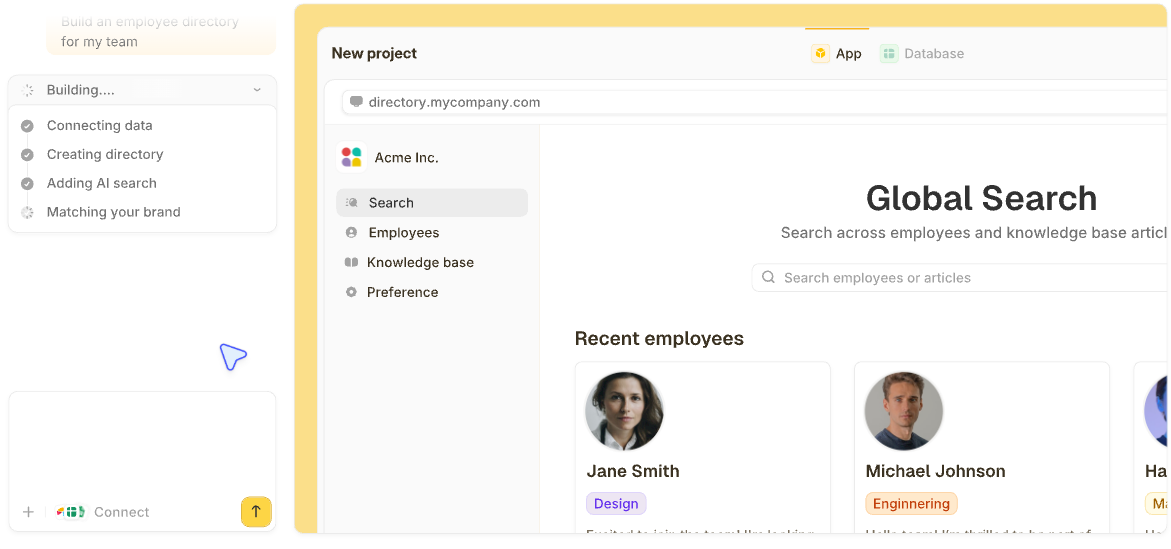
Zite is the newest of the three and works differently. Instead of dropping you into a builder, Zite generates apps from a plain-language prompt, then lays out the database, workflows, and access rules visibly so you can see and refine what it built by prompting.
The product targets non-technical users (operations teams, support managers, SMB owners) who want to build business apps without learning a developer tool. The built-in database has a spreadsheet feel; the workflow editor shows AI-generated logic as a flowchart you can inspect; and pricing is flat, with unlimited users on every plan.
ToolJet vs Appsmith vs Zite: feature breakdown
Building experience and learning curve
ToolJet: Drag-and-drop visual builder with components for tables, buttons, forms, charts, and more. AI app generation is built in for first drafts; then you refine visually. The learning curve is moderate.
Appsmith: Code-first approach where you write JavaScript inside component properties and bind data through a query syntax. More flexible than ToolJet for complex custom logic, but takes longer to learn.
Zite: Describe the app you want, and Zite generates it. The AI builds the database, UI, and workflow logic in one pass. Because the workflows and database stay visible, the same non-technical person can understand and maintain the app afterward, not just generate it once.
The workflow logic shows as an inspectable flowchart, and the database is right there, so nothing is a black box.
Winner: Zite for non-technical users, ToolJet for developers who want visual building, Appsmith for developers who prefer code flexibility.
Database and data handling
ToolJet: ToolJet Database is built on PostgreSQL, giving you a real relational database without setup. Also connects to 50+ external data sources, including PostgreSQL, MySQL, Cloud Firestore, Redis, REST APIs, and major SaaS tools.
Appsmith: No first-party database. Strong at connecting to existing databases through queries (PostgreSQL, MySQL, MongoDB, REST APIs, and GraphQL endpoints). Best for teams that already have data stored elsewhere.
Zite: Built-in database with tables and fields that look like a clean spreadsheet but behave like a real database underneath. AI Fields can enrich records and search the web. Native integrations include Airtable, Google Sheets, and Slack.
Winner: ToolJet for the built-in PostgreSQL with broad external connections, Zite for non-technical ease of use, Appsmith for teams with existing data sources.
Pricing model and predictability
ToolJet: Per-builder pricing with end-user caps at each tier. Starter is $24/builder/month with 50 end users, Pro is $99/builder/month with 100 end users, and Team is $249/builder/month with unlimited end users.
Appsmith: Flat $15/user/month on Business. Every user counts the same. Enterprise is $2,500/month for 100 users with advanced features. Simpler than ToolJet but more expensive than Zite at scale.
Zite: A single rate with unlimited users across all plans. Pro is $19/month total; Business is $69/month total. The same plan costs the same whether you have 5 users or 500.
Winner: Zite for single-rate, unlimited pricing; Appsmith for the simplest per-user model when teams are small; ToolJet for teams with many end users and few builders.
Open source and self-hosting
ToolJet: Fully open source under the AGPL license. The Self-Hosted Free tier runs on your own infrastructure with all core features. Paid Self-Hosted tiers add version control (Pro) and SSO (Team).
Appsmith: Fully open source under the Apache 2.0 license. Self-hostable on Docker, Kubernetes, or various cloud providers. The Free tier on Self-Hosted offers unlimited apps and workspaces.
Zite: Not open source. Hosted only on Zite’s infrastructure. Teams that need data fully inside their own environment will need one of the other two.
Winner: ToolJet and Appsmith (tie) for teams that need open source or self-hosting. Zite is hosted-only by design.
What real users say
Reviews and discussion pulled from G2, Capterra, and Reddit communities.
ToolJet
Pros from users:
- “ToolJet simplifies the process of creating internal tools, eliminating the need for extensive engineering effort.” Himanshu B, G2
- “I like how easy it is to connect to different data sources and build screens using drag-and-drop components.” Rahul Kumar T, G2
- “I like that ToolJet is a low-code internal tool builder.” Francess A, G2
Cons from users:
- “I experience performance slowdowns when working with heavy pages, which can be frustrating because it affects the overall efficiency of my tasks.” Chandani V, G2
- “Some features of ToolJet still feel limited.” Mohit R, G2
- “Performance can be inconsistent, especially with large datasets or complex queries.” Mariam B, G2
Appsmith
Pros from users:
- “I appreciate how Appsmith caters well to business users, making it a valuable tool in a professional setting.” Obed N, G2
- “Its user interface is smooth and easy to navigate, where most details are accessible [on] a single page.” Verified User, G2
- “In Appsmith, I don't need to write any code for design; I can simply focus on the functionality for my application.” Ritankar D, G2
Cons from users:
- “UI customization is limited (compared to pure frontend code).” Varun S, G2
- “Getting aligned to the best practices (in order to scale your efforts down the line) takes time.” Lucian M, G2
- “One area that could use improvement is the documentation. There are certain aspects that are hard to find information on.” Carlos S, G2
Zite
Pros from users:
- “Implementation was straightforward; connecting forms to the ERP was much faster than expected, with no custom glue code to maintain afterward.” Alvaro H, G2
- “Unbelievably impressed by Zite. I made a whole website last night in about an hour, and the result is as good as anything.” Verified User, Reddit
- “Zite is a game changer in terms of what you can produce and the cost per user.” Verified User, Reddit
Cons from users:
- “It does not sync with GitHub like v0 or Lovable.” Verified User, Reddit
- “I hate how the chat/plan feature eats into your daily limit of messages, and there's virtually no student discount tier available, zip import availability, sync or export solution.” Verified User, Reddit
Which tool should you choose?
Each of the three wins goes to a different team. There’s no universal best.
Choose ToolJet if you:
- Have developers on the team but want a visual building experience faster than coding from scratch.
- Need the built-in PostgreSQL database without setting up infrastructure.
- Want self-hosting under an open-source license at zero cost.
- Have many more end users than builders, so per-builder pricing works in your favor.
Choose Appsmith if you:
- Have developers who prefer code-first flexibility over visual builders.
- Want the simplest per-user pricing model in the category.
- Need to connect to existing databases without setting up a new data layer.
- Want self-hosting under an Apache 2.0 license (more permissive than ToolJet’s AGPL).
Choose Zite if you:
- Are non-technical and want an app generated from a description, with no components to wire up yourself.
- Need a client-facing app or portal with branded login and role-based access for external users.
- Want predictable flat pricing that doesn’t change as your user count grows.
- Don’t need self-hosting.
My final verdict
After testing all three, I’d pick ToolJet over Appsmith for most engineering teams because the visual builder gets you to a working app faster than Appsmith’s code-first approach, and the AI app generation produces a usable first draft.
The catch: ToolJet’s pricing gets expensive fast. If you’re a small team or find the per-builder pricing unpredictable, Appsmith’s flat $15/user plan is more straightforward.
For non-technical teams, neither ToolJet nor Appsmith is the right starting point. Both expect a developer who can write JavaScript or build with components. Zite is built for the team that doesn’t have that developer and wants the AI to do the building.
You can also compare Zite against other AI app builders at Zite vs. Lovable, Zite vs. Base44, or Zite vs. Replit to see which fits your team best.
Ready to try Zite?
If you've been looking at ToolJet vs Appsmith and your team isn't developer-heavy, both will require an engineer to get real value out of them. Zite's prompt-to-app approach, built-in database, and flat pricing without per-seat math are built for teams that don't have one.
You get on the free plan:
- AI-generated apps from plain-language prompts.
- A spreadsheet-like database with linked records and AI Fields.
- Visual workflows you can inspect and troubleshoot.
- Role-based permissions for internal and external users.
- Unlimited users and unlimited apps.
Start building with Zite if the prompt-to-app approach fits how your team works.
Frequently asked questions
Is ToolJet or Appsmith better for non-technical users?
Neither ToolJet nor Appsmith is built for non-technical users. ToolJet’s visual builder is more approachable, but both expect a developer who can write JavaScript. For non-technical teams, Zite is built for the prompt-to-app workflow that ToolJet and Appsmith don’t offer.
Which is cheaper, ToolJet or Appsmith?
Appsmith is cheaper than ToolJet for small teams at $15/user/month vs ToolJet Pro at $99/builder/month. ToolJet wins on the Starter plan ($24/builder/month) if you have up to 50 end users and a few builders. (Zite is the cheapest paid option overall at $19/month flat.)
Can I self-host ToolJet and Appsmith for free?
Yes, you can self-host both ToolJet and Appsmith for free under open source licenses. ToolJet uses AGPL, and Appsmith uses Apache 2.0. Both have permanent free tiers when self-hosted. Zite is not self-hostable.
How do ToolJet and Appsmith handle AI features?
ToolJet has a built-in AI app builder that generates first-draft apps from prompts, as well as AI agent capabilities. Appsmith added AI features for code generation and field suggestions. Zite is the most AI-native, generating the entire app, database, and workflow logic from a prompt.
Which has more integrations, ToolJet or Appsmith?
ToolJet and Appsmith both connect to 50+ data sources, including major databases, cloud storage, REST APIs, and SaaS tools. ToolJet has a slight edge in visual integration setup, while Appsmith has stronger support for custom APIs and GraphQL.
What’s the best alternative to ToolJet and Appsmith for client-facing apps?
The best alternative to ToolJet and Appsmith for client-facing apps is Zite, with built-in role-based permissions, branded client logins, and no per-seat pricing. ToolJet and Appsmith both focus on internal tools; customer-facing portals require workarounds on either.