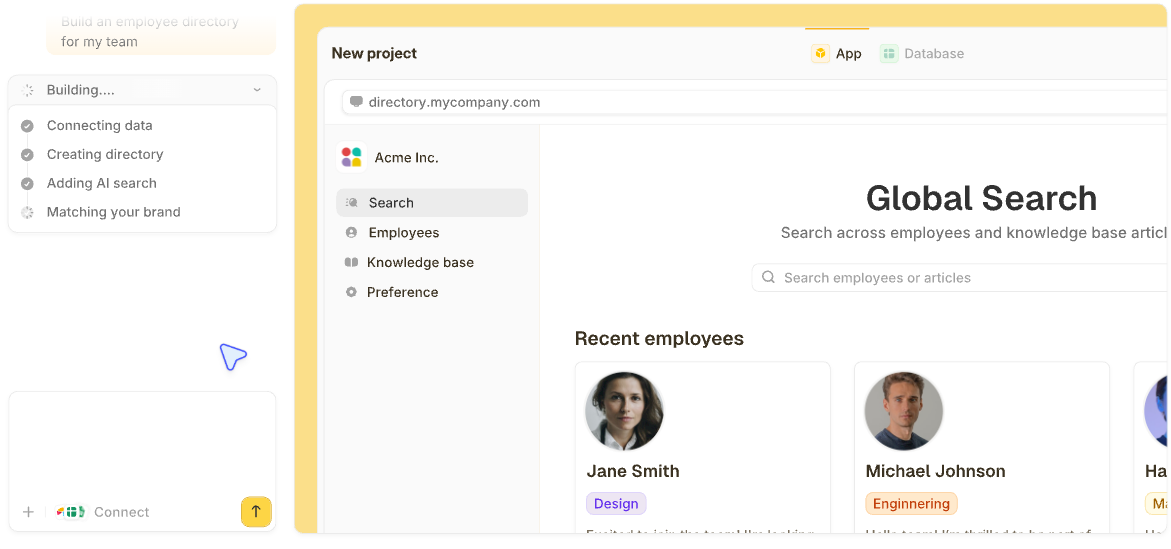


Is Lovable right for you? After 3 weeks building apps in Lovable and reading through 1,200+ Lovable reviews across Trustpilot, Reddit, and G2, the answer comes down to what you're building and how technical you are.
This honest take covers what Lovable does well, where it falls short, and which type of builder gets the most out of it.
Quick verdict
Lovable is one of the fastest AI app builders for turning a prompt into a complete, working web app with clean React code, but credit-based pricing burns through credits fast, and complex apps trip up the AI.
Lovable’s at a glance scores:
- Speed: 5/5
- Code quality: 4/5
- Pricing predictability: 2/5
- Beginner-friendly: 2/5
For developer-leaning founders who want code ownership and prototype speed, Lovable delivers. For non-technical teams who need predictable pricing and a visible database they can edit without writing code, it's the wrong pick.
What is Lovable?
Lovable is an AI-powered complete app builder that turns plain-language prompts into working web apps. It generates React, TypeScript, and Tailwind CSS on the frontend, connects to Supabase for backend services like authentication and storage, and deploys with one click.
Originally launched as GPT Engineer, the tool is built for founders, indie developers, and product designers who want to ship MVPs and prototypes fast. It sits between pure no-code builders (Bubble, Glide) and code-first AI assistants (Cursor, GitHub Copilot).
Features
Here’s what Lovable includes and where the limits are:
- AI app generation from prompts: Describe your app, and Lovable generates pages, components, and logic. Works well for landing pages and dashboards; struggles with complex multi-step workflows.
- Supabase backend integration: Connects to Supabase for authentication, storage, and database tables. Straightforward if you know Supabase; confusing if you don’t.
- GitHub two-way sync: Push code from Lovable to GitHub and pull updates back. You own the React and TypeScript code Lovable generates.
- Visual editor: Click elements in the preview to change colors, sizing, or spacing without writing a new prompt.
- Code mode: Edit the underlying code directly within Lovable (paid plans only). Useful when the AI’s iteration goes off the rails.
- One-click deploy: Publish to a lovable.app subdomain or your own custom domain (paid plans).
- Limits: Web only, no native iOS or Android. Credit-based pricing means every prompt and bug-fix attempt costs credits, even when the AI gets it wrong.
Lovable reviews: what real users are saying
I pulled reviews from Trustpilot (1,228+ reviews, mixed scores), Reddit threads in r/nocode and r/lovable, and product review sites. Here’s the consistent feedback, split into pros and cons.
Pros
- Speed of building MVPs and prototypes: Users consistently call out how fast Lovable goes from idea to working prototype. One described building a SaaS app with auth and a database in two weeks despite knowing nothing about coding.
- Clean generated code quality: Developers praise the React and TypeScript code. The component architecture follows modern patterns and uses shadcn/ui components that look professional out of the box.
- GitHub integration for code ownership: Users like not being locked in. The bidirectional GitHub sync means they can export their code and continue building elsewhere.
- Visual editor for UI tweaks: The click-to-edit UI lets users make small visual changes without burning a credit on a new prompt.
Cons
- Burns through credits fast: The number one complaint across Trustpilot, Reddit, and review sites is unpredictable credit consumption. Users describe getting charged for the AI’s own mistakes.
- AI hallucinations and looping debugging issues: When apps get past simple prototypes, the AI starts breaking things. Users describe asking for one change and watching the AI break something unrelated.
- Supabase setup is a wall for non-technical users: Lovable generates the frontend cleanly, then asks you to connect to Supabase, configure security policies, and debug authentication errors.
- Web only, no native mobile: Lovable doesn’t generate native iOS or Android apps. If your idea needs App Store distribution, you’d have to wrap or rebuild the web app.
Overall, users appreciate Lovable’s speed and code quality, but many complain about credit consumption running away on complex projects and the Supabase setup being a barrier for non-technical builders.
What users say

“Lovable is probably the most user-friendly tool to build your own website or application.” Francis Doom, Trustpilot

“Lovable takes you from a prompt to a working full-stack app, not just a front-end mockup.” Naumaan Zahid, Product Hunt

“The biggest drawback I’ve run into is the credit-based usage model.” Saiprasad A, G2

“The subscription is basically extortion. If you do not use your tokens and end the subscription, they are gone.” Johan W, Trustpilot
My take on Lovable
I tested Lovable across three projects: a landing page for a fake SaaS, a small internal directory app, and an attempt at a more complex multi-user portal with role-based access.
What impressed me was the speed and the code quality. The landing page came together in under 10 minutes. The directory app took about an hour, and the generated React code was clean enough to read without wincing.
What frustrated me was the moment the AI hit its complexity limit. The multi-user portal ate through 40 credits in an afternoon trying to fix issues the AI introduced (Lovable's per-action pricing charges about 1.20 credits to add authentication alone; fixing loops compounds fast). By the end, I was using Code mode to write the fix myself, which defeated the point.
Lovable mostly matches what other users say. The speed is real. The credit burn is real. The Supabase setup is a wall for anyone who doesn’t already know Supabase. If you’re a developer building an MVP, you’ll be impressed. If you’re non-technical, you’ll hit the same wall thousands of others describe.
Is Lovable right for you?
Who will love Lovable
- Solo founders building MVPs to validate ideas. If you need a working prototype to show investors or test with users, Lovable gets you there fast.
- Developers who want code ownership. The GitHub sync and clean React output mean you can prototype in Lovable and finish in your IDE.
- Product designers who think in interfaces. The visual editor and AI generation let designers build working demos without engineering help.
- Students and indie hackers. The free tier and student discount make Lovable accessible for learning and small projects.
Who should avoid Lovable
- Non-technical teams building business apps. The Supabase setup, credit unpredictability, and need for Code mode make Lovable risky for non-developers.
- Teams needing predictable pricing. Credit-based billing means a complex project can cost 2 to 3x what the sticker price suggests.
- Anyone building native mobile apps. Lovable doesn’t generate native iOS or Android apps.
- Teams whose apps run on structured data. For internal tools or customer-facing portals with role-based access and database-driven workflows, a tool with a visible database serves better.
The best Lovable alternative: Zite
If credit unpredictability, the Supabase setup wall, or a developer-leaning workflow makes Lovable a stretch for your team, Zite is the alternative built for non-technical people building apps with real functionality, from internal tools and dashboards to client portals, marketing sites, and community apps.
Where Lovable generates code you have to wire into Supabase and keep troubleshooting, Zite generates an app you can see and edit visually, with the database, workflow logic, and access rules all in one view.
Because the workflows and database stay visible, the same non-technical person can understand and change the app afterward, no code required. Lovable gives you code and a GitHub export, but maintaining that output takes a developer, while Zite's output stays workable for the person who prompted it.
Four specific advantages of Zite worth knowing:
- Visible database with tables and fields: Where Lovable hides the database behind Supabase, Zite gives you a spreadsheet-like database with linked records, AI fields, and formulas. You inspect and edit the structure without writing SQL.
- Visual workflows you can inspect: The logic the AI builds shows as a flowchart you can read and trace, so you can confirm what happens after a form submit or a record change. Workflow changes happen by prompting the AI, with no code to dig through.
- Predictable pricing with unlimited users: Zite's Pro plan is $19/month, and Business is $69/month, both billed monthly and with unlimited users, so headcount never changes the cost.
Also, where the top Lovable complaint is burning credits on the AI's own failed fixes, Zite's smaller edits and error fixes don't consume credits; only major AI generation does.
- Built-in roles, permissions, and publishing controls: Zite includes role-based access from day one. Apps are internal by default. When you're ready to publish to external users, you turn on login from the access settings panel, with no separate backend or security policies to wire up first.
For a head-to-head comparison, see Zite vs. Lovable.
Final verdict
Lovable is hard to beat if you're a developer chasing the fastest path from prompt to working MVP with real code ownership. But for teams that need predictable pricing, a database they can see and edit, and an app non-technical people can run without engineering help, Zite is the better fit.
Frequently asked questions
Is Lovable worth it in 2026?
Lovable is worth it in 2026 if you’re a developer or technical founder building MVPs where speed matters more than predictable pricing. It’s not worth it for non-technical teams due to the Supabase setup requirement and the risk of credit burn on complex projects.
How much does Lovable cost?
Lovable's paid plans start at $25/month for Pro (100 monthly credits, custom domain, code mode) and $50/month for Business (SSO, data opt-out). There's also a free plan with 5 daily credits capped at 30 per month. Cloud hosting and in-app AI features draw from the same credit balance as your builds.
Is Lovable free to use?
Yes, Lovable has a free plan with 5 daily credits and a monthly cap of 30. The free tier covers public projects on Lovable.app subdomains and the visual editor. You'll need Pro ($25/month) for private projects, custom domains, or serious building.
Can Lovable build production-grade apps?
Lovable can build production apps for simple use cases, such as landing pages and basic SaaS prototypes. For complex apps with multi-user roles and intricate logic, user feedback in 2026 suggests that Lovable struggles to get past the prototype stage.
What’s the best Lovable alternative?
The best Lovable alternative depends on what you’re building. For non-technical people building internal tools, client portals, or customer-facing apps on a visible database, Zite is the strongest. For developers wanting more control, Cursor or Bolt.new are common picks. For a category overview, see this roundup of no-code AI app builders.
Can I export my code from Lovable?
Yes, Lovable supports two-way GitHub sync, so you can export your React and TypeScript code, edit it locally, and push updates back to GitHub. The catch is that the exported code still requires Supabase to be configured separately.
Is Lovable better than Bubble?
It depends on what you're building. Lovable is faster for AI-generated React prototypes; Bubble is more powerful for complex web apps with a steeper learning curve. For non-technical teams, Zite fits better than either, since you get a visible database without writing code or wiring up a separate backend.