

After testing Airtable extensively as a database and app builder, here's my complete Airtable review about what it does well, where it falls short, and who should use it.
Quick verdict (TL;DR)
Airtable gives you a flexible database where teams manage information through predefined views such as Grid, Kanban, Calendar, and Gantt, but it can’t build standalone applications.
Best for: Teams that want a central source of truth for their data and simple interfaces to interact with it.
Not for: People who need fully custom business apps with flexible layouts and logic.
What is Airtable?
Airtable is a no-code platform that lets teams organize data, build interfaces, and automate workflows. It started as an alternative to spreadsheets, but has since added app-building features.
You can link records across tables, build custom views (Kanban, Gantt, Calendar, Gallery), automate workflows, and create front-end interfaces on top of your data, all without writing code.
Key features
Airtable started as a spreadsheet and database hybrid, but it's grown into a no-code platform with the following features:
Relational database and custom views
This is Airtable's main offering. You create bases (databases), custom field types (checkboxes, attachments, formulas, rollups), and can switch between Grid, Kanban, Calendar, Timeline, Gallery, and List views.
One of the best features is linked records. You can connect a Clients table to a Projects table, for example, and the data stays linked. Updating a client’s info updates the corresponding data in the projects table. You get the power of a relational database without needing to know SQL.
Automated workflows
You can build triggers based on record changes, time intervals, or form submissions, then chain actions together. For example:
- Auto-send a Slack message when a deal moves to "Closed Won."
- Auto-assign team members based on project type.
- Auto-create linked records in other tables when a form gets submitted.
This is great if you combine automations with Airtable's integrations and use it as the hub that orchestrates data across your entire stack. For complex multi-step workflows, you'll still lean on Zapier or Make.
Integrations & data syncing
Airtable connects natively with Slack, Google Workspace, Salesforce, Jira, Tableau, and more. Through Zapier, the list extends to thousands of apps. Airtable Sync lets you pull records from one base into another to keep data consistent across your organization.
Omni AI assistant
Airtable's AI assistant (Omni) lets you chat with your data in plain language, generate summaries from records, and extract info from PDFs.
It also generates interfaces from prompts, but the UIs are rigid. Omni assembles interfaces from Airtable's prebuilt blocks (charts, grids, forms, buttons), so what you get is a rearrangement of existing components, not a custom-designed UI. If the layout you need doesn't fit neatly into those blocks, you're stuck tweaking it manually or settling for something close enough.
Enterprise security
Airtable holds SOC 2 Type II, ISO 27001, and ISO 27701 certifications. It supports SSO on Business plans and HIPAA compliance, SCIM provisioning, audit logs, and Enterprise Key Management on Enterprise plans.
Pricing
Airtable’s free plan supports 5 editors and 50 commenters. Paid plans charge per editor seat and add more records, automation runs, and administrative features.
Here’s a quick breakdown:
If you're using Airtable as a full business operating system (CRM + project management + service tracking + finance tracking), the pricing is good value for what you get. The pricing feels steep when you're only using it for basic project tracking or as a glorified spreadsheet.
See which plan is right for you in our in-depth Airtable pricing breakdown.
Airtable reviews: What real users are saying
I pulled reviews from G2, Capterra, TrustRadius, and Reddit to see what other users are saying.
Below is what they love and what frustrates them.
Pros
- The flexibility to build almost anything: This comes up in nearly every positive review. Users build CRMs, inventory trackers, content calendars, and more, all inside one platform.
- Formulas and automations: You can create automations that match your workflows and add formulas to filter data according to your needs.
- Strong third-party ecosystem: Between native integrations, Zapier connections, and the API, Airtable integrates well with almost every tool.
Cons
- The learning curve is steep: Multiple reviewers mention that building a well-structured relational database takes time. You'll figure it out, but expect a ramp-up period.
- Someone usually ends up "owning" Airtable: Someone on your team inevitably becomes the Airtable admin, maintaining bases, fixing automations, and onboarding new users.
- App flexibility is limited: Airtable's Interface Designer lets you create custom front-ends for your data, but they're relatively basic compared to dedicated app builders.
My personal take on Airtable
I’ve used Airtable extensively, and it’s hard to beat when it comes to centralizing data and automating data-heavy workflows.
What impressed me most was the ability to make Airtable the single point where all your business data comes together. You can have CRM data, project data, finance data, and service data in one platform, then build automations that route information between them.
That said, the setup takes some getting used to. The AI assistant helps, but there’s still a learning curve in understanding how the platform works.
Where Airtable falls short is in building standalone software. The interfaces work well for lightweight internal views, but they’re not designed for full production-grade apps. Portals are a step in the right direction. They let you share controlled access to base data without paying for full seats, which is genuinely useful.
The problem is pricing. Portals are an add-on and start at $120 for 15 guests. In many cases, it’s hard to justify the cost compared to other purpose-built platforms like Zite, which don’t have per-user costs.
Is Airtable right for you?
You'll love it if:
- You want a central database for your operations data
- You're ready to invest time upfront in setup
- You automate heavily and want one platform orchestrating data across your stack
You should look elsewhere if:
- Your team is growing fast, and per-seat pricing doesn't fit your model
- You need a dedicated app builder, not a database platform
A better alternative if you've outgrown Airtable: Zite
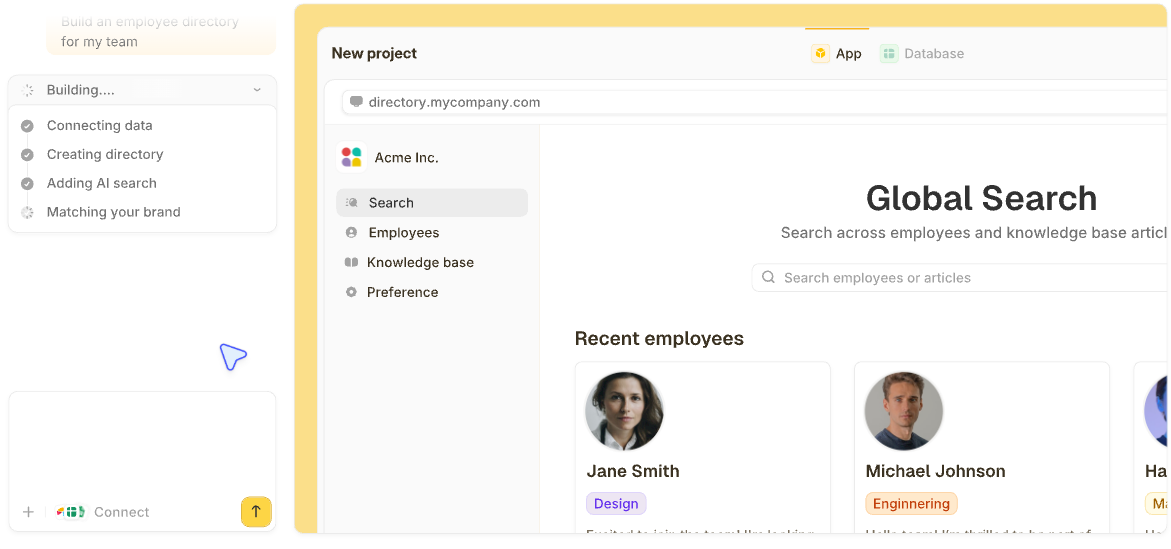
If you've hit the limits of what Airtable's Interfaces can do, Zite is worth a look. It's an AI-powered platform that builds full-production apps from a plain-language description.
The biggest difference: With Airtable, you set up a database, learn the platform, configure views, and bolt on Interfaces. With Zite, you describe what you want in plain language and get a working app in minutes, complete with database, forms, and workflows. There's no learning curve to fight through.
Where Zite fills the gap:
- AI-first with zero setup time: This is the direct answer to Airtable's steepest con. Instead of spending days configuring tables, views, and automations, you describe your app, and Zite builds it. The database, fields, and logic are generated automatically.
- Real apps, not limited Interfaces: Airtable Interfaces are constrained views on your data. Zite builds full production apps with custom UI, authentication, and permissions. If you've ever outgrown what Interfaces can do, this is the upgrade.
- Apps, database, forms, and workflows in one place: Airtable users often end up stitching together Airtable + Softr + Zapier to get a real app. Zite gives you everything in a single platform, no tool sprawl.
- Visual workflows: Your app's automations display as flowcharts you can trace and troubleshoot. Compared to Airtable's automations, which get confusing at scale, Zite's visual approach makes it easy to see exactly what happens and when.
- Unlimited users on all plans (even free): Your costs stay low and predictable no matter how fast your team grows, unlike Airtable's per-seat charges.
Final verdict
Airtable is a strong choice if you mainly want a flexible database with pre-defined views and are okay with per-seat pricing. Zite is better when you want to go from idea to working software in minutes without learning a complex platform. You get full production apps with a built-in database that just works underneath.
Zite’s free plan supports unlimited users with enough credits to build your apps and make several rounds of changes. No credit card required.
Frequently asked questions
Is Airtable free?
Yes, Airtable offers a free plan with unlimited bases, up to 1,000 records per base, 1 GB of attachment storage, and 100 automation runs per month. It supports up to 5 editors per workspace. Most teams outgrow it once they need more records or automations, but it's enough to learn the platform and test your use case.
Is Airtable better than Excel or Google Sheets?
Airtable is better than Excel or Google Sheets when you need linked records across tables, custom views, workflow automations, or a front-end interface.
Can Airtable replace a CRM?
Yes, Airtable can replace a CRM, and many teams use it this way. You can build pipeline views, contact management, deal tracking, and automated follow-ups.
Is Airtable HIPAA compliant?
Airtable supports HIPAA compliance on Enterprise plans and will sign a Business Associate Agreement (BAA), but you must properly configure the platform and follow your own organization’s compliance protocol.
How does Airtable's AI (Omni) work?
Airtable's AI (Omni) lets you chat with your data in plain language, generate summaries, extract document info, and build interfaces from prompts. It's for quick scaffolding and data insights rather than as a primary building tool.