

Lovable, Bolt, and Zite build apps from prompts, but only Zite lets you debug and maintain apps without touching code. Here's the full comparison of their key features and which one to pick based on your use case in 2026.
Lovable vs Bolt vs Zite: What are the key differences?
Lovable is a similar prompt-to-app builder, but it only builds React-based web apps. Its main draw is GitHub integration. You can edit apps locally and sync changes back to Lovable.
Bolt is a browser-based coding environment that generates full-stack web and mobile apps from prompts. You'll likely need to debug code yourself, but it handles both web and mobile.
Zite is an AI-powered no-code platform built specifically for business software like internal tools, dashboards, portals, and CRMs. The database is built in and fully visible, and workflows stay visual from start to finish, which is perfect for non-technical users.
Choose Lovable if you're prototyping a web app and want GitHub sync so you can edit locally.
Choose Bolt if you want to prototype web and mobile apps fast and don't mind jumping into code to fix things.
Choose Zite if you're building production-ready internal tools, client portals, or other business apps and want zero code involvement from build to deployment and maintenance.
Before we get into more details, here’s a quick side-by-side comparison:
Meet Lovable: Best for web app prototypes and MVPs
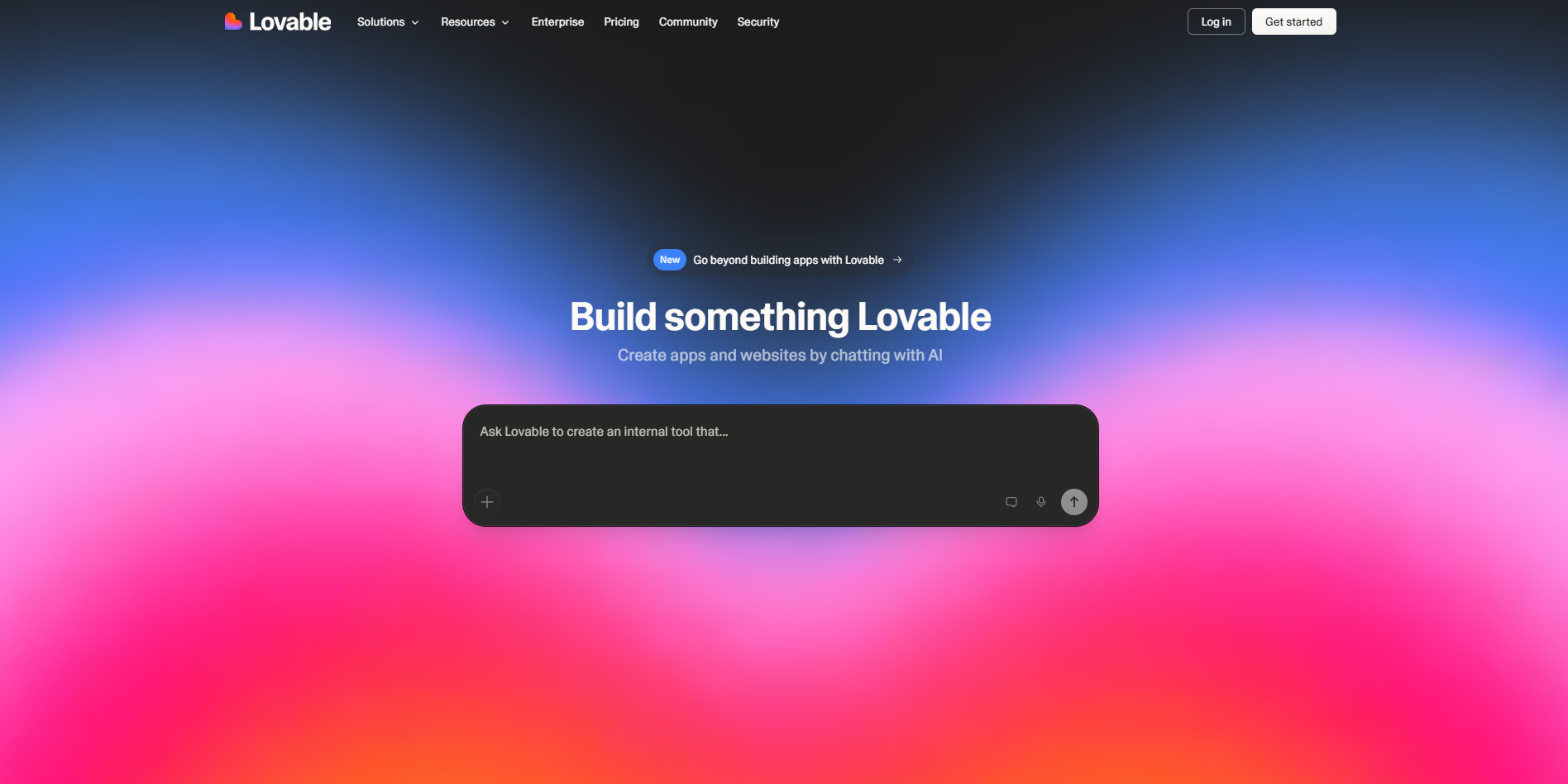
Lovable lets you describe your app in a chat interface and then generates a React frontend along with database setup and API integrations. You can visually edit UI elements in the live preview, though bigger changes to the UI, app logic, or database structure require additional prompts or manual code adjustments.
Key features:
- GitHub sync: Every project pushes to a repo automatically. If you or a developer wants to edit the code outside of Lovable, you can, and changes sync both ways.
- Lovable Cloud: Handles user authentication, database, and file storage using Supabase (a developer’s database platform that handles backend functions like user authentication and data storage). You can also connect to your own Supabase project.
- Visual editing: Click any element on the page to change text, colors, or layout directly.
Limitations:
- You need to read and edit code to debug the app when prompts fail.
- Only builds React web apps.
Best for: Founders validating ideas, designers creating prototypes, and anyone who needs a working demo fast.
Meet Bolt: Best for web and mobile app prototypes and MVPs
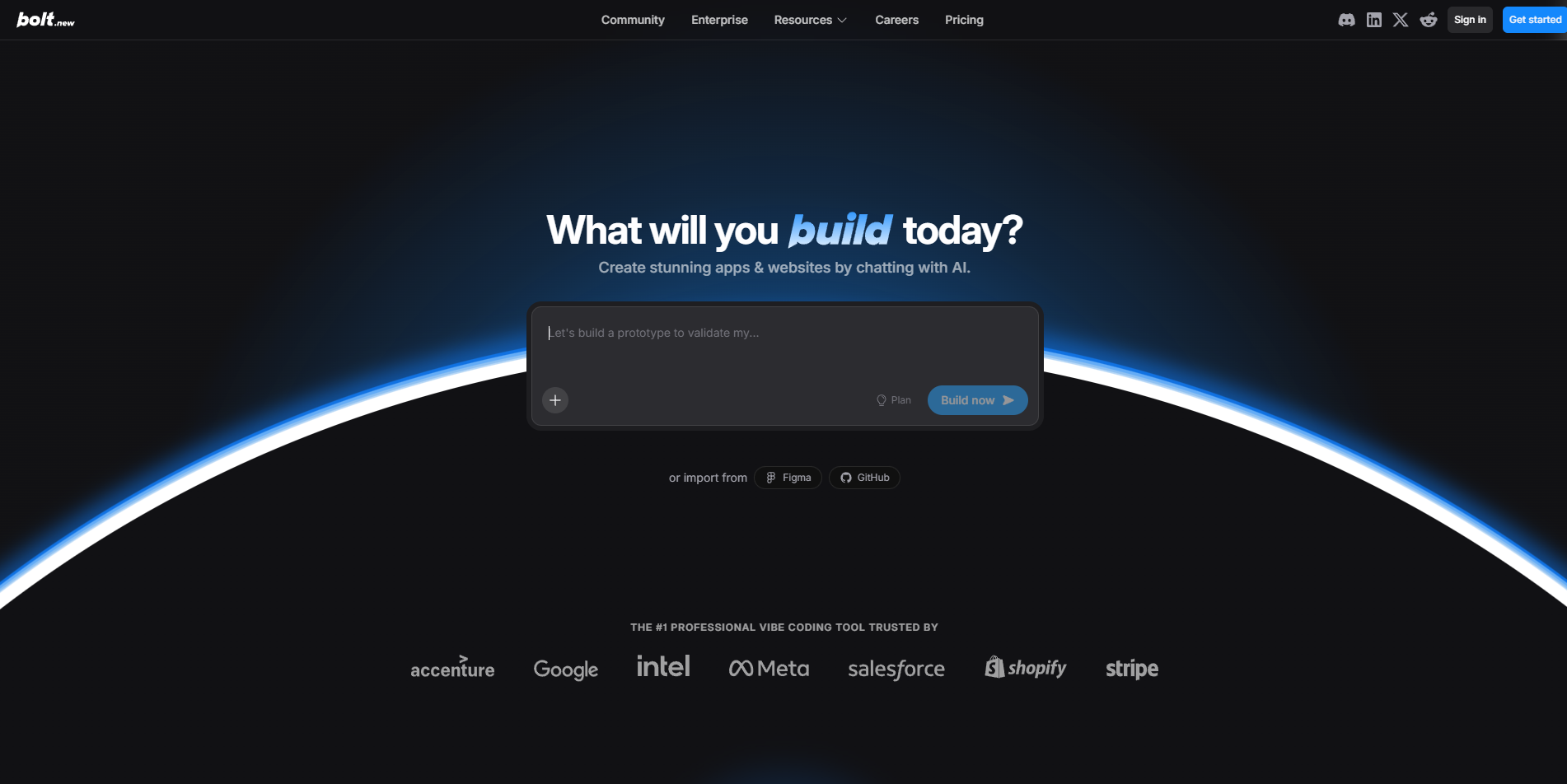
Bolt has a chat interface where you describe your app. The AI generates code for the frontend, backend, and database connections, then displays a live preview. You can click elements in the preview to target them in your next prompt for quick iteration.
Key features:
- Supports more than one framework: You can build React, Vue, Svelte, Next.js, Astro apps, and more.
- In-browser IDE for technical builders: Edit the generated code directly and add third-party tools or extensions without leaving your browser.
- Import from GitHub: Bring your existing GitHub project into Bolt to fix bugs or add new features.
- Bolt Cloud: Comes with a database for storage, user authentication, and hosting.
- One-click deploy: Deploy your app live from Bolt or export to a hosting platform like Netlify.
Limitations:
- Complex apps can burn through your usage allowance in a few sessions.
- If the AI prompts fail, you’ll need to debug the generated code.
- You can't edit the UI visually. Every change goes through the chat or code editor.
Best for: Builders with some technical background who want AI to handle the heavy lifting while keeping full control over the code.
Meet Zite: Best for production-grade business software
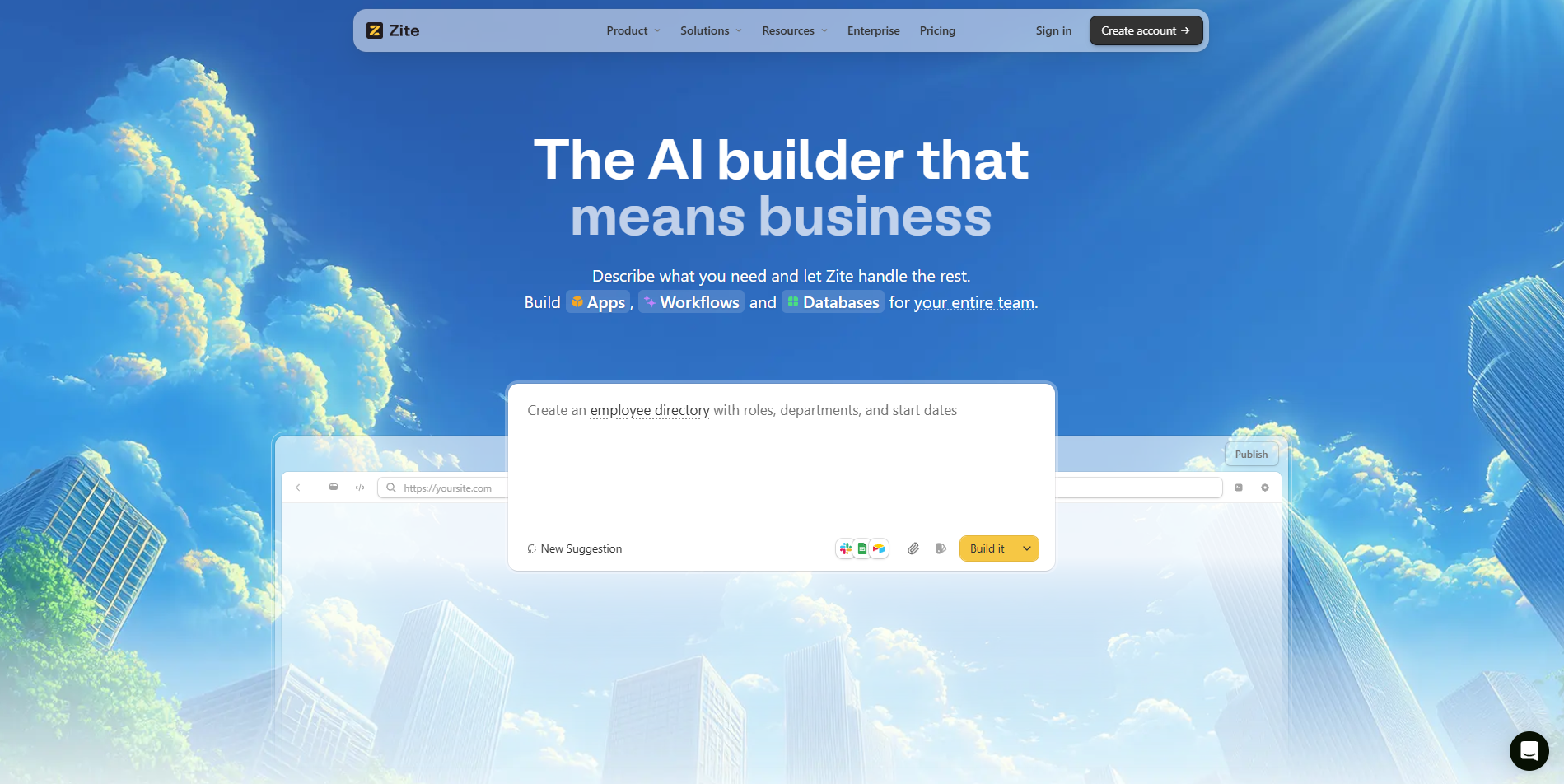
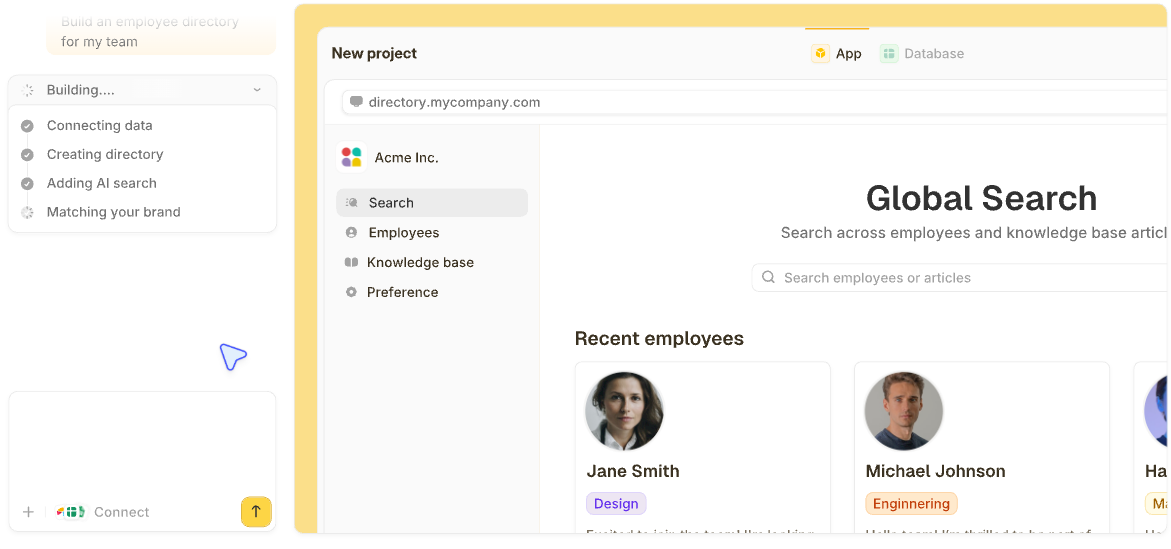
Zite is built specifically for business teams that need real apps without hiring engineers. It’s a prompt to app builder and generates your app’s UI, databases, forms, and logic from natural-language descriptions. It has a visual editor for direct UI tweaks and renders logic as flowcharts, so it's easy to verify what it's built.
Key features:
- Built-in database: Zite auto-generates your tables and fields based on what you're building. View and edit your app's data in a spreadsheet-like interface.
- Unlimited users on every plan: Even the free tier. Your costs don't spike when you roll out an app to 50 team members.
- Production-ready from day one: Comes with secure hosting, access control, and authentication. You also get SSO and audit logs in the Enterprise plan.
- Visual workflows: App logic appears as flowcharts so you can inspect and verify what’s built. You don’t need to read code to debug.
- Selective edits: Click any component to modify it directly instead of constantly prompting.
Limitations:
- Apps live on Zite's infrastructure. You can't export code and self-host.
- Not for consumer apps (like social platforms and games) or native mobile apps.
Best for: Ops teams, support managers, SMBs, and anyone else who needs employee portals, inventory trackers, CRMs, or other business tools without coding.
Lovable vs Bolt vs Zite: Feature-by-feature comparison
App building capabilities
Lovable, Bolt, and Zite have a chat interface where you describe your app, and it builds it. However, each tool handles editing and debugging differently.
Lovable and Zite give you more visual control over the UI. Click an element and edit text, colors, or layout right on the page without re-prompting.
Where approaches really differ is in troubleshooting the underlying logic. With Bolt and Lovable, if functionality breaks or the logic gets complex, you'll need to read through code files to find the error. You can re-prompt, but that costs credits, and on complex apps, the AI often gets stuck in a loop. You’ll need a developer to fix it.
Bolt doesn't have a real visual editor. You can click an element in the preview to target it for your next prompt, but you can't restyle anything directly. Every change goes through the chat or code editor.
Zite visualizes app logic as flowcharts you can inspect. You can see exactly what happened step-by-step, replay runs, and spot errors without digging through code. Then, you can ask Zite to fix it with prompts. This is more effective than blindly prompting since you can tell the AI exactly what to fix.
Winner: Zite. Non-technical users can understand, debug, and maintain complex logic visually without ever needing to read code.
Database and data management
Lovable uses Lovable Cloud (powered by Supabase) to auto-generate databases and let you manage data within the builder. For advanced database behavior like detailed authentication policies, row-level security, or optimized queries, you may need to use the underlying technical settings.
You can also connect to your own Supabase project and configure those features directly.
Bolt uses a built-in database, but you can also connect to your own Supabase project. It has a table viewer where you can see and edit rows, but for structural changes or complex data management, you'll still need to use AI prompts or write SQL code.
Zite automatically generates a database from your description, including the tables and relationships your app needs. Crucially, Zite gives you a full spreadsheet-like interface to view and edit data directly. You don't need SQL knowledge at all.
Winner: Zite for ease of use.
Pricing and cost predictability
Pricing for AI builders can be tricky. You need to look at both the subscription cost and the "fuel" (tokens or credits) required to build.
Lovable uses credits instead, starting at $25/month for 100 monthly credits plus 5 daily credits (up to 150/month). Credits get used when you send messages, and more complex requests use more.
The upside is that Lovable doesn't charge you credits when the AI is fixing its own mistakes. The downside is that Lovable Cloud and AI usage start free but shift to pay-as-you-go, which can catch you off guard.
Bolt uses a token-based system. Paid plans include a monthly token allowance (e.g., the Pro plan starts at $25/month for 10M tokens). Every prompt, edit, and debugging run burns tokens. Complex debugging loops can drain your balance surprisingly fast, and once you're out, you're stuck until you pay more or wait for a reset.
Zite also uses credits. You get a free tier with 50 credits, and paid plans start at $19/month for 100 credits. This covers building with AI, database, hosting, authentication, and AI-powered features. There is no separate cloud or AI bill unless you use your own OpenAI key for the AI features.
Winner: Zite for predictable costs.
Enterprise and security features
Lovable is SOC 2 Type II audited and ISO 27001:2022 certified. It supports SSO on higher plans, so you can connect to identity providers like Okta, Auth0, or Microsoft Entra ID. However, this is often applied at the workspace level, not per-app.
Bolt focuses on speed and prototyping. It supports Google SSO for your app's users and runs automated security audits during publishing. However, security implementation is largely up to the developer.
Zite is built for business operations from day one. The platform is SOC 2 Type II compliant. Zite includes secure hosting and user authentication on all plans. On Enterprise plans, you get SSO and detailed audit logs.
Winner: Zite, especially for applying SSO at the app level.
Deployment
Lovable lets you publish directly to the web with one click. You can use a free lovable.app subdomain or connect your own custom domain directly in the settings. For more control, you can export your code to GitHub and manually deploy it to platforms like Vercel or Netlify, giving you full ownership of your hosting pipeline.
Bolt gives you flexible options. You can publish instantly to Bolt Hosting (a quick, managed option) or connect your own Netlify account for deployments. You can also export to GitHub and host anywhere you like (Vercel, AWS, etc.).
Zite is fully managed. You click Publish, and Zite deploys your app to secure, scalable hosting. You get a Zite domain (app.zite.so), but you can connect a custom domain on any paid plan. There is no code export option, but that also means zero DevOps work for you, ever.
Winner: Tie. Zite wins if you want a publish-and-forget experience where hosting, scaling, and security are handled for you. Bolt/Lovable wins if you need code export and custom infrastructure.
What real users are saying
I pulled feedback from G2, Reddit, Product Hunt, and community forums to see what actual users think about Lovable, Bolt, and Zite.
Lovable
Pros:
- Fast builds: Users love how quickly they can get a polished UI up and running. One user on Product Hunt said they'd already saved significant time on mock-ups and were getting code that's close to production-ready.
- Code export: You can export your project to GitHub and access the code anytime, which gives developers flexibility to keep building outside of Lovable.
- Visual design and previews: Lovable generates clean designs with fewer prompts. You can also customize layouts visually, revert changes, and preview on different devices.
Cons:
- Debugging loops: A common complaint is that the AI gets stuck fixing errors. It tries to resolve one issue but introduces new ones in the process, burning through credits along the way.
- Accuracy drops with complexity: As apps grow, the AI struggles to keep up. Sometimes you need to manually code to get the app working, which defeats the purpose for non-technical users.
Bolt
Pros:
- Speed: Users are consistently impressed by how fast Bolt builds a working app. One user described building a complete landing page with a slider, multilingual support, auto-translation, and a contact form.
- Full-stack out of the box: Bolt generates frontend, backend, and database code together, so you're not stitching pieces from different tools.
- Great for first drafts: Where Bolt really shines is that initial build. If you have a clear idea of what you want, it can get you 80% of the way there surprisingly fast.
Cons:
- Debugging creates new problems: A recurring frustration is that fixing one thing breaks something else. Users report the AI fighting their edits and breaking unrelated components of the app, and throwing them into loops where each fix creates a new issue.
- Tokens disappear fast: If you don't nail what you want on the first try, costs escalate quickly. The moment you start refining or debugging, you can drain all your tokens.
Zite
Pros:
- Ready-to-use outputs: One Airtable community member built a full Asana-style task manager in under 4 hours using Zite with an Airtable backend.
- Visual debugging: The flowchart-style view made it easy to see each step in a workflow, track how data moved through the system, and pinpoint exactly where the app is failing.
- Generous plans: It doesn’t charge per user and supports unlimited users across all plans, even the free one.
Cons:
- New platform: Zite’s community is smaller, and there are fewer templates.
- No code export: Your app stays within Zite’s infrastructure.
Lovable vs Bolt vs Zite: How to make your choice
Lovable and Bolt are a good fit for people building MVPs or demos that are technical enough to debug code when AI prompts fail. Zite is the better fit if you're building internal tools, client portals, dashboards, or other business software and don't want to code at all.
Pick Lovable if you specifically want two-way GitHub sync and the option to pull your project into a local code editor for hands-on development.
Pick Bolt if you need to build both web and mobile app prototypes.
Pick Zite if you need to build, debug, and maintain business apps without ever touching code. The visual workflows and built-in database mean you're not dependent on a developer at any stage.
My verdict
After using all three, Zite is the clear winner for non-technical users building business apps. The visual debugging alone sets it apart. You can actually understand what's happening under the hood without reading code. Lovable and Bolt are excellent for quick prototypes and MVPs, though.
Build your first app with Zite
See how much faster you can ship with Zite when you don't have to worry about reading code to debug your apps. The free plan gives you enough credits to build a complete app and make several rounds of changes.
Frequently asked questions
What's the best AI builder for non-technical users?
Zite is the best AI app builder for non-technical users because it generates visual flowcharts representing the underlying logic. You can inspect it and rerun it to understand how it works.
How is Lovable different from Bolt?
Bolt supports multiple frameworks and can build mobile apps, while Lovable only builds React-based web apps. On the other hand, Lovable includes a visual editor for clicking and styling elements directly, plus two-way GitHub sync so you can develop locally. Bolt doesn't offer either of those.
What are AI credits?
AI credits are the internal currency that platforms use every time you send a prompt or ask the AI to fix a functionality. Complex requests and debugging use more credits than simple ones.
Should you use Lovable?
You should use Lovable if you’re building web apps. Just be ready to manually debug code once AI prompts stop making correct changes.