
Less paperwork. More opportunity for Boston.
How Boston built a unified grants management platform on Zite, with $1.92 million in projected annual savings for the City and its community partners.
An investment in people, buried in paperwork
Every year, Boston’s Office of Workforce Development (OWD) awards $15–20 million across more than 200 grants. Behind each award is a community organization helping residents participate in the city’s economic future. Behind the administration was a different story: repeated data entry, hand-built reports, and email after email to find out where things stood.
The team relied on a Microsoft Access database with records dating to 2001, running on a single office PC that staff had to remote into. Around it sat paper forms, email, and hundreds of spreadsheets. City staff and grantees entered the same organizational and program details in multiple places. Reporting meant compiling a snapshot by hand, rather than seeing progress as it happened.
Boston’s goal was straightforward: give the people managing grants less administrative work, and the people delivering programs more time to serve residents. Working with Zite partner MetroIQ, the City brought that vision into GHub.
Two workspaces. One source of truth.
GHub connects the full grant lifecycle, from contracting to closeout. Instead of asking everyone to work around a patchwork of tools, Boston built two connected experiences: GHub Admin for OWD staff and GHub Portal for community partners, both working from a shared Zite database.
GHub Admin
One workspace to manage grants, monitor deadlines and compliance, and see financial and program performance across active funding cycles.
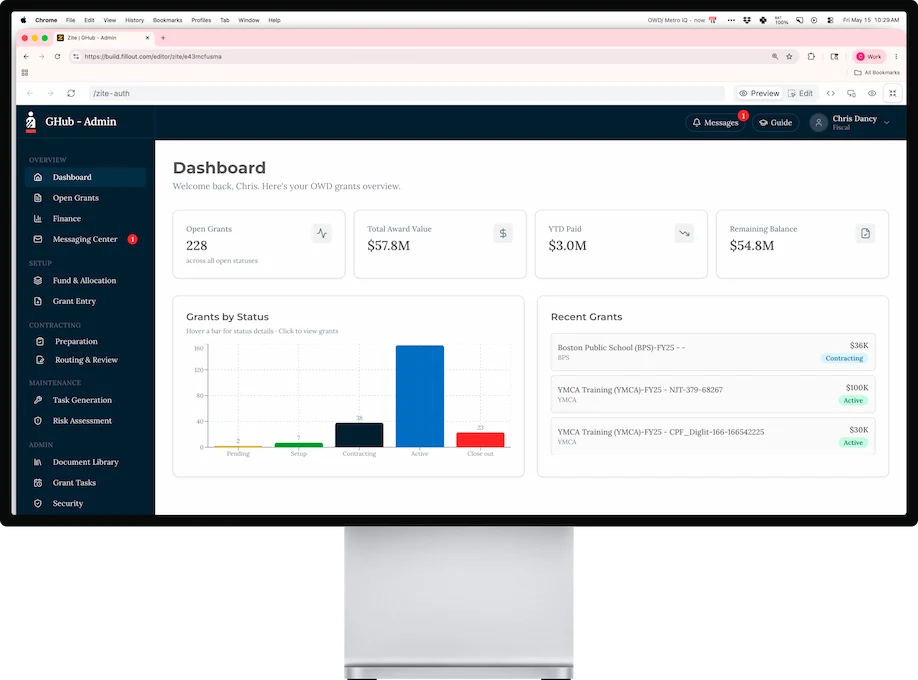
- A live view across grants and funding cycles
- Automated compliance and deadline tracking
- Centralized, audit-ready reporting for funders
For City staff, that means a live view of grants, finances, deadlines, and performance. For grantees, it means submitting documents and checking status in one place. A reusable organizational profile carries information across grant cycles, so a new award does not mean starting the same paperwork all over again.
“GHub takes the guesswork out of grant management. GHub replaces endless email follow-ups with real-time visibility.”
From Airtable to Zite Database
As GHub evolved, Boston brought its grants data onto Zite too. Moving from Airtable to Zite Database put the underlying records and both GHub apps on one platform.
The team migrated the existing data and reconnected GHub Admin and GHub Portal. Before switching over, OWD staff tested familiar tasks in a separate workspace, checking the migrated apps against the existing system.
City staff gained a faster GHub experience while keeping the workflows they already knew.
A quarter-century of records, ready to work
Modernizing did not mean leaving Boston’s history behind. GHub’s database brings together 5,570+ grants, 27,000 transactions, and more than 500 organizations. The historical portfolio represents $471.5 million in awarded grants across more than 25 years.
Those records now sit alongside the data needed to manage current programs. Staff can use the same foundation for day-to-day reporting and longer-term analysis, instead of treating the archive and the current grant cycle as separate worlds.
The value extends beyond grant administration. In October 2025, Boston launched a searchable Workforce Development Directory, with workflows connected to the new grants database keeping program information up to date.
“The dashboard is especially helpful. Being able to quickly see our open awards… gives a much clearer snapshot of where everything stands.”
The return: time back on both sides of a grant
Boston projects $1.92 million in combined annual savings from reducing administrative work. The benefit reaches both the City team overseeing funding and the community partners putting it to work.
- City staff: a projected 40% reduction in administrative burden, returning approximately 20,300 hours per year, valued at $1.12 million.
- Community partner staff: a projected 50% reduction in administrative time, returning approximately 20,800 hours per year, valued at $800,000.
Together, that is approximately 41,100 hours each year that could go toward monitoring programs, supporting partners, and serving residents. These are estimates of staff-time value, rather than a claim of budget cuts or cash already recovered.
The City’s estimated implementation and system costs decline from $97,500 in year one to $57,500 in year two and $17,500 in year three and beyond, as implementation expenses end and internal staff take on system management. On Boston’s estimates, City staff-time savings alone exceed the full first-year cost by more than $1 million.
Projections from OWD’s July 2026 GHub impact presentation. Hours are rounded; combined savings include City and community partner staff.
Built with the people who use it
Boston treated the rollout as an organizational change, not just a software launch. Built with MetroIQ, the core project was completed in six months, within an 18-month implementation and improvement effort that included City staff training and virtual and in-person education for grantees.
Support is part of the experience. A built-in GHub Assistant answers questions about grants management and app features. Staff and partners can submit questions, support requests, and feedback inside the app, then follow their status.
To guide what comes next, Boston established a Change Advisory Board of GHub Champions, with a representative from every OWD team. The people closest to the work help weigh proposed improvements and the impact on different stakeholders.
More capacity for Boston’s mission
GHub gives Boston a shared view of the work behind its workforce investments: what has been awarded, what is due, what has been paid, and what needs attention. Community partners get that visibility too, without another round of email follow-ups.
With Zite, the City has built a foundation it can keep improving as programs and requirements change. The payoff is practical: less time reconstructing the status of a grant, and more time helping that grant deliver for Boston residents.
Put more time toward your mission
See how your team can bring grants, partner portals, and reporting together with custom software built on Zite.
Talk to our team