
Replacing a $20,000 Policy System with Zite
How the Peoria Police Department runs policy review, accreditation and command reporting on a portal built in Zite.
Background: policy management ran on Teams
Peoria PD tracked its policy revisions in Microsoft Teams. Policies lived in folders. Assignments got passed around in messages. There was no single place to see who owed what.
A policy could sit in a review phase for weeks because the reviewer never realized it was theirs. Nobody could say where a policy was stuck, or for how long. Finding a current policy meant digging through nested folders, so people stopped wanting to.
“People just hated trying to find policies. If you’ve worked in Teams, you know how it is, this folder, then that folder. It was a mess. So people were getting upset about it.”
Jeana Johnson was handed the problem and told to find a policy management system. She started getting quotes.
The challenge
- No visibility into assignments. Reviewers missed work because nothing told them it was waiting.
- Stalled policies. Policies stalled between phases with no way to see where the holdup was.
- Hard-to-find documents. Staff avoided the process because finding anything took too long.
- No data. No processing times, no phase metrics, nothing to report to command staff or city hall.
- Expensive software. Off-the-shelf policy software was quoted at $15,000 to $20,000.
“I was getting quoted about 15 to 20,000 to have a basic policy management system. And it wouldn’t even be customizable to our workflows!”
From experiment to production system
Instead of buying, Jeana built. A peer had mentioned building their own site on Zite, so she started experimenting. She got far enough, fast enough, that the department told her to keep going.
“Once we saw the initial results, our agency was like: yes, absolutely, let’s do this.”
Peoria PD now runs two portals off a shared database. The Policy Management Portal is live and in daily use across the department. An Accreditation Management Portal is close behind, solving the same visibility problem for accreditation proofs, where people used to drop files in a folder with no record of who owned what. A training portal is under consideration.
What the portal does
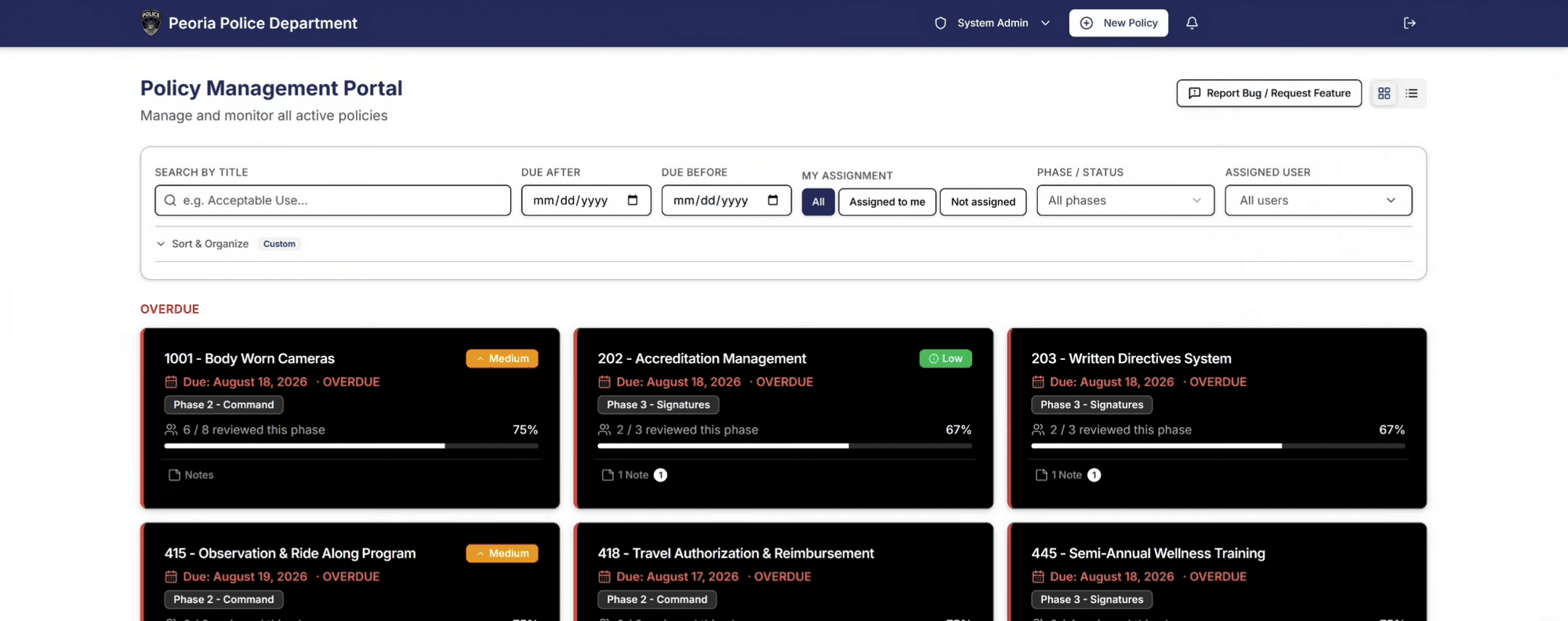
The dashboard shows what is assigned to you and what is late. Staff filter by title, due date, phase, status or assigned user, or switch to “assigned to me.” Overdue work sorts to the top. Each policy card shows its phase, its due date and how far the review has actually gotten, such as six of eight reviewers done, 75 percent through the phase.
Jeana kept adding the things a real review process needs:
- Phase locking. Once a policy advances, edits to the previous phase are locked, so nobody can revise a review after the fact.
- Interim revisions. A way to log work happening between phases, so a policy that is moving doesn't look stalled.
- Fail-to-review logging. If a reviewer is on vacation or otherwise unavailable, that gets recorded as a reason instead of counting against them.
- Department, bureau and unit tagging. Any policy can be traced to the command that owns it, so “how many policies sit with the Operations Bureau?” has an answer.
- Reassignment requests. A reviewer can ask for a policy to be handed to someone else. Jeana approves it and the system reassigns it.
- Groups. A thirteen-member committee gets added to a phase in one action instead of thirteen.
- User archiving. Departing staff are archived rather than deleted, so their history on past policies survives and reports stay accurate.
A changelog inside the app
When you build your own software, users notice every time it changes.
“I go and do something, and then the users are like, why is this suddenly different? And then they freak out, and then it’s a headache.”
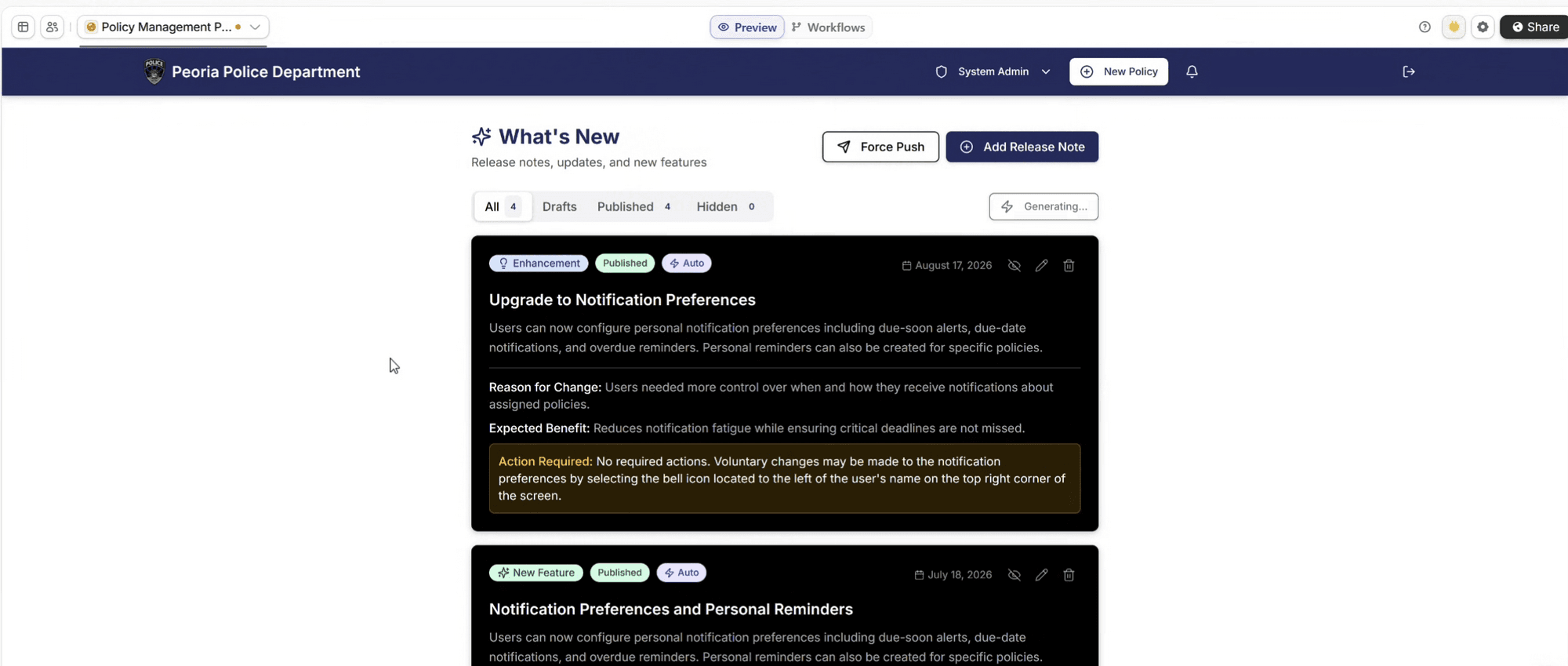
So she built a What's New page. Zite drafts release notes from recent changes on demand. Jeana reviews them, edits what she wants and publishes. The note pops up for users the next time they log in, and they acknowledge it. Next to it sits a bug and feature request form that feeds an internal tracker, so suggestions from the department get logged the same way hers do.
Notifications tuned to how the department works
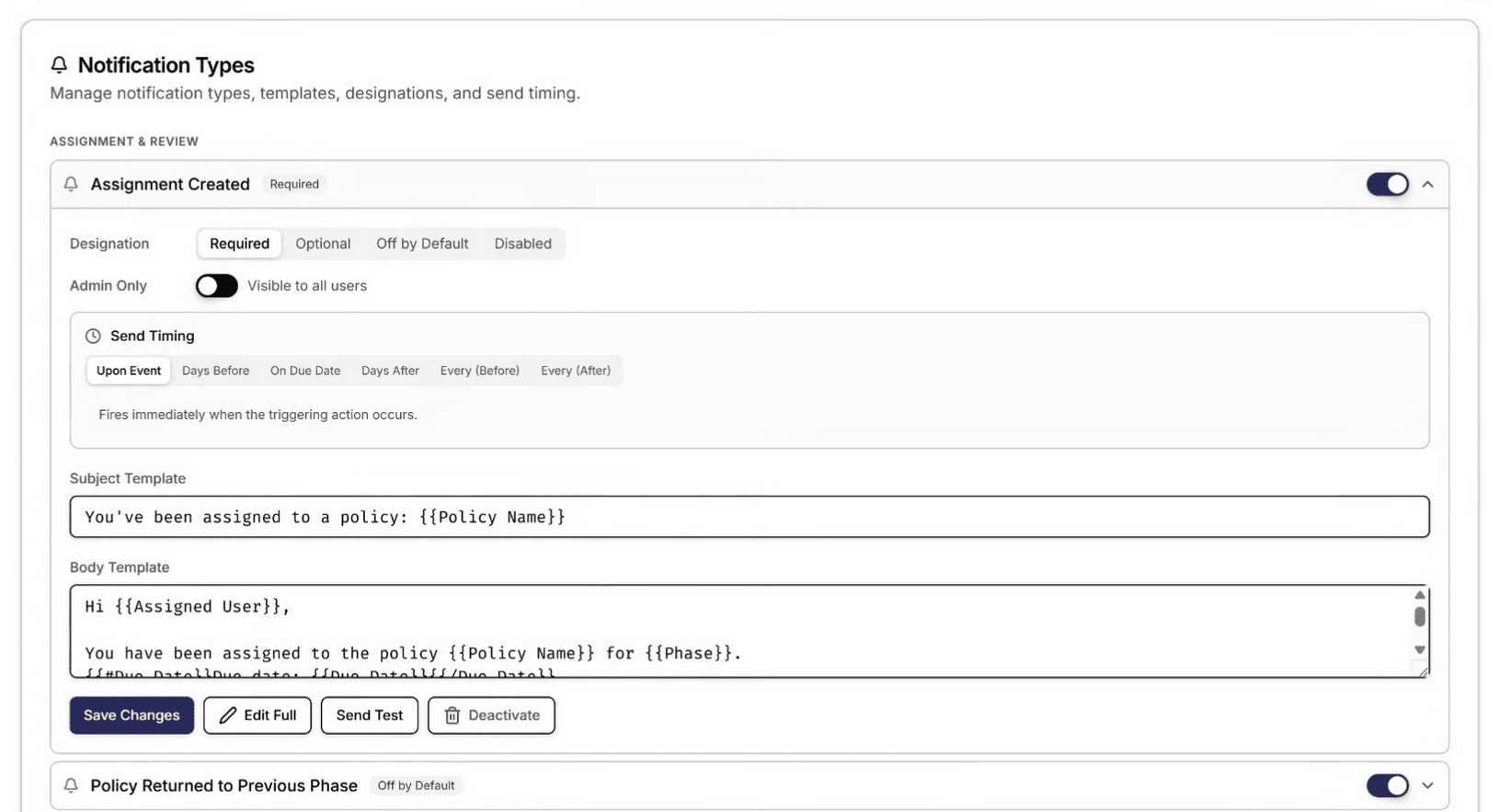
Notifications got the most attention, because a system that emails the wrong people is one staff will tune out. Every notification type carries one of four designations: Required, Optional, Off by Default or Disabled. Send timing is set per type, either on the event, a set number of days before or after the due date, or on a repeat.
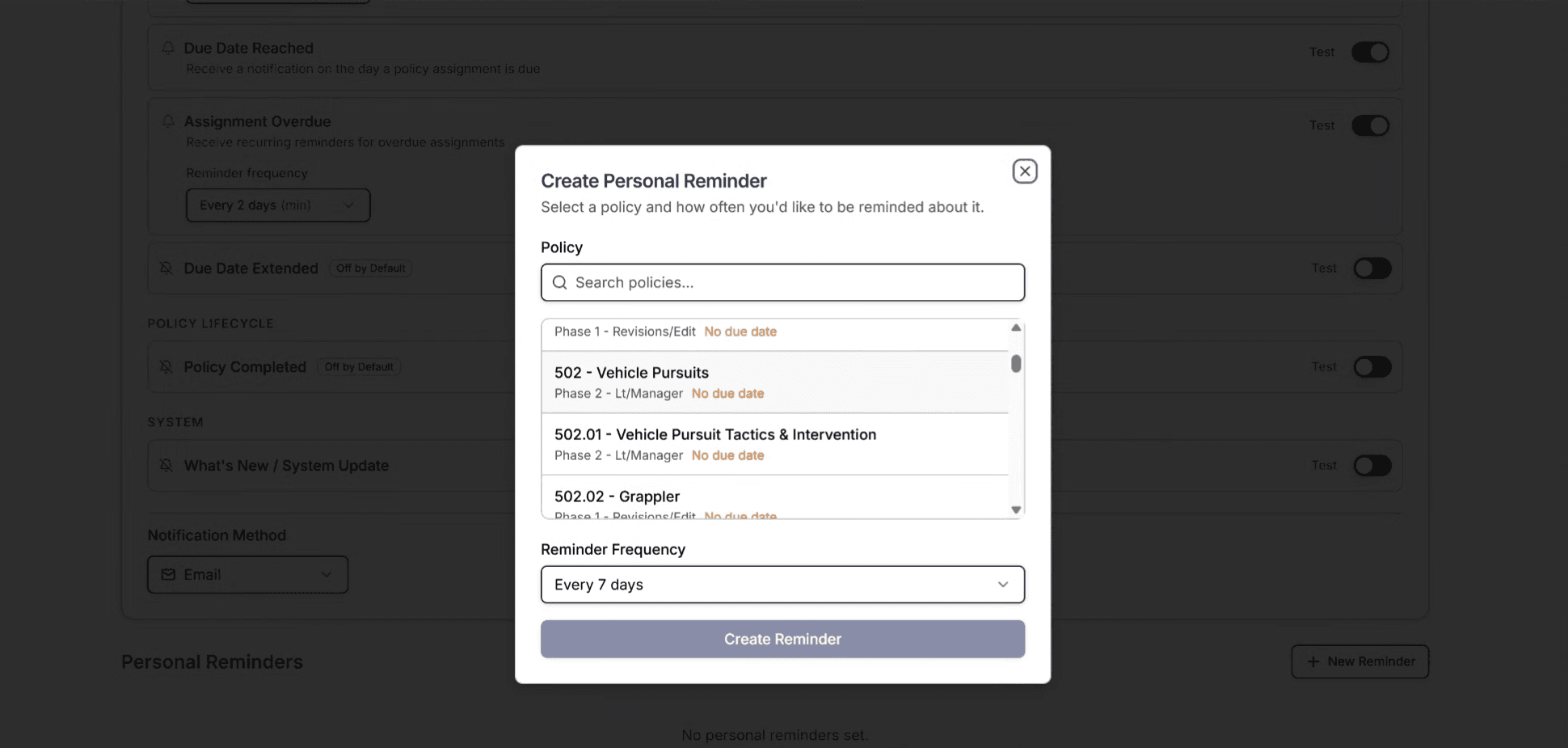
Admins keep their own preferences separate from the department defaults, since the assistant chief does not need the same inbox as the policy manager. Users can also set personal reminders. A commander who has delegated a policy can subscribe to a recurring nudge to check that it is still moving.
Overdue alerts only go to people who still owe something.
“If somebody already did it, I don’t want them getting an email telling them it’s overdue, because then they think they have to do something. I only want it to go to the people who actually need to take action.”
New users get a welcome email when their account is created, with a link to a training video. That matters when a brand new system is going out to a whole department.
The reporting command staff asks for
Three kinds of reporting come out of the portal, and each one replaced something manual or something that did not exist.
- The policy audit trail. A per-policy report showing who was assigned, what they changed and when, through every phase down to the signature stage. Jeana prints it and hands it to the chief with the policy, so his pen-to-paper signature sits on top of a full record of who touched it.
- Workflow analytics. Phase metrics, per-user performance and bottleneck analysis, showing which units are sitting on work and for how long. The department set a goal of 40 days from start to finish on a policy, and the dashboard tracks how they are doing against it. When a supervisor asks whether someone is keeping up, there is a report for it.
- The strategic plan dashboard. Built for reporting up to city hall, with targets against actuals, completion rates, and policies broken down by category and phase.
“I sat down with my commander and we literally went through it with pen and paper. We want this, we don’t want this, change this. Then I went in and made those tweaks, piece by piece.”
Why build instead of buy
The $15,000 to $20,000 the department did not spend is the easy headline. It is not the first thing Jeana mentions.
“It’s kind of a twofold benefit. Cost was a big benefit. But realistically, once we actually got into the system and started building it, it was the fact that we have control of it.”
Off-the-shelf software would not have had phase locking that matched Peoria's workflow, or fail-to-review logging, or a strategic plan dashboard shaped by a commander over an afternoon with a notepad. And it would not have changed when the department needed it to.
“Honestly, the customization has been the biggest thing. I say I want it to do this, and we can make it happen.”
What’s next
- Finishing the Accreditation Management Portal, linked to the same database as policy.
- Policy archiving, clearing completed policies out of the active queue while keeping them reportable.
- Trend reporting, once the system has enough history behind it.
Zite for law enforcement
See how agencies run policy, accreditation and training on Zite, with SSO, permissions and audit logs.
Talk to our team