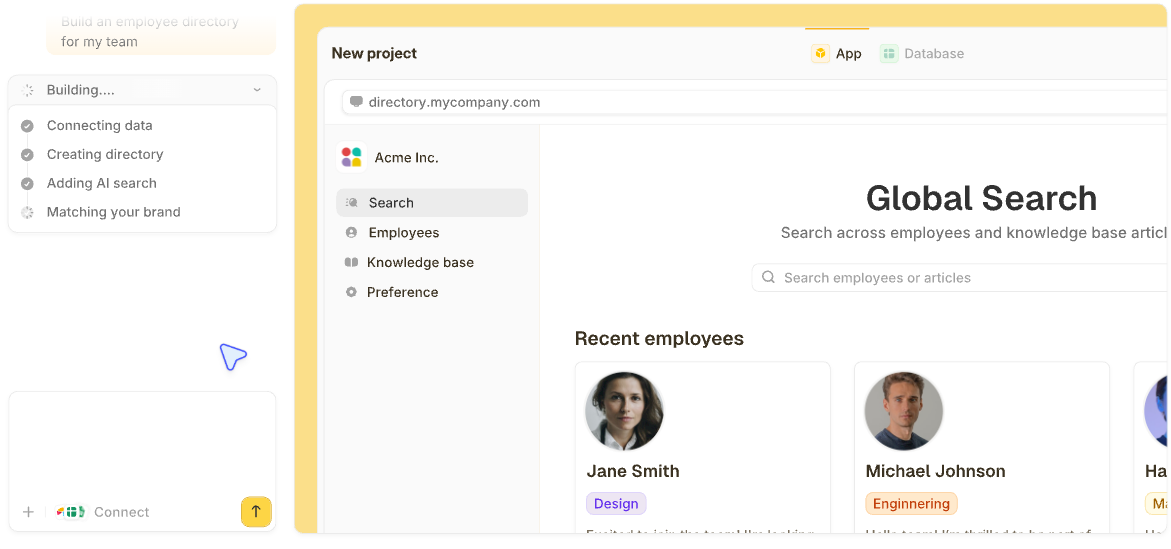


I built multiple apps with Lovable, Replit, and Zite over the past few months to see how they perform for real apps. Here’s what each platform does well, where they struggle, and which one I’d choose for businesses in 2026.
Lovable vs. Replit vs. Zite: What's the difference?
Choose Lovable if you're prototyping a React web app.
Choose Replit if you want flexibility to build either web or mobile apps and need collaboration features.
Choose Zite if you're building production-ready business apps and want to build and maintain them without involving a developer.
Meet Lovable: Best for web app prototypes
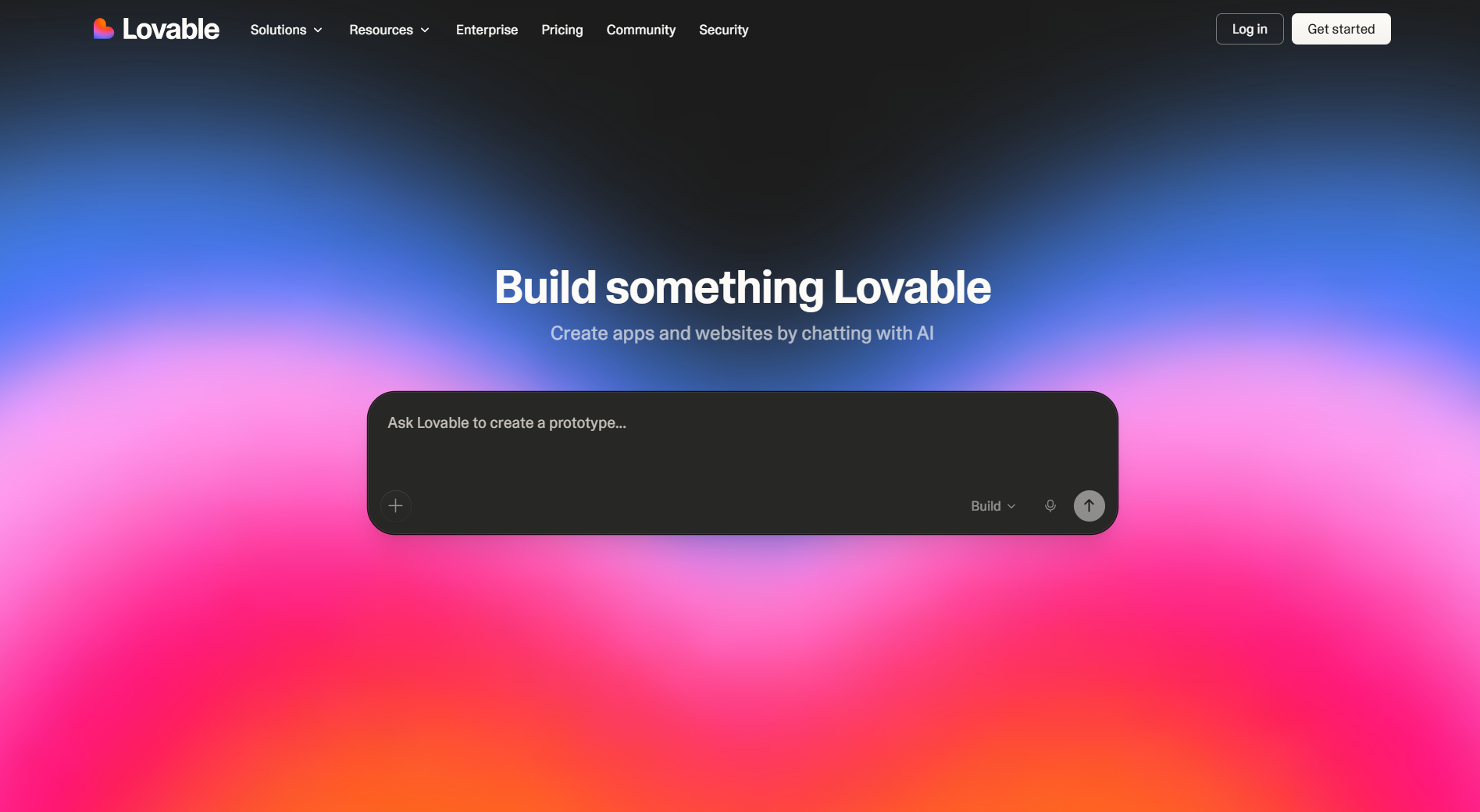
Lovable is a prompt-to-app builder that builds React web apps from plain English descriptions.
It lets you describe an app in a chat window and generates the React frontend, database connection, and API calls. You can click elements in the live preview to edit them visually or prompt for changes.
Key features:
- GitHub sync: Every project pushes to a GitHub repository once you configure it. Developers can open the project in their own coding editor, make changes, and those updates sync in Lovable.
- Lovable Cloud: This is Lovable's backend service. It stores your app's data, manages user logins, and handles file uploads. It's powered by Supabase (a database platform). Technical users can connect their own Supabase project for more control.
- Visual editing: Click any element on the page to change text, colors, or layout directly.
- Credit-friendly error fixing: Lovable doesn't charge credits when the AI is correcting its own mistakes, which helps keep costs down during debugging.
Limitations:
- Only builds React web apps.
- Complex apps eventually require manual code fixes when the AI can't resolve issues.
- Lovable Cloud costs are billed separately on a usage basis, especially as your app scales.
Best for: Solo founders prototyping product ideas, designers turning mockups into working apps, and small teams that need a shareable demo quickly.
Meet Replit: Best for web and mobile prototypes
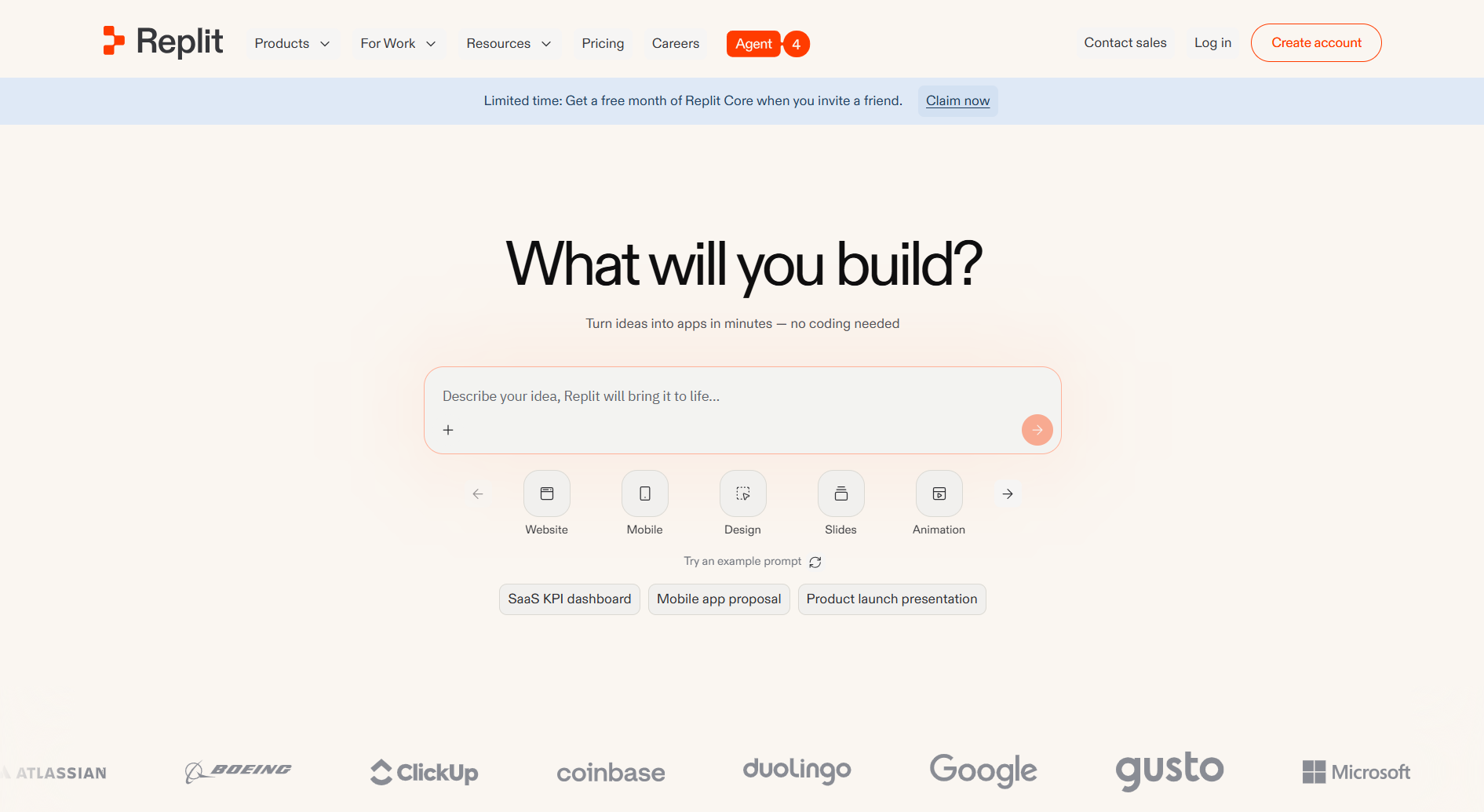
Replit is a browser-based development platform with an AI Agent that builds web and mobile apps from prompts. It also sets up databases, authentication, and handles deployment.
Key features:
- Multi-language support: Build apps in React, Python, Node.js, and 50+ other languages.
- AI Agent: Describe what you want, and the Agent writes code, installs dependencies, sets up databases, and deploys. It can work autonomously for extended sessions.
- Multiple deployment types: Autoscale (adjusts resources with traffic), static (for simple sites), reserved VM (always-on), and scheduled (runs at set times). Replit picks the best option for your app, though you can choose it yourself.
- Import apps: Bring existing projects from GitHub, Bolt, Lovable, or Figma designs and continue building in Replit.
- Built-in database: Use the built-in SQL database to store your app and user data.
Limitations:
- Credits burn fast, especially during debugging loops. Users regularly report spending well beyond their monthly plan.
- The database interface is more developer-oriented. Non-technical users will hit a learning curve.
Best for: Developers and semi-technical builders who want AI to handle the scaffolding while keeping full control over the codebase.
Meet Zite: Best for production-grade business software
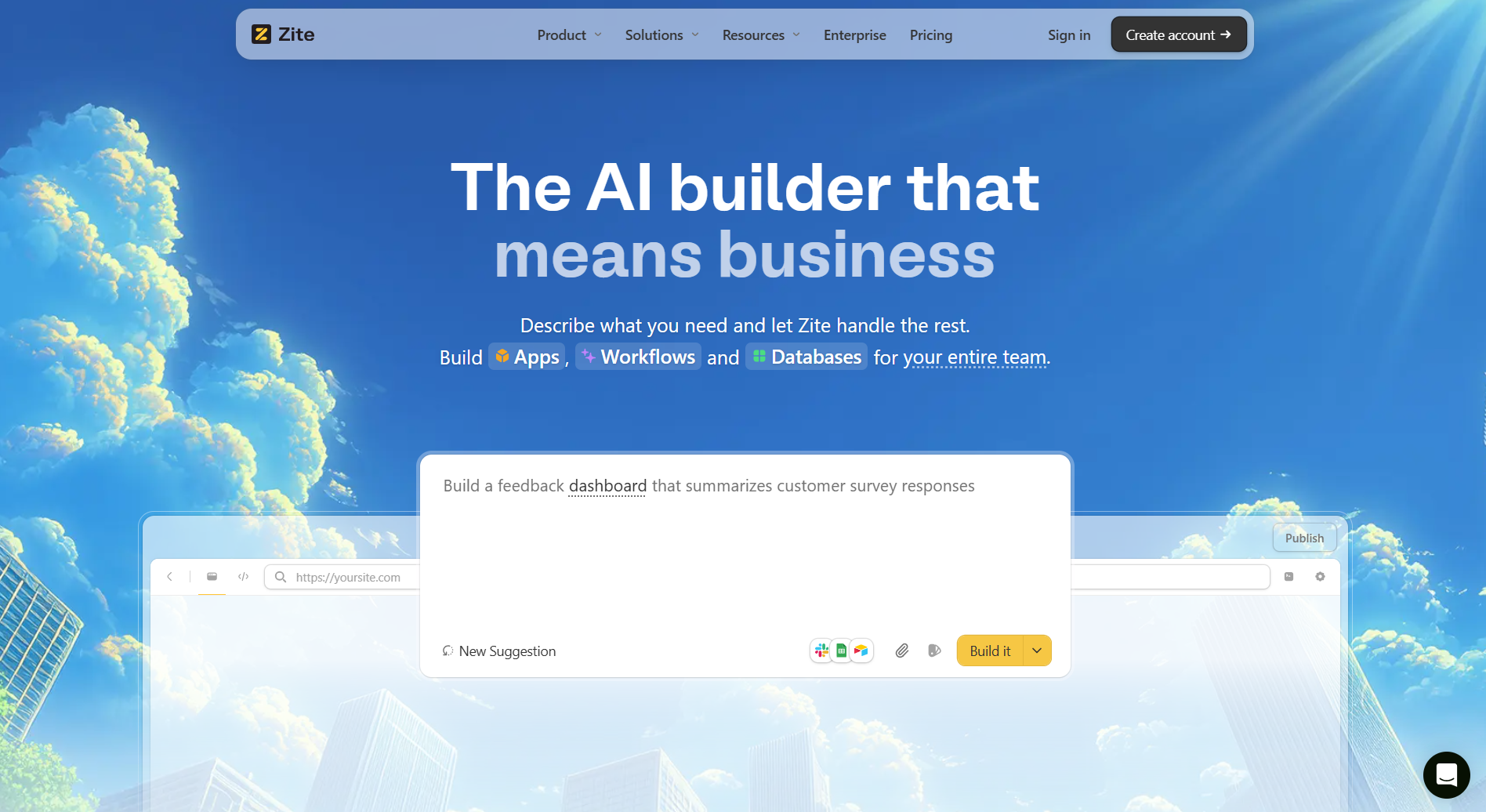
Zite is an AI no-code platform designed for production-grade business software. It’s perfect for non-technical users since the app logic is fully visual and doesn’t require reading code to understand.
Key features:
- Built-in database: Zite proposes tables and relationships based on your app description. Once you approve, it generates the entire table and fields. The interface looks and feels like a spreadsheet, so you can browse and update records without writing queries. It also supports importing from CSV, Airtable, or Google Sheets.
- Visual workflows: Backend logic renders as step-by-step flowcharts. You can replay test runs, trace how data moves through each step, and identify exactly where something went wrong. Then ask Zite to fix the specific issue instead of re-prompting blindly.
- Production-ready defaults: Secure hosting, access control, and user authentication come standard. Enterprise plans add SSO and audit logs.
- Visual edits: Click any component to modify it directly rather than describing the change in chat.
Limitations:
- No code export. Apps are hosted on Zite's infrastructure.
- Not intended for consumer-facing apps or SaaS products.
Best for: Building business apps like portals, dashboards, or custom CRMs without code.
Lovable vs. Replit vs. Zite: Feature-by-feature comparison
App building capabilities
All three platforms generate apps from prompts. You describe what you want in a chat, and the AI builds it.
The real differences show up after that first draft. Editing, troubleshooting, and maintaining the app is where these tools’ approaches differ.
Lovable includes a visual editor. You can click elements and restyle them directly on the page, which makes UI tweaks easy. The challenge starts when your app gets more complex.
If functionality breaks, the logic lives in generated code. To diagnose it, you either read through that code or ask the AI what went wrong. You’re relying on the model to correctly interpret its own output. Sometimes it does. Other times, it gets stuck in debugging loops.
Replit is more autonomous. It can run for longer independently, asking follow-up questions, running tests, and debugging on its own. It supports web apps, mobile apps, animations, and even 3D projects.
Replit also has a visual editor for UI updates. However, like Lovable, debugging the app usually means blindly re-prompting the AI or digging through generated code files.
Zite has a visual UI editor and also exposes the backend logic in a way that non-technical users can follow. Every workflow appears as a visual flowchart. You can click into each step and see what triggers what. You can replay a workflow and watch exactly where it fails. When you re-prompt, you're telling Zite exactly what's broken instead of hoping it figures it out.
Winner: Zite. Business users can troubleshoot and update complex workflows without needing a developer or reading code.
Database and data management
Lovable uses Lovable Cloud for its backend, which runs on Supabase. It can generate your database tables and structure for you, and there’s a built-in data viewer in the UI. You can also connect it to your own Supabase project if you prefer. That setup gives you flexibility, but configuring it properly does require some SQL and database knowledge.
Replit provisions a managed Postgres database automatically with every project. It's a real, configurable database with an SQL console. Powerful if you know your way around SQL, but for a non-technical user, the interface is intimidating.
Zite handles database creation conversationally. Describe what your app needs, and Zite proposes the tables, fields, and relationships. After you approve, it builds the database. The editing interface is spreadsheet-like. You can click a cell and change the value. You can also pull in existing data from CSV files, Airtable, or Google Sheets without writing migration code.
Winner: Zite for ease of use.
Pricing and cost predictability
Lovable uses a credit-based system. Plans start at $25 per month and include a monthly credit allowance. Each time you build or modify the app, credits are deducted. More complex requests consume more credits. If an AI makes mistakes, it doesn’t cost you credits to fix it.
Lovable Cloud and AI usage are billed separately based on usage. All plans support unlimited users, which is a plus.
Replit starts at $20 per month, billed monthly. That includes $20 in usage credits, which cover Agent prompts, deployments, databases, and storage. Once those credits run out, you move to pay-as-you-go pricing.
When you publish and run an app, you’re using compute, memory, storage, networking, and database resources. These are also metered and factored into usage once your included credits run out. If your app gets popular or you run prolonged tasks, your bill may spike.
You can read more about it in our Replit pricing breakdown.
Zite starts at $19/month, billed monthly, for 100 credits. It only consumes credits during active AI building, and debugging AI mistakes doesn’t consume credits. Plans include hosting, the database, authentication, and storage. There's no separate infrastructure bill.
All plans support unlimited apps and users, even the free plan. There’s also no per-user charge.
Winner: Zite because it offers a more predictable cost structure.
Enterprise and security features
Lovable is SOC 2 Type II compliant, which means outside auditors have reviewed how it protects data. On Business and Enterprise plans, you can use single sign-on (SSO) so people log in with tools like Okta, Auth0, or Microsoft Entra ID. Enterprise plans also add automatic user management (SCIM), so large teams can control access from one place.
Replit is SOC 2 Type II compliant. On higher-tier plans, it includes SSO, SCIM, role-based access control, and the option to restrict apps so only your team can access them. You can also run security scans to check your code for known vulnerabilities before sharing the app with users.
Zite’s enterprise plans are SOC 2 Type II compliant. It offers secure hosting, access controls, and user authentication. Enterprise customers also get app-level SSO, so your end users sign in through your own identity provider, plus audit logs to track who did what in your apps.
Winner: Zite. All three check the standard enterprise boxes (SOC 2 Type II, SSO, access controls). Where Zite pulls ahead is that visual workflows let you inspect and verify exactly what your app does before connecting it to real business data.
With Lovable and Replit, the logic lives in generated code, so verifying your app's security posture requires reading that code. Zite makes it auditable without a developer.
Deployment
Lovable publishes with one click to a lovable.app subdomain or your own custom domain. You can also export the generated code to GitHub and deploy it to platforms like Vercel, Netlify, or any hosting provider you prefer.
All plans allow you to share apps publicly. Business and Enterprise plans add internal-only publishing so you can limit access to authenticated workspace members.
Replit gives you the most deployment options. It supports multiple deployment types, including autoscale (traffic responsive), static (for sites where user input doesn’t change the app), reserved VM (always on compute), and scheduled deployments for timed execution.
Custom domains are available on paid plans, and higher-tier plans allow private deployments restricted to organization members.
The tradeoff is complexity. Your deployment type affects performance and cost. Autoscale hosting, for example, can increase your bill as traffic grows. You’re making infrastructure decisions, not just publishing an app.
Zite keeps deployment simple. Apps default to internal-only publishing, so your team members get access immediately. You can enable authentication on any plan to control external access. Publishing is one click to Zite’s managed infrastructure, with custom domains available on paid plans.
There’s no code export option. That means no deployment overhead, but it also means you stay within Zite’s hosting environment.
Winner: Zite is the simplest path to getting an app in front of your team, with no deployment decisions.
What real users are saying
I gathered feedback from G2, Reddit, Product Hunt, and community forums to see how these tools perform for other users.
Here’s what users love and what they’re frustrated with:
Lovable
Pros:
- Speed to first version: Reviewers consistently highlight how fast Lovable gets a polished interface up and running.
- GitHub export flexibility: Developers appreciate being able to pull their project into a local editor and continue building outside the platform.
- Clean visual output: Lovable tends to produce better-looking UIs with fewer iterations than competitors.
Cons:
- Error correction loops: Multiple users describe the AI getting trapped in cycles where fixing one bug creates another. Each attempt costs credits.
- Struggles at scale: Once an app moves past simple data entry or adds interconnected features, the AI's accuracy drops. Several reviewers ended up writing code manually to finish their project.
Replit
Pros:
- Idea-to-app speed: Users praise how quickly the Agent turns a natural language description into a working full-stack app. You don’t have to set up or install anything.
- Agent autonomy: The AI can scaffold entire projects with minimal guidance. It handles its own follow-up questions, runs tests, and fills in details you didn't specify.
- Mobile app workflows: Replit supports mobile apps, with pathways to submit apps to the App Store and Google Play.
Cons:
- Credit consumption is the top complaint: Reddit threads are full of users who burned through their monthly allowance in hours. One user reported a $350 charge in a single day of active Agent use.
- Hosting costs scale unpredictably: Autoscale deployments and managed database pricing climb once your app gets real traffic, making it hard to budget.
Zite
Pros:
- Quick time to working app: An Airtable community member built an Asana-style task management tool with task assignments and status tracking in a single afternoon using Zite.
- Visual troubleshooting: The flowchart view lets you trace data through each workflow step and see where it stopped. Users highlight this as the feature that saves the most time when something breaks.
- No user-based pricing: Teams can deploy apps to 10 or 100 people without the cost changing.
Cons:
- Still growing: The template library and community resources are thinner compared to more established platforms.
- No code export option: You’re building and hosting within Zite’s environment, with no option to export the underlying code.
Lovable vs. Replit vs. Zite: How to make your choice
Lovable and Replit are strong for prototyping applications, but you need to have the technical skills to step in and fix logic manually once AI prompts stop working. If you're building internal tools, client portals, dashboards, or other business software and don’t want to touch code at all, Zite is the better option.
Pick Lovable If:
- You're building React web prototypes
- You need to hand off a codebase to developers for continued work
- You don't mind managing separate Lovable Cloud billing as your app scales
Pick Replit If:
- You want to build both web and mobile apps
- You need granular deployment controls (autoscale, reserved VM, scheduled runs)
- You're comfortable reading and editing code when the AI gets stuck
Pick Zite If:
- You're specifically building production-grade business apps
- You don’t want to code at any stage of development
- You want one flat bill with no surprise cloud charges
My verdict
After hands-on testing with all three, Zite is the strongest choice for non-technical teams building business software. The visual workflows are what tip it over the edge. When the app breaks, you’re not guessing what the AI generated or digging through code to understand the logic. You open the flowchart, follow the steps, and see exactly where the process failed.
Lovable and Replit remain excellent for rapid prototyping, but both eventually require technical skills to maintain complex apps.
Get started with Zite
Build fully custom apps with Zite without reading or editing code. The free plan gives you enough credits to build a working app and make several rounds of changes. No credit card required!
Frequently asked questions
What's the best AI app builder for people without coding experience?
Zite is one of the best AI app builders for people without coding experience. It lets you visually trace your app’s logic step by step. You can verify how your app works, find problems, and request fixes without understanding code.
What are AI credits?
Credits are the internal currency AI platforms charge for each AI interaction. Building, editing, and debugging requests costs credits. Understanding how fast they're consumed is critical to managing your monthly spend.
Can I move my app off these platforms?
You can move off Lovable easily if you use your own Supabase backend, since you can export your React code and database. With Replit, you can export your project’s codebase, but you’ll need to set up hosting and database services yourself outside of Replit’s infrastructure.
Which tool has the lowest risk of surprise charges?
Zite has one of the lowest risks of surprise charges because hosting, database, and authentication are all included in your plan, and AI credits cover the building process. Lovable has a separate Lovable Cloud bill for database and authentication services, and Replit deducts credits for compute resources.