

I’ve tested and reviewed different order management software platforms to understand how they work. Here’s everything you need to know about what this software does, its benefits, and how to choose between buying and building in 2026.
What is order management software?
Order management software tracks and manages orders from the moment they’re placed through fulfillment, delivery, and returns. You might also see it referred to as an order management system (OMS).
Think of it as mission control for your orders. Instead of juggling spreadsheets and emails across five different platforms, this software pulls everything into one place. It consolidates inventory levels, order status, shipping updates, and customer details.
Key functions of order management software
Most OMS handle the following tasks:
- Order capture and validation: The system pulls in orders from wherever they originate. This can be your website, Amazon, a sales rep's phone call, or a retail partner. It checks payment details, verifies inventory, and flags anything suspicious before processing.
- Inventory management: It keeps track of stock levels across all your warehouses, stores, and fulfillment centers. When someone buys the last blue widget, the system updates everywhere instantly.
- Order routing: The OMS decides which location should fulfill each order based on proximity, stock availability, shipping costs, or rules you set.
- Shipping and tracking: It integrates with carriers (FedEx, UPS, USPS, or regional options) for rate shopping, label generation, and tracking updates.
- Returns processing: When a customer sends back an order, the system creates a return authorization, processes their refund, and adds the item back to your available inventory.
How order management software works
Order management software works by automating every step of the order process, from capturing the order, validating payment, to shipping and processing returns.
The exact process looks different for every business.
For example, a small Etsy shop shipping from a garage has a much simpler setup than a brand with three warehouses and 1000 SKUs.
To give you a full picture of what order management software can do, the example below assumes a mid‑sized ecommerce operation that gets around 500+ orders per day and has multiple fulfillment locations.
Here's what happens when someone orders online:
- Capture: Customer completes checkout. The software receives order details via API or webhook.
- Validate: System confirms payment processed, checks for fraud signals, and verifies shipping address.
- Allocate inventory: The system reserves 1 unit of Product X from available stock to prevent overselling.
- Route: Based on your rules, the system picks the optimal fulfillment location, maybe the warehouse closest to the customer, or the one with excess stock you're trying to move.
- Fulfill: Pick list appears on a warehouse worker's screen or handheld device. They grab the item, scan it, and pack it.
- Ship: The system generates a shipping label, schedules pickup, and captures the tracking number.
- Invoice: It marks the order complete, sends the invoice, and records revenue.
- Returns (if needed): The customer initiates a return, receives a return number, ships the item back, and the system processes the refund and updates inventory.
For a small business, an OMS might simply pull orders from a single online store into one dashboard. Then generate a list of what to pack and shipping labels so the owner can ship from their home or shop.
Benefits of an order management system
An order management system reduces the amount of work that goes into keeping track of your inventory and fulfilling orders.
These are its main benefits:
- Fewer stockouts and oversells: Real-time inventory sync means you stop selling products you don’t actually have in stock.
- Faster fulfillment: Automated routing and pick lists cut processing time; a pick list is a simple document or on‑screen list that shows exactly which items to grab for each order.
- Lower shipping costs: Smart routing chooses the most cost‑effective fulfillment location, and rate shopping finds the best carrier price for each package.
- Better customer experience: Customers get accurate tracking updates, send you fewer emails asking where their order is, and returns run more smoothly.
- Easier day‑to‑day management: You can see new orders, what’s in transit, and what’s delayed in one place instead of jumping between spreadsheets and apps.
- Ready for busy seasons: When order volume jumps (like on Black Fridays), the system handles more of the work automatically. You don’t need to hire a big temporary team or work late to keep up.
Who needs order management software?
You probably need one if:
- You're selling through more than one channel (website + Amazon, for example)
- You have multiple fulfillment locations
- You're processing more than 100 orders per day
- Overselling or stockouts happen regularly
- Your team spends hours on manual data entry between systems
- Order errors are eating into margins
You can probably wait if:
- Order volume is under 50 per day and is manageable manually
Implementation options for order management software
There are three main ways to get an order management system up and running:
- Buy an off‑the‑shelf product
- Build on a no‑code/low‑code platform
- Commission a fully custom build
Option 1: Use off-the-shelf OMS
With this approach, you pick a ready‑made OMS and adapt it to your business instead of building anything yourself.
Typical implementation follows these steps:
- Choose a platform (like Ordoro, Skubana, and Blue Yonder)
- Connect your sales channels via built-in integrations
- Configure fulfillment rules and workflows
- Train your team
- Go live
It’s usually the fastest way to move off spreadsheets or basic e‑commerce back‑office screens.
When it's a good fit:
- You sell through common channels like Shopify, Amazon, or retail POS, and want plug‑and‑play integrations.
- You prefer proven software with a support team and a clear roadmap over building and maintaining your own system.
Pros
- Faster to get running.
- Updates, hosting, and maintenance are handled for you.
- Comes with prebuilt integrations to major ecommerce, shipping, and accounting tools.
- Battle‑tested features and best‑practice workflows out of the box.
Cons
- Ongoing subscription and usage fees can grow as order volume increases.
- You’re constrained by the product’s feature set and roadmap.
- Deeper customization often requires paid professional services or workarounds.
- You may end up paying for modules or features you never touch.
Option 2: Build custom with no-code/low-code tools
In this path, you assemble your own OMS using AI or a drag-and-drop builder instead of writing everything in a traditional programming language. You design the data model, screens, and workflows, and the platform handles the hosting, access control, and integrations.
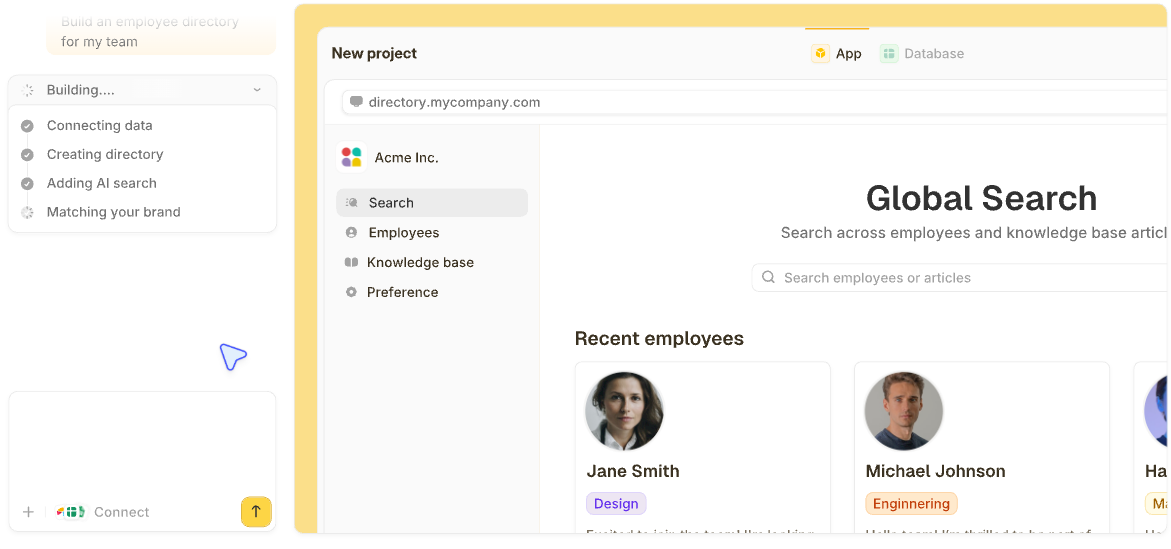
On a platform like Zite, which is AI-first, you can describe the workflow you need, and it generates your apps. It easily connects to your data sources and has pre-built integrations for tools like Airtable, Zapier, and Stripe.
When it’s a good fit:
- Your workflows don't fit neatly into off-the-shelf solutions.
- You expect your process to change frequently and want to iterate quickly without waiting on a vendor.
- You want more control than a standard SaaS app gives you, but don’t have (or don’t want to hire) a full dev team.
- Budget is limited, but you have operations or product people who are comfortable configuring software.
Pros
- Much more flexibility to match your exact workflows, fields, and business rules.
- Easier to modify over time.
- Lower upfront cost than full custom development.
- Non‑developers (ops, product, and founders) can own and adjust the system instead of everything going through engineering.
Cons
- Though AI-first platforms like Zite can generate initial designs and databases from a description, you'll still need to refine them.
- Complex integrations or edge cases may still require custom connectors or help from someone technical.
Option 3: Commission a fully custom build
This approach means hiring engineers or an agency to design and build an order management system from scratch, tailored exactly to your business.
When it’s a good fit:
- Your workflows are highly specialized and can’t be supported by off-the-shelf or no-code tools.
- You need full control over architecture, performance, and integrations.
- You have the budget and internal capacity to maintain custom software long-term.
Pros
- Complete control over features, data models, and integrations.
- No dependency on a vendor’s roadmap or pricing changes.
Cons
- Highest upfront and ongoing cost.
- Longer time to launch.
- Ongoing maintenance, security, and updates are entirely your responsibility.
9 order management software options to consider
There are several order management software platforms to consider, ranging from custom no-code builders to enterprise tools and ecommerce-native systems.
Here’s a quick overview of how they compare:
Common challenges in OMS implementation
Even with the right software, getting order management software working smoothly is rarely plug‑and‑play. Most issues come from how the new system fits into your existing tools, data, and people’s day‑to‑day habits.
These are the common challenges you should be aware of:
- Integration headaches: Your OMS needs to share data with your online store, warehouse tools, shipping carriers, accounting system, and CRM. Off‑the‑shelf products might not offer every connector or API you need. With no‑code platforms, you may still have to build a custom connector for some systems.
- Inventory accuracy: An OMS is only as good as your inventory data. If your physical counts don't match your system, you'll still oversell or not sell available products. Plan for an inventory audit before you go live.
- Change management: Your warehouse team has built habits around the current fulfillment process. If you don’t explain why the change is happening, they might avoid using the system.
- Choosing the wrong size of tool: Some businesses buy enterprise OMS when they only run a single online store, so they pay too much and struggle with complexity. Others try to stretch basic tools past their limits. Match the solution to your actual order volume and sales channels.
Use Zite to build order management software
If off-the-shelf OMS platforms feel too rigid and custom development feels too expensive, there's a middle path.
Zite is a no-code, AI app builder for building production-ready business software. Teams can create fully customized order management workflows by describing what they need in plain English.
Zite comes with the core order management building blocks out of the box. It includes a built-in database, secure hosting, granular permissions, and role-based access control, and it’s SOC 2 Type II compliant.
And you don’t have to dig into code to update your apps. You can inspect workflows in the flowchart-style interface and resize or restyle UIs directly on the page. The database is spreadsheet-like, and you can fix data issues without writing queries.
There’s no need to hire expensive developers or buy expensive off-the-shelf software that doesn’t meet your needs. Anyone, technical or non-technical, can build and maintain software themselves.
What you can build:
- Order intake forms that capture orders from sales reps, phone calls, or manual entry
- Order database with real-time status tracking and full history
- Routing logic that assigns orders to the right fulfillment location based on your rules
- Team dashboards showing order queues, fulfillment progress, and bottlenecks
- Customer portals where buyers can track orders and initiate returns
- Automated notifications when orders ship.
Plans start at $19/month and support unlimited users and apps, making it an affordable option for teams that want customization and security without heavy development.
It’s not a replacement for a high-volume consumer ecommerce backend. Zite isn’t trying to be Shopify, and it doesn’t handle public storefronts or checkout flows. But it’s great for custom, internal order management that non-technical teams can build and maintain over time.
Ready to build your order management system fast?
For SMBs that need more than spreadsheets but don't want to pay enterprise OMS prices or wait months for implementation, building with Zite gets you a production-ready system in days.
Frequently asked questions
What is the difference between an OMS and CRM?
An OMS manages orders, inventory, fulfillment, and returns, while a CRM tracks who the customer is and how your team interacts with them.
Is SAP an OMS system?
SAP is not solely an OMS, but it offers order management capabilities through products like SAP S/4HANA (Sales and Distribution, Commerce) and SAP Order Management foundation. These can function as an OMS in large enterprises, but they are typically complex to implement and require significant configuration and integration work.
Should you build your own OMS?
You should build your own OMS if your business has unique order workflows that can't be met by standard, off-the-shelf solutions.