

Softr caps builders, app users, and workflow actions, so you can outgrow your plan fast. Features, like SQL databases and API calls, are also locked behind expensive tiers. I dug into each plan to find out where these limits kick in and the alternatives you can switch to.
Softr pricing plans: At a glance
The main things to watch out for with Softr's pricing plans are how many builders, app users, and records you get at each tier, and whether you'll eventually need higher-tier features like SSO.
Here's a quick overview of what each plan offers:
Softr pricing plans breakdown
Softr's pricing scales with the number of builders, app users, and database records. Every plan now includes unlimited apps, but you're still capped on user groups, custom domains, AI credits, workflow actions, and integrations.
App users are also split into two buckets. Team users share a business email domain with one of your builders, and Client users are everyone else (including anyone on Gmail). Each plan caps both.
The bigger issue is that some key features are gated behind expensive tiers. Even if you're fine with the basic feature set, you have to upgrade to a high-priced plan to use your own SQL databases or make API calls from your app.
Free plan: $0/month
This plan works for testing Softr, building a personal project, or shipping a single internal MVP. But the 5 app user limit and lack of a custom domain make it impractical for any client-facing software.
What's included:
- Unlimited apps on softr.app domains
- Up to 3 builders
- 5 app users
- Visitor and logged-in user groups only
- 5,000 Softr Database records (1,000 per database)
- 500 workflow actions per month
- 5 AI credits per month
- All building blocks, including custom (vibe code) blocks
- Softr API and MCP access
- Integrations: Airtable, Google Sheets, Notion, Slack, and more (39 apps)
Best for: Individuals testing the platform or building personal projects with minimal users.
Pros:
- Unlimited apps and databases
- Free forever
- Access to the AI Co-Builder and every building block
Cons:
- Softr badge on all apps
- 5 app users is too restrictive for real projects
- No custom domain or custom code support
- Only 5 AI credits a month
Basic plan: $25/month ($19/month billed annually)
The Basic plan suits a small app that needs its own custom domain and more room for data. Custom code, embedding, and advanced permissions all wait on Pro. Once you need more than 10 app users, you are quickly nudged into Pro or Business pricing.
What's included:
- 1 builder (extra builders cost $6/month each, or $5/month billed annually)
- 10 app users (5 Team + 5 Client)
- 50,000 Softr Database records (10,000 per database)
- 2,500 workflow actions per month
- 10 AI credits per month
- 1 custom domain
- Conditional form logic
- Automated database backups every 3 days
- Extra built-in workflow actions (email triggers, bulk actions, PDF extraction, web scraping)
- Integrations: Same as Free
Best for: Solo makers or freelancers building lightweight apps for a handful of users.
Pros:
- Custom domain included
- 10x the database records of Free
- Automated database backups
Cons:
- Only 10 app users, and you can't buy more on this plan
- No custom code or embedding
- Light Softr branding is still visible
Pro plan: $119/month ($99/month billed annually)
The Pro plan looks affordable at first, but pricing increases as soon as you pass 10 Team users or 50 Client users. Extra app users start at $1/month each. As your portal grows, you can quickly approach Business-level pricing without the advanced features.
What's included:
- Unlimited apps
- 2 builders (extra builders cost $12/month each, or $10/month billed annually)
- 60 app users (10 Team + 50 Client), with extra users from $1/month
- 3 custom user groups
- 500,000 Softr Database records (50,000 per database)
- 10,000 workflow actions per month
- 50 AI credits per month
- Advanced permissions and visibility rules
- Email OTP and Google sign-in for app users
- Custom code and API connectors
- Call API action, comments, inline editing, and e-signature
- Export CSV and PDF
- Embed blocks on other sites
- Remove Softr branding and use a custom email sender
- Integrations: Adds monday.com, ClickUp, Supabase, Xero, and Coda
Best for: Companies building client portals or internal tools that need branding control and advanced features.
Pros:
- Remove Softr branding completely
- API calls, custom code, and exports are finally available
- Advanced permissions for client-facing portals
Cons:
- Extra custom domains cost $15/month each, or $13/month billed annually
- Only 3 custom user groups
- No installable mobile app (PWA). That starts on Business
Business plan: $395/month ($329/month billed annually)
The Business plan is the first plan with SQL database support, two-factor authentication, and 10 custom user groups. If you need to connect to PostgreSQL, MySQL, SQL Server, or HubSpot, this is the minimum entry point.
The $276/month jump from Pro (billed monthly) is steep. But if your data lives in SQL databases, you have no choice. There's no cheaper path to that integration.
What's included:
- Unlimited apps
- 3 builders (extra builders cost $24/month each, or $20/month billed annually)
- 130 app users (30 Team + 100 Client), with extra users from $2/month
- 10 custom user groups
- 1 million Softr Database records (200,000 per database)
- 25,000 workflow actions per month
- 100 AI credits per month
- Two-factor authentication and domain-restricted signup
- Installable mobile app (PWA) and push notifications
- Global search and global data restrictions
- Priority support and onboarding
- Integrations: Adds HubSpot, Excel, PostgreSQL, MySQL, and SQL Server
Best for: Companies needing SQL connections, two-factor authentication, or granular permission controls at scale.
Pros:
- SQL database support finally unlocked
- Two-factor authentication for app users
- Installable mobile app (PWA) with push notifications
- 130 app users before add-on charges
Cons:
- Still no SSO. That's Enterprise only
- Extra domains still cost $15/month each, or $13/month billed annually
Enterprise plan: Custom pricing
If your organization requires SAML/OpenID authentication, SOC 2 reporting, or audit logs, this is the plan for you.
What's typically included:
- Everything in Business
- SSO (SAML/OpenID)
- SCIM provisioning
- Audit logs
- SOC 2 report access
- IP whitelisting
- Advanced security and governance
- Customer success manager
- Payment by invoice
- Custom agreements and SLAs
Best for: Organizations with strict security requirements, compliance needs, or high-volume usage.
Pros:
- Only plan with SSO support
- Customer success manager for faster resolution
- Custom limits based on actual needs
- SOC 2 reporting for compliance
Cons:
- Requires a sales conversation
- Minimums may exceed what smaller teams need if they just need one feature, like SSO
Which Softr plan should you choose?
Choose Free if you:
- Want to test Softr before committing
- Are building a personal project with 5 or fewer users
Choose Basic ($19/month, billed annually) if you:
- Need a custom domain for a small app
- Want automated database backups
- Have 10 or fewer app users
- Are the only person building
Choose Pro ($99/month, billed annually) if you:
- Need custom code, API calls, or embedded apps
- Have up to 60 app users (more with paid add-ons)
- Need to remove Softr branding for client-facing portals
Choose Business ($329/month, billed annually) if you:
- Need SQL database connections (PostgreSQL, MySQL, etc.)
- Require two-factor authentication or domain-restricted signup
- Need an installable mobile app (PWA) with push notifications
Choose Enterprise if you:
- Require SSO (SAML/OpenID) for compliance
- Need SOC 2 reporting or audit logs
- Want a dedicated customer success manager
Is Softr worth the cost?
Softr is worth the cost if you already have data in Airtable, Google Sheets, or Notion and want to build a light interface on top of it without coding.
Below is how to know if it's right for you.
Softr is worth it if you:
- Need client portals or internal tools quickly.
- Have non-technical team members who need to build apps.
- Already use Airtable as your backend.
- Need a quick front-end layer on existing data.
Skip Softr if you:
- Need SQL connections on a budget.
- Need AI to handle complex logic and multi-step automations.
- Want to build complete applications, not just interfaces on data.
Hidden costs to watch out for
Before committing to Softr, understand these less-obvious limitations:
- Per-user pricing on Pro: The Pro plan looks affordable at first, but pricing increases as soon as you pass 10 Team users or 50 Client users. As your portal grows, you can quickly approach Business-level pricing without the advanced features.
- Per-builder pricing: Each paid plan includes 1 to 3 builders. Every extra builder costs $6 to $24 a month on monthly billing, depending on your plan, so adding teammates to the build side raises your bill too.
- Custom domains cost extra: Paid plans include 1 custom domain. Additional domains cost $15/month each, or $13/month billed annually. If you're an agency with 5 clients on custom domains, that's additional costs on top of your plan.
- SQL databases locked in the Business plan: There's no budget-friendly option for PostgreSQL, MySQL, or other SQL connections. You jump straight to the Business tier, which costs $395/month ($329/month billed annually).
- AI credits run out fast: Basic includes 10 AI credits a month and Pro includes 50. Base-plan credits reset monthly and don't roll over, so heavy AI building means buying add-on credits.
- Feature gating is aggressive: Call API actions, CSV and PDF exports, custom code, and embedding all require Pro ($119/month). These feel like basic features, not premium add-ons.
Softr alternatives & pricing comparison
Softr's pricing works for teams building simple interfaces on Airtable data. But feature gating and user limits push teams toward alternatives.
Here's how the top alternatives stack up:
Glide is the closest match for spreadsheet-first teams, and Glide vs Softr mostly comes down to where your data lives and how many users each app needs to support.
Zite vs Softr: Which should you choose?
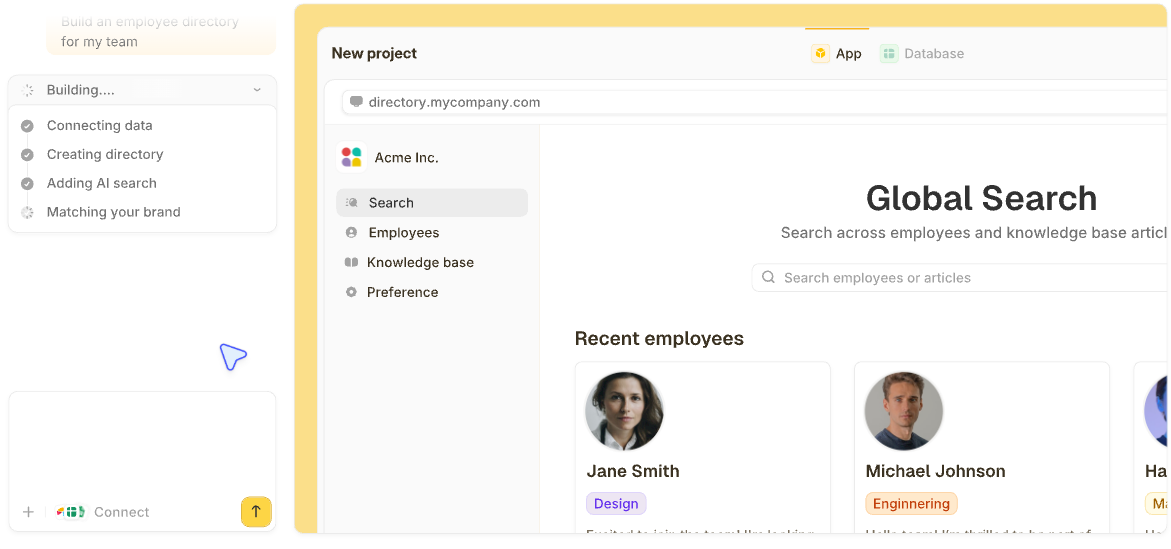
Softr builds interfaces on top of existing data. Zite builds full applications, meaning you get the UI plus the underlying database, workflows, and logic you'd expect from production business software.
Where Zite beats Softr:
- Production-ready out of the box: Zite apps ship with authentication, role-based permissions, and secure hosting. On higher tiers, you get SSO, audit logs, and the option to enforce two-factor auth.
- Visual backend logic: Zite shows workflows as flowcharts you can inspect and modify. Non-technical teammates can understand what's happening without digging into configuration panels.
- Complexity and depth of apps: Zite is better suited for production-ready business software with richer workflows, more complex logic, and deeper backend behavior, not just data views.
- AI that builds the logic, too: Zite is AI-first. It generates more of the app (pages, flows, and data structures) from prompts, so you get to a functional, branded version faster. Softr's AI Co-Builder now takes follow-up prompts, but its docs note that complex multi-step automations may still need manual adjustments.
- Auto-generated data schema: Both tools offer a built-in database, but Zite can generate your data model (tables and relationships) from prompts. You have to structure Softr's database manually.
- Unlimited users on all plans: Zite includes unlimited users and editors on all plans, including free. Softr caps app users at every tier, charges for extra users on Pro and Business, and bills separately for each extra builder.
Softr is better if you:
- Need simple client portals without complex logic.
- Prefer drag-and-drop blocks over AI generation.
My bottom line on Softr pricing
Softr is a solid choice for teams building lightweight interfaces on data, but it gets expensive once you have decent traffic.
The Pro plan is $119/month ($99/month billed annually) and feels like the true starting point for teams. You get 2 builders, 60 app users, custom code, and the ability to remove Softr branding.
If you want more value for your money, consider Zite. You get unlimited apps and users completely free. Paid plans start at $25/month (billed monthly) and include 100 AI credits, 100,000 database records, and no Zite branding. This is enough to generate and deploy several production apps.
Companies like The Athletic, Bombas, and Domino's Pizza already use the platform to build their business software.
Frequently asked questions
How much does Softr cost per month?
Softr's paid plans start at $25/month (or $19/month billed annually) for the Basic tier. This includes 1 builder, a custom domain, and up to 10 app users.
Is Softr free forever?
Yes, Softr's Free plan has no time limit. You can use it indefinitely with unlimited apps, 5 app users, and 5,000 database records. However, the 5-user limit makes it impractical for most business use cases.
What's the cheapest Softr plan with unlimited apps?
Every Softr plan, including Free, now comes with unlimited apps on softr.app domains. The real limit is users: Free allows 5 app users, and you need Pro ($119/month) before you can pay for users beyond your plan's allowance.
Can I use SQL databases with Softr?
Yes, you can use SQL databases with Softr, but only on the Business plan or higher. SQL databases (PostgreSQL, MySQL, SQL Server) are locked behind this tier.
What's the best Softr alternative for teams?
Zite is the best Softr alternative for teams who need production-ready business apps, not just interfaces on existing data. It offers conversational AI building, a built-in database with auto-generated schema, and unlimited users on all plans, including free.