

A client portal exists to end one specific annoyance. A client asks you to resend a file you already sent, and nobody can find the original.
I've built and tested portals across agencies and ops teams. Here's the plain-English version of what they do, what they cost, and whether you need one.
What is a client portal? The 30-second answer
A client portal is a secure login-protected space where each client sees only their own files, updates, and requests. It replaces scattered attachments and status-check messages with one organized hub.
The bottom line: a portal gives your clients a single, secure place to work with you and gives your team fewer repetitive questions to answer.
Key features
Most client portals share the same core parts:
- Secure login and role-based access: Each client signs in and sees only their own records, never another client's data.
- Document sharing: Upload, share, and collect files in one place, instead of email attachments that expire or get lost.
- Messaging and updates: Keep conversations and status updates next to the work they relate to.
- Forms and e-signatures: Collect intake details, approvals, and signatures without a separate tool.
- Activity tracking: See what was accessed, submitted, or signed, which helps with accountability and follow-up.
- Branding: Put your own logo and colors on the portal, so it feels like your business rather than a generic tool.
How does a client portal work?
A client portal sits between your business and your clients as a shared space. You control what goes in, and each client sees only what belongs to them.
The flow is straightforward:
- You set up the portal with the sections your clients need, covering documents, forms, updates, or requests.
- You connect your data, whether that's a database, a spreadsheet, or files you upload.
- You invite each client, who gets their own login.
- Each client sees only their own records, controlled by role-based permissions.
For example, an agency gives each client a login where they see their own project files, approve deliverables, and submit requests, while the agency manages everything from one place behind the scenes.
Who needs a client portal?
Portals earn their keep when the same client comes back repeatedly, and the relationship involves files, approvals, or status questions.
Agencies and consultancies
Creative and marketing teams use portals to share deliverables and collect approvals without version confusion. The client sees the current draft rather than hunting for the latest attachment in a thread.
Accounting and legal teams
These teams handle the most sensitive documents of any group on this list, including tax records, contracts, and case files. A portal keeps those behind a login with a record of who opened what.
Both fields also carry compliance obligations, and a forwarded email attachment leaves no reliable trail to prove who saw what.
Legal technology company A2J Tech uses the same no-code approach for a related job. It handles data intake for legal kiosks across seven states, using forms rather than a client-facing portal.
Service businesses with ongoing projects
Home services, recruiting, and similar teams run multi-step processes with a client waiting at each stage. A portal shows the client where things stand and cuts the status emails.
Bombas scaled its Giving Program to more than 4,000 partners on a portal-style app, which shows how far this model stretches once the client list grows.
Who can skip one
A portal is hard to justify for one-off transactions. If you sell once and never exchange documents again, an account page or a simple email covers it.
Client portal security, explained plainly
Security is the main reason teams move off email, so it's worth understanding what actually protects the data.
The stakes are measurable. IBM's Cost of a Data Breach Report 2025 puts the global average breach cost at $4.44 million, down 9% from the year before.
Four controls do most of the work:
Compliance requirements vary by field. Legal and financial teams often need SOC 2 Type II evidence before an enterprise client will sign, and teams handling EU resident data fall under GDPR.
What does a client portal cost?
Three pricing models dominate:
- Per-client pricing: You pay for each client account. Predictable early, expensive once you're serving dozens of clients.
- Per-user pricing: You pay per person with a login. Costs climb as each client adds team members to the portal.
- Single-rate pricing: One monthly fee regardless of headcount, which keeps the bill steady as you grow.
Ready-made portal tools run from a free tier to a few hundred dollars a month. The cost that surprises teams is growth. A per-client model that looks cheap at five clients gets painful at fifty.
Build-it-yourself options change the math. A no-code builder like Zite is free to start, and Pro is $19/month, both with unlimited users.
Client portal vs ready-made portal software
There are two ways to get a portal, and the right one depends on how closely it needs to fit your process.
A ready-made tool gives you a fixed set of features you configure. A no-code builder lets you shape a portal around your exact workflow, including custom data and logic.
For a standard document-and-messaging portal, a ready-made tool is quick. For a portal that matches how your business runs day to day, a no-code builder gives you more control without code.
Winner: the no-code builder, for most teams. Ready-made tools are fast to set up, and the fit gets worse as your process outgrows what the vendor built for. The moment your process has a wrinkle the vendor didn't anticipate, you work around the tool instead of with it.
See this guide to building a custom client portal for the build path.
What I liked and didn't like about client portals
Pros (what works well)
- Fewer repetitive questions: Clients self-serve for files and updates, so your team spends less time answering requests to resend things.
- Better security: Sensitive documents live behind a login with role-based access, rather than in forwarded email chains that anyone can screenshot.
- A more professional client experience: A branded, organized hub signals that you run a tight operation, which builds trust.
- A record of what happened: Activity logs settle questions about who approved what and when, which email threads rarely resolve cleanly.
Cons (where it falls short)
- Adoption takes effort: The best portal sits unused if clients don't log in. You have to nudge people off email, which takes follow-through.
- Ready-made tools can box you in: Preset portals are fast to start and hard to reshape when your process doesn't fit their template.
- Setup exposes messy processes: Mapping a workflow into a portal forces you to define it first, which takes longer than teams expect.
Should you use a client portal? My take
A client portal is worth it if you work with clients repeatedly and share files, updates, or approvals with them. If your client work is a one-off or lives entirely in email by preference, the setup may not pay off yet.
A client portal is perfect for:
Agencies sharing deliverables, accounting and legal teams collecting sensitive documents, service businesses running ongoing projects, and any team drowning in client email threads.
Skip a client portal if you:
- Work with clients who won't move off their current channel.
- Need a full internal tool rather than a client-facing one, in which case a broader no-code app builder fits better.
How to build a client portal in 5 steps
You don't need a developer to build a portal in 2026. Here's the path with a no-code builder:
- Map what clients need to see: List the documents, updates, and actions each client should have.
- Set up your data: Create the tables and fields, or connect existing data, that the portal will show.
- Build the client-facing views: Add the pages clients will use to view files, submit forms, and check status.
- Set permissions: Use role-based access so each client sees only their own records.
- Invite clients and test: Send logins to a pilot client first, confirm they see the right data, then roll out.
Pro tip: Start with one client or one workflow as a pilot. It's easier to fix problems with a single account than after you've onboarded everyone.
Client portal best practices I wish I knew earlier
A portal succeeds or fails on how you roll it out, which matters as much as how you build it.
Rollout is where portals live or die:
- Keep it focused: Move your highest-value workflow first and leave the rest on email until that one sticks.
- Set clear rules: Decide which communications belong in the portal and hold to them, so it doesn't become one more channel to check.
- Track usage: Watch who logs in and which features they use, so you can nudge the clients still stuck on email.
Common mistakes to avoid:
- Overbuilding early: A cluttered portal confuses clients. Add features as needs prove out.
- Ignoring adoption: Clients drift back to email without training and follow-up.
My verdict on client portals
A client portal is one of the highest-return upgrades a client-facing business can make. It cuts busywork and raises the client experience at the same time.
The real question is whether to buy a ready-made tool or build one that fits your process. For a standard portal, a ready-made tool works.
Zite suits a portal shaped around how your business runs, giving you a real database, custom views, and role-based access without code. Unlimited users keep the cost steady as you add clients.
Ready to build your client portal?
You can describe the portal you want and have a working version in an afternoon, with no developer required.
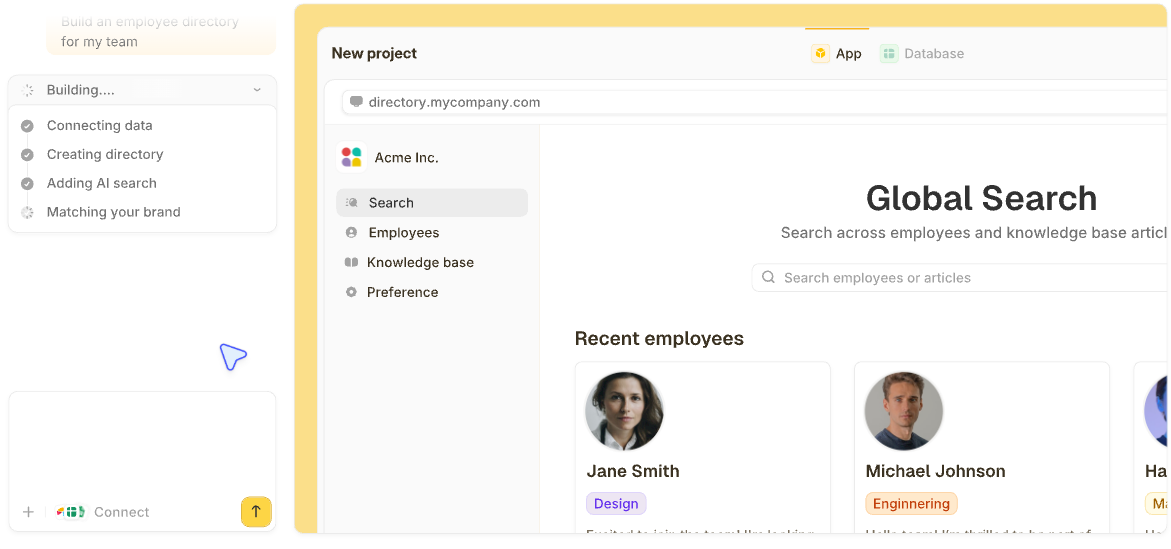
Zite generates the app, the database, and the logic from a plain-language description. Apps are published internally by default, with roles and permissions deciding who sees what.
Zite also builds the logic that makes the portal do things, not just show them. A request coming in can email your team or drop a message in Slack. Stripe handles the payment if one is due. Each step runs as a traceable workflow. The connections run directly to Gmail, Outlook, Slack, Teams, and Stripe, so none of this needs a separate integration tool.
You can also publish to the web when clients need access from outside your team. Teams like Bombas and Domino's build business apps this way.
Start building with Zite for free and build your first client portal today.
Frequently asked questions
What is a client portal in simple terms?
A client portal is a secure website where your clients log in to see their own documents, messages, and updates in one place. It works like online banking for your business relationship, where each client has a private dashboard showing only their own information.
Are client portals secure?
Yes, client portals are secure when built well. They keep documents behind a login with role-based access instead of in email. Look for encryption, multi-factor authentication, and audit trails, because the tool you pick sets your security floor.
How much does a client portal cost?
Client portal costs range from free tiers to a few hundred dollars a month, depending on the tool and how it charges. Per-client and per-user pricing both climb as you grow, while Zite, at $19/month, includes unlimited users.
What is the best tool to build a client portal?
The best tool to build a client portal depends on how custom it needs to be. For a portal shaped around your own workflow with a real database and unlimited users, Zite is the strongest pick. For a standard document portal, ready-made tools work well.
Can I build a client portal without coding?
Yes, you can build a client portal without coding. No-code builders like Zite let you describe the portal and generate the app, database, and permissions, then adjust them visually without hiring a developer.