

I tested Jotform across its forms, apps, tables, and store builder to see where it works well and where it falls short. Here's my complete Jotform review, breaking down its strengths, limitations, and alternatives in 2026.
Quick verdict
Jotform is great for building professional online forms for surveys, payments, and other types of data collection. It has an app builder and Tables for simple portals and internal tools, but it’s still focused on form-based workflows rather than fully custom software projects.
What is Jotform?
Jotform is an online builder for creating forms, workflows, apps, and payment pages. You build forms and apps with a visual drag-and-drop editor, customize them with your branding, and collect submissions without writing code.
The platform started as a form builder but expanded into adjacent products:
- Jotform Apps: Bundle forms into mobile-friendly apps
- Store Builder: Create simple e-commerce storefronts
- Jotform Tables: Manage submission data in a spreadsheet-like workspace
- Jotform Sign: Collect e-signatures
These products make Jotform feel like an app platform, but the reality is that everything revolves around forms. The apps are just forms that are easier to access from a mobile device. The stores look and feel like online shops, but underneath, they're built using Jotform's forms.
Jotform Tables, on the other hand, are built to store submissions, but they lack relational database features.
Forms power everything. So, if you need an app that goes beyond collecting and displaying form responses, skip to the Zite section below.
Key features of Jotform
Jotform offers a suite of features for building forms, apps, stores, and managing data.
These features include:
- 800+ templates across categories like business, education, healthcare, and e-commerce
- Drag-and-drop builder plus AI generator for quick form and app creation
- Payment integrations with 40+ payment gateways, including PayPal, Stripe, and Square
- Add to home screen functionality for mobile-like experiences
- Push notifications to alert users about updates or new submissions
Limitations
Some of Jotform’s downsides include:
- Limited app complexity since you're essentially packaging forms, not building real software
- Strict form and submission limits on paid plans
- Can't publish to app stores and can only add to your home screen
Jotform pricing
Jotform pricing is tied to caps on forms, submissions, and storage. Hitting any cap forces an upgrade even if the others are underused.
Even the highest paid plan (Gold) only supports 100 forms and 10,000 submissions per month, so organizations with many small forms or high traffic will routinely hit ceilings.
Team collaboration is also paywalled behind Enterprise. All standard plans (Starter, Bronze, Silver, Gold) are single‑user. Teams that need multiple editors working on forms simultaneously have limited options.
If you're in healthcare, you need the Gold plan at $129/month (billed monthly) for HIPAA compliance, which gets pricey for smaller practices.
Below is a quick overview of the pricing structure:
- Starter ($0/month): The free plan only supports 1 user, 5 forms, and 100 monthly submissions. So while you get access to most features, the limits mean you'll hit the ceiling quickly for any real business use.
- Bronze ($39/month, billed monthly): Includes 25 forms, 1,000 monthly submissions, and 1 GB of available space. This plan fits freelancers and small businesses who've outgrown the free tier but don't need high volume.
- Silver ($49/month, billed monthly): Includes 50 forms, 2,500 monthly submissions, and 10 GB of available space. It also removes Jotform branding from your forms. This is the most popular plan for small businesses that need clean, professional forms.
- Gold ($129/month, billed monthly): Includes 100 forms, 10,000 monthly submissions, and 100 GB of available space. It also includes optional HIPAA compliance for healthcare providers collecting patient data. This plan fits organizations with high volume or compliance requirements.
- Enterprise (Custom): Includes SSO, advanced security features, dedicated support, unlimited forms, and unlimited submissions. Contact Jotform for pricing.
For a full breakdown of which plan to use, see our Jotform pricing guide.
Jotform reviews: What real users are saying
I read hundreds of reviews from sites like G2, Reddit, and independent blogs to find out what users love and don’t like about it.
Pros
- Ease of use: Users consistently praise how quickly they can get started. One reviewer noted that the setup is fast using templates and the drag and drop builder.
- Push notifications: Multiple users appreciate how push notifications make it easy to alert everyone at once.
- Integrations: Users highlight the ability to connect with tools like payment gateways, Google Sheets, and Slack.
- AI chatbot addition: Some users call the AI chatbot feature a great addition, noting that it handles customer inquiries 24/7 without requiring constant availability.
Cons
- Limited design customization: Users repeatedly mention that the forms are bland and don't offer room for customization. You can change colors, fonts, and background images, but the overall structure is preconfigured.
- Performance issues: Several reviewers report buffering problems and noticeable lag when customers open the Jotform app or while editing the complex form.
- Can't publish to app stores: This is the most common complaint with the app builder. Users can only share apps via link or QR code, which means coaching end-users through an unfamiliar installation process.
My personal take on Jotform
The core Form Builder is excellent at its job. The drag-and-drop interface makes sense immediately, and the templates give you a running start on almost any form type. I built a customer feedback form with conditional logic and Stripe integration in about 15 minutes. That's legitimately fast.
I mostly used Tables to manage submissions after the form was live. It was much cleaner than exporting CSVs constantly, and the filtering and assignment features made it easy to organize responses without switching tools.
During testing, Jotform worked best on straightforward data collection.
The limits showed up when I pushed beyond forms. Jotform Apps produced pages that worked but looked dated and blocky. The preconfigured layouts don't give you room for a modern aesthetic. The Store Builder can handle simple product sales, but not anything resembling a real e-commerce storefront.
My experience matches most of the user reviews. It’s easy to use and fast to deploy, but customization is limited. The inability to publish to app stores is also a dealbreaker for anyone trying to distribute apps broadly.
Is Jotform right for you?
Jotform is right for your business if you need professional online forms without coding or technical setup. It works best when your primary need is collecting data, feedback, registrations, or payments through forms. For apps, look at other Jotform alternatives.
Who will love it
- Small businesses needing professional forms for contact, feedback, registrations, or orders
- Anyone who wants to display their forms in a mobile-friendly app
- Healthcare providers needing HIPAA-compliant forms (on the Gold plan)
- Freelancers and consultants collecting client information, contracts, or payments
Who should avoid it
- Anyone needing app store distribution
- Businesses building internal tools like CRMs, dashboards, or inventory systems
- E-commerce businesses that need inventory management, shipping logic, or customer accounts
Final verdict
Jotform is one of the easiest ways to collect data and payments online via forms or simple form-based apps. For a builder that handles dashboards, portals, CRMs, and internal tools beyond forms, Zite is the better choice.
The best Jotform alternative: Zite
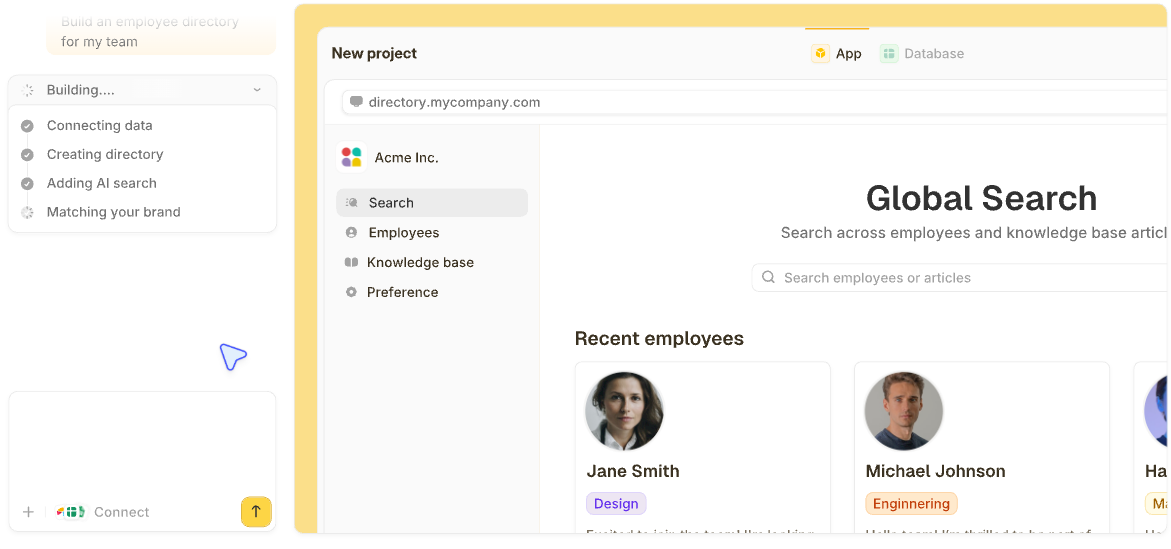
After testing Jotform, I found that Zite works better for business apps that go beyond forms. It does everything Jotform does and more. You can build forms for data collection, surveys, quizzes, and payments, or go further with production-grade dashboards, client portals, CRMs, and internal tools.
You describe the business tool you want, and Zite creates the apps in minutes without code. Fillout, from the same team, handles form functionality and integrates directly with Zite.
Zite helps you build real software with features like:
- AI app generation: Zite lets you create fully custom apps on top of your form responses by simply describing them. There’s virtually no learning curve, so the jump from form to actual software is straightforward for a non‑technical user.
- Form functionality included: Fillout is a full-featured form builder with 1,000 free monthly submissions, which is 10x Jotform's free plan. It integrates directly with Zite, so you get professional form collection plus the ability to build full applications on top of that data.
- Real database underneath: Zite autogenerates your tables and fields and displays them as a spreadsheet you can directly browse and edit.
- Visual workflows: The app logic appears as flowcharts. You can inspect them to understand how they work and verify they're correct. When the app breaks, just trace the flowchart, rerun the flow to pinpoint where it failed, and ask Zite to fix it.
- Modern design output: Apps look polished and contemporary, not blocky and dated. You get design flexibility that Jotform Apps can't match.
- Unlimited users on every plan: No per-seat charges. Invite your whole team without cost scaling.
Zite is free to get started. You get unlimited apps/users and enough credits to build and make several rounds of changes. No credit card required.
Start building with Zite today→
Frequently asked questions
What is Jotform Apps used for?
Jotform Apps is used to bundle multiple forms into a single mobile-friendly app. Common use cases include order submission apps, event registration portals, appointment booking systems, and internal employee request forms.
Can I publish Jotform Apps to the App Store or Google Play?
No, you cannot publish Jotform Apps to the Apple App Store or Google Play Store. Jotform Apps are progressive web apps (PWAs) that can only be shared via link, QR code, or added directly to a device's home screen.
Is Jotform Apps free?
Jotform Apps is included with every Jotform plan, even the free Starter plan. Your app will have limits on forms, submissions, views, and storage, depending on the plan you get.
What is the best alternative to Jotform?
Zite is the best alternative if you need to build more than form-based apps. It uses AI to build dashboards, portals, CRMs, and internal tools, all with unlimited users on every plan.