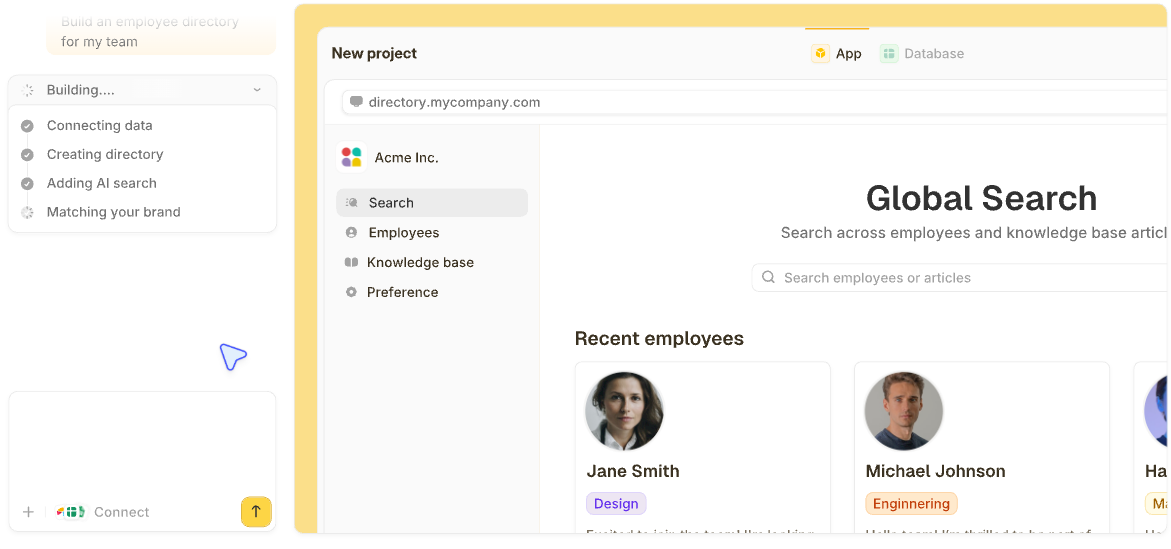


The choice between Stacker and Softr comes down to depth of control versus speed and polish. Stacker builds permission-heavy internal tools on its own database or a connected source, while Softr has grown into a broader no-code builder with its own database, forms, and workflows.
I built the same client portal in both. Here's what each does well and which one fits your team.
Stacker vs Softr: what's the difference?
Stacker is a portal builder with the deepest record and field-level permissions of the two, running on its own built-in database or data you connect from Airtable, Google Sheets, or SQL.
Softr is a no-code builder that started as an Airtable front end and now includes its own database, forms, and workflow automation.
Choose Stacker if: your data lives in Airtable or SQL and you need fine-grained control over who sees which records.
Choose Softr if: you want a client portal that looks sharp with little effort, with forms and workflows built in.
Meet Stacker: features and highlights
Stacker builds portals and internal tools on a built-in relational database, and can two-way sync with Airtable when your data lives there, on a schedule that defaults to every 30 minutes. Other connected sources, Google Sheets among them, come in read-only.
It was one of the first tools to make a database readable as an interface, and permissions remain its strong suit.
It's built for internal teams and agencies that need tight control over who sees which records. Its move toward an AI-agent model added scheduled tasks, automations, and custom skills.
The main tradeoffs are a plainer look than Softr and no native forms.
Meet Softr: features and highlights
Softr began as an Airtable front end and has grown into a fuller no-code builder. It now includes its own database, native forms, workflow automation, and payments, alongside connections to more than 15 data sources.
It's built for teams that want a client-facing portal quickly, using drag-and-drop blocks. The output looks modern out of the box, which suits external-facing work.
The main tradeoff is that each tier caps the number of app users you can have, so a larger audience means a higher tier.
Stacker vs Softr: at a glance
Stacker vs Softr: feature-by-feature comparison
Permissions and access control
This is Stacker's clearest advantage.
Stacker offers record and field-level permissions that rank among the most detailed in the category. You control exactly which rows and fields each user sees, which matters for sensitive internal data.
Softr has real user groups and role-based access that cover most needs, though custom user groups start on Pro at $119 a month. For the deepest per-field control, reviewers give Stacker the edge.
Winner: Stacker.
Design and client-facing polish
Softr pulls ahead here.
Softr's drag-and-drop blocks produce a modern, branded portal out of the box, which suits client-facing and public work. A non-designer ends up with something that looks professional.
Stacker focuses on making a database readable for internal users, so its output leans utilitarian. Function comes first, and a portal your clients will see usually needs more polish than that.
Winner: Softr.
Forms, workflows, and built-in features
Softr is the more complete tool now.
Softr includes native forms, a workflow builder, and payments, so you run a portal without bolting on other tools. Form responses stay unlimited on every plan.
Stacker added scheduled tasks, automations, and custom skills through its AI-agent model, though it still has no native forms and no native payments. You connect outside tools for those.
Winner: Softr, for native forms and payments.
Data sources and where your data lives
Both tools have closed this gap.
Stacker now includes its own built-in relational database, and two-way syncs with Airtable (on a default 30-minute schedule) when you'd rather keep data where it is. Other sources like Google Sheets connect read-only. Its newer builds moved away from an Airtable-first setup, which longtime users found disruptive.
Softr connects to more than 15 sources and now has its own native database, so you can hold data inside Softr or connect what you already run. That flexibility helps teams reduce their dependence on spreadsheets.
Winner: Tie. Both hold data natively or connect out, so pick on the rest of the feature set rather than the data layer.
Pricing and how it scales
Here the two tools stop resembling each other.
Stacker runs one paid plan, Standard, starting at $50 a month for 250 credits. It includes unlimited agents, unlimited customer portals, white-label portals, custom domains, and no per-seat charges. Enterprise is quoted case by case.
That $50 is only the entry point: the same plan runs up to $2,000 a month as you buy more credits, and credits reset monthly rather than roll over, so the rate card is simple, but your bill still depends on how much work you give the agent. You start free with $100 in credits.
Softr starts free with 5 app users, then Basic at $25, Pro at $119, and Business at $395 a month ($19, $99 and $329 billed annually). Each paid tier caps app users, split between your own team and outside clients: 5 and 5 on Basic, 10 and 50 on Pro, 30 and 100 on Business. Pro and Business let you buy more, up to 50 and 250 on Pro and 100 and 500 on Business, so you upgrade mostly to admit more people rather than to unlock features.
Winner: Stacker. One plan with no seat charges beats four tiers with user caps, though heavy agent usage burns credits fast.
What real users are saying
Both tools rate well, though Softr has far more reviews, sitting around 4.7 across 726 reviews, while Stacker sits near 4.4 from a smaller pool. I pulled feedback from G2, Reddit, and Capterra.
Stacker
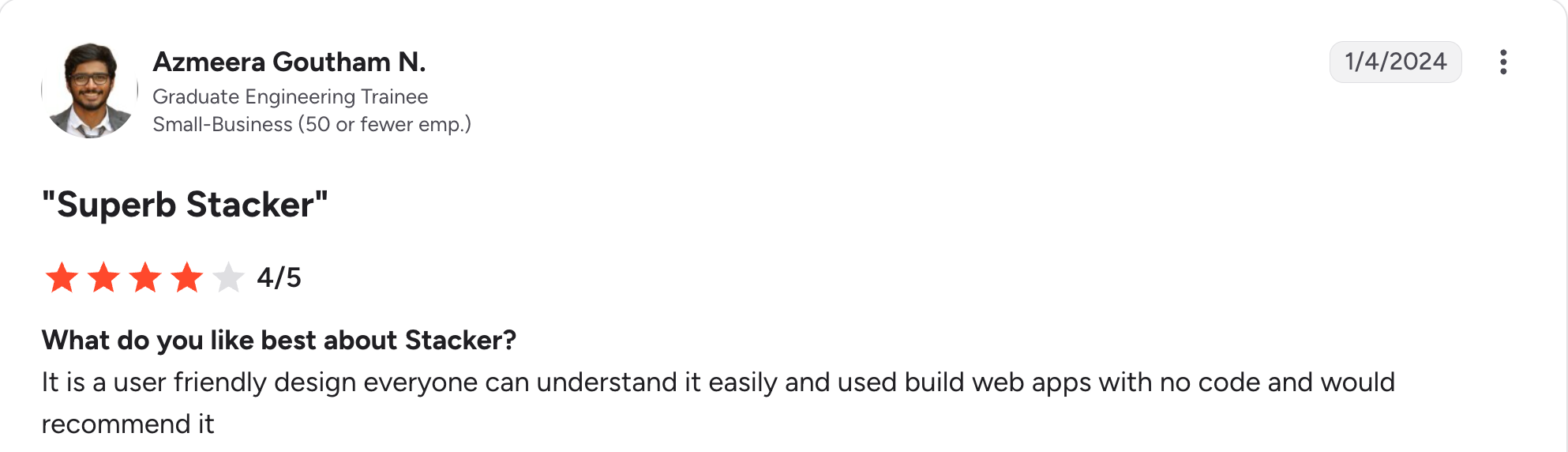
“It is a user-friendly design everyone can understand easily and use to build web apps with no code, and I would recommend it.” Azmeera Goutham N, G2
Pros: Users find it approachable enough that non-technical staff can build with it, and they praise the record and field-level permissions once apps are running. Teams with a heavy Airtable dependence find it a natural fit.

“Sometimes the Airtable connection might have limitations that Stacker can't fix on its own.” Mauricio D, G2
Cons: Reviewers flag the lack of native forms and workflows, the utilitarian look, and disruption from the move away from Airtable in newer builds.
Softr

“I like Softr because it's more affordable and customizable (e.g., design, permissions). The native Airtable integration is very good, and support is also fantastic.” Verified User, Reddit
Pros: Users point to the price, the design and permission controls, and the native Airtable integration. Reviewers also call out how quickly a client-ready portal comes together, with forms, workflows, and payments built in.

“There are some more advanced features that require some money.” Myles W, Capterra
Cons: Reviewers note the app user caps climb the tiers quickly, and that block-based building hits limits when a feature isn't available as a block.
How to make your choice
The decision comes down to what you're building and where your data lives.
Stacker wins for internal teams on Airtable or SQL that need the deepest permissions. Softr wins for teams that want a client-facing portal that looks sharp with little effort, with forms and workflows built in.
Both now natively hold data, so the data layer isn't the deciding factor it once was. That leaves the choice to how much permission control you need, weighed against how polished the client-facing side needs to look.
Stacker is better for:
- Internal teams whose data already lives in Airtable or SQL
- Use cases that need record and field-level permissions.
- Teams that value data control over design polish.
Softr is better for:
- Teams shipping branded portals for outside clients.
- Projects needing native forms, workflows, and payments in one tool.
- Non-technical teams that want speed and a modern look.
My verdict
Both are capable portal builders, and the pick is clear. Stacker for permission depth, Softr for speed and built-in features. Softr covers more ground for most client-facing work, while Stacker holds its edge on fine-grained permissions.
Both now offer AI generation, so neither starts from a blank canvas. Each one hits a ceiling after that, and the ceilings are different. Softr builds from a catalog of blocks, so a feature with no block is a feature you don't get. Stacker sends every change back through its agent, which draws down credits.
That gap is where Zite fits, since it generates the app, its own database, and the logic from whatever you describe, rather than from a set of prebuilt blocks.
Where Zite fits if you'd rather describe the portal than build it
Stacker and Softr both generate a first version, then leave you to shape it inside a block catalog or through an agent that meters credits. Describe the portal you want, and Zite generates the app, a real database, and role-based access together.
Five things set it apart for teams weighing Stacker against Softr:
- No block ceiling: Softr builds from a catalog of blocks, so when there isn't a block for what you want, that's the limit. Zite generates whatever you describe, then leaves it open to edit in a spreadsheet-style database, with AI fields that fill in each record as the portal grows.
- Role-based access, built in as it's made: Clients, staff, and admins each get their own view of only the records they should see, set as the app is generated rather than configured afterward. Permissions are what Stacker and Softr compete on, and Zite sets them up for you as it builds.
- Change things without spending an agent action: You click an element and change its properties directly, with no prompt. In Stacker, clicking an element attaches it to your next AI message, so the change runs through the agent and draws down credits. Direct edits in Zite cost nothing.
- On-brand from the first screen: Give Zite your logo or your existing site's address, and it pulls your colors and fonts throughout the whole app, so the portal looks like your business rather than something you style piece by piece.
- Flat price with unlimited users: Softr caps app users by tier, and Stacker's one plan meters credits based on agent activity. Zite includes unlimited users on every plan at a flat rate, with a free tier and Pro at $19/month.
For more, see these roundups of Softr alternatives or this guide to building a custom client portal.
Start building with Zite for free and build your first portal today.
Frequently asked questions
Is Stacker or Softr better?
Whether Stacker or Softr is better depends on your use case. Stacker suits internal teams needing the deepest permissions on Airtable or SQL data, while Softr suits polished client-facing portals with forms and workflows built in.
What is the difference between Stacker and Softr?
The difference between Stacker and Softr is depth versus breadth. Stacker focuses on fine-grained permissions over connected Airtable or SQL data, while Softr is a broader builder with its own database, forms, workflows, and payments.
Is Stacker or Softr cheaper?
Softr is cheaper to start, with a free plan and a low-cost Basic tier at $25/month, though its app-user caps are tight. Stacker costs $50 a month on one plan with no seat charges and no user caps, so it works out cheaper once your audience grows or you need more than a handful of client logins.
Does Stacker or Softr have better permissions?
Stacker has better permissions than Softr, with record and field-level access control among the most detailed in the category. Softr covers most needs through user groups, though custom groups start on its Pro tier.
What is the best Stacker and Softr alternative?
The best Stacker and Softr alternative for teams wanting the data and app in one tool is Zite, which generates the app, database, and logic from a description with unlimited users at $19 a month.