

After testing dozens of app-building tools and talking to teams who have shipped portals, dashboards, and CRMs, the takeaway is simple: the difficulty depends almost entirely on which path you pick.
How hard is it to make an app? TL;DR
A consumer app with millions of users, real-time feeds, and custom algorithms can take 6-12 months and cost six figures. A custom app like a client portal, inventory tracker, or dashboard is a different story. You can build a first version that works in hours, even if it's your first time.
AI-powered platforms now handle most of the technical work that used to require a full development team. You still need a clear plan, the right tool, and realistic expectations about what each path involves, though.
Below is how difficulty breaks down across four main approaches.
4 Ways to build an app (ranked by difficulty)
Each approach involves different trade-offs in time, cost, technical skill, and flexibility. Here’s a quick comparison of how hard it is to make an app across the four most common approaches in 2026:
1. Learn to code yourself
Difficulty: Very Hard
Learning to code and building an app from scratch is the hardest path by far, but it gives you full control over every detail of your product.
What’s involved:
- Just learning a programming language like Swift, Kotlin, or JavaScript takes 3-6 months of consistent study before you write a single line of your app.
- Total time to a working product: 6-12 months at a minimum.
That is just the coding. You could also learn database design, connecting to outside tools, user login systems, publishing, and ongoing upkeep. Each of those has its own learning curve.
When this path makes sense:
- You want a career in software development
- You’re building something with complex, custom logic that no platform can handle
- You enjoy programming as a skill
When it doesn’t:
- You need a working app within weeks
- You’re an ops manager, not an aspiring developer
- Your goal is to solve a business problem, not to learn a new profession
For someone who needs an employee portal or a client intake system, this path is like getting a pilot’s license to fly from New York to Boston. You’ll get there eventually, but there are much faster ways.
2. Hire a development team
Difficulty: Hard
Hiring developers removes the technical burden from you. It also creates distinct challenges. You'll need to write detailed specs, review prototypes, give feedback on designs, test features, and make dozens of decisions about things you don't fully understand.
According to a survey of 267 app development companies, here's what costs and timelines look like:
- Simple app: $10,000-$50,000, 2-4 months.
- Mid-complexity app (custom workflows, integrations, user roles): $50,000-$150,000, 4-8 months.
- Enterprise or consumer-facing app: $150,000+, 6-12+ months.
Common problems teams run into:
- Scope creep. Features keep expanding, so costs and timelines balloon.
- Miscommunication. What you described and what got built don’t match.
- Ongoing costs. The app needs updates and bug fixes after launch. Budget another 15-20% of the build cost per year.
When this path makes sense:
- You have a funded startup building a consumer product
- You need a complex app with custom algorithms, real-time features, or millions of users
- You have a technical co-founder or CTO who can manage the dev team
When it doesn’t:
- You need a custom tool or dashboard (this is overkill)
- Your budget is under $15,000
- You need something running this month, not next quarter
To put it in perspective, if you’re building custom business software, a client dashboard that takes hours to build with an AI tool could cost $15,000 or more and take months with a traditional dev team.
3. Traditional no-code (drag-and-drop builders)
Difficulty: Medium
No-code platforms like Bubble and Softr let you build apps by dragging and dropping components instead of writing code. They opened up app development to non-technical people, which was a big deal when they first launched.
The thing most articles skip over: drag-and-drop builders have a steep learning curve of their own.
What's involved:
- You still need to understand how your data connects, who can access what, and how tasks flow from one step to the next.
- Most platforms require watching hours of tutorials before you can build anything useful.
- Customization is limited, so your app ends up looking and working like everyone else’s.
- More complex workflows often require workarounds, Zapier automations, or custom code snippets.
Non-technical builders using drag-and-drop platforms can realistically target a 5-8 week timeline for a first version. Pricing ranges from $32/month for Web (Bubble Starter, billed monthly) to $399/month for Softr Business (billed monthly), depending on the platform and plan.
Here is the typical experience:
- Sign up, excited about building “without code.”
- Spend a week watching tutorials and reading documentation.
- Build something basic that mostly works.
- Hit a wall when you need a feature the platform doesn’t support.
- Either compromise on functionality or start looking for alternatives.
When this path makes sense:
- You’re comfortable with tools like spreadsheets and databases
- Your app needs are relatively standard (creating, viewing, and updating records, simple forms)
- You have time to invest in learning the platform
When it doesn’t:
- You need a polished, branded experience for clients or customers
- You want something that matches your exact vision, not a template
- You don’t have weeks to spend learning platform quirks
4. AI app builders
Difficulty: Easy
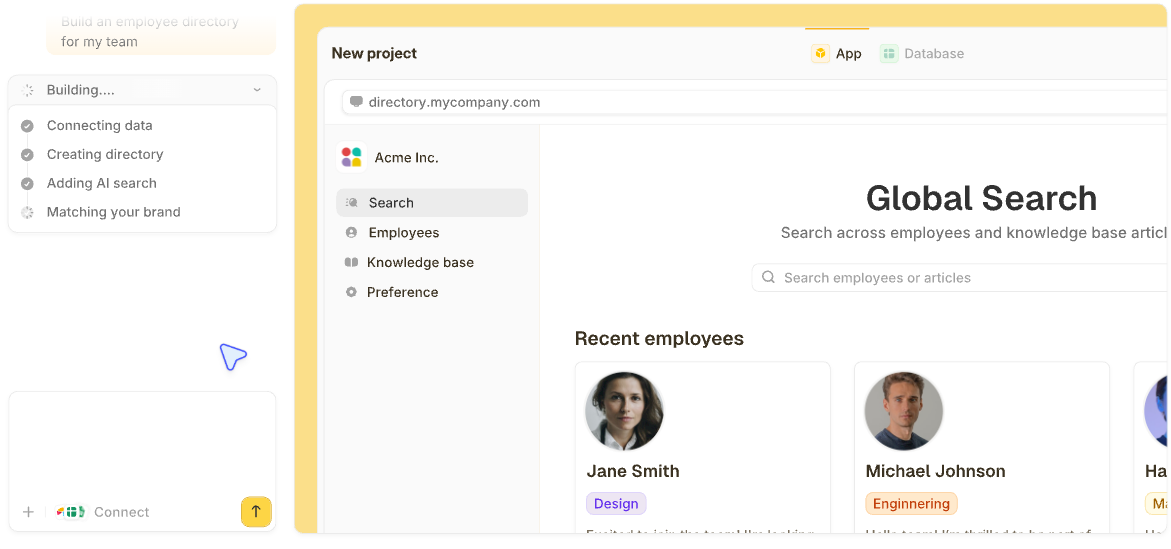
This is where things changed in 2025 and 2026. AI app builders let you describe what you want in plain English, and the AI generates a working app with a database, user interface, workflows, and logic already connected.
How it works:
- Describe your app ("I need an inventory tracker where my team can log products, update stock levels, and get alerts when items run low").
- The AI builds it with tables and fields, screens, navigation, and workflows.
- You review, adjust, and customize.
- Publish to your team or customers.
What makes this different from traditional no-code:
- No learning curve. You are describing what you want, not figuring out how to build it.
- Flexible interfaces. Not locked into rigid templates or pre-built layouts.
- Faster iteration. Change your mind? Describe the change, and the AI handles it.
- Built-in database. The database is built right in. No separate tool to set up, no database language to learn.
Where most AI app builders fall short:
Most AI app builders in this category, including Lovable, Bolt, and Replit, generate raw code. That is powerful if you have developers on hand, but it creates real downsides for non-technical people:
- Broken features mean staring at code you cannot read. The AI built a React and TypeScript app under the hood. When a button stops working or the login fails, you need someone who can read that code to fix it.
- The data behind the app is hard to see or control. Records sit in a separate database that the AI wired up for you. Viewing, editing, or exporting them often means logging into a second tool and figuring out how the tables connect.
- There is no way to verify what the AI actually built. The app works on the surface, but the rules and permissions inside it are buried in code. Most teams find out something is wrong only after real customer data is flowing through the system.
For a team building a prototype to hand off to developers, this is fine. For an ops team that needs to own and run the app themselves, it is a real problem. That is the gap Zite is built to close, which is covered below.
Real-world timelines (for code-generating AI builders):
- Simple app (task tracker, calculator, directory): 1-2 hours.
- Custom app (CRM, client portal with login): 1-3 days.
- Multi-page app with integrations (dashboards, workflows, outside data sources): 3-7 days.
When this path makes sense:
- You’re building custom software for your team or clients (portals, dashboards, CRMs, forms, workflows, websites)
- You want apps that are ready to publish, not just prototypes.
- You need it to run fast, and you don’t have a technical background
When it doesn’t:
- You’re building a consumer app for app stores (think social media, games, ride-sharing)
- You need highly specialized algorithms or real-time processing at a massive scale
What makes building an app hard?
Most articles about app difficulty focus on the technical side. The teams I have talked to tell a different story. The hardest parts are almost always about decisions, not code.
Feature creep and scope control
Feature creep is the #1 killer of app projects at every budget level. Most teams spend more time debating what to include than building anything.
Here is how to avoid it:
- Start with one core problem your app solves.
- List every feature you want, then cut half of them for v1.
- Ask: “Would someone use this app without this feature?” If yes, cut it.
Designing for real users
A working app can still frustrate users if the interface confuses them. The interface needs to make sense to the people who’ll use it daily, not just to you.
What helps:
- Show early versions to 3-5 real users before you “finish.”
- Watch how they navigate without guiding them.
- Pay attention to where they pause, get confused, or ask questions.
Integrating with existing tools
Most apps don’t live in isolation. They need to connect with your CRM, spreadsheets, payment processor, or email system.
Before choosing any building method, check whether it supports the tools your team already uses. An app that doesn’t connect to your existing workflow creates more work, not less.
Keeping the app running after launch
Most people forget about ongoing work until something breaks. Plan for updates, bug fixes, and feature requests from the start.
With traditional development, budget 15-20% of the build cost annually for upkeep. With no-code and AI builders, updates are usually as simple as describing the change.
How hard is it to make an app with Zite?
Not hard. If you are a non-technical person who needs custom apps that your team or clients will use, Zite was built for this.
Most AI app builders give you the speed of describing an app in plain English. Most no-code platforms give you visibility and human control over how your app works. Zite combines both. You get the speed of AI generation, with an app you can open, read, and edit at every layer, rather than a black box of code.
Zite is built by the same team behind Fillout (a form builder with 8,500+ paying customers and 30,000+ active organizations). You describe what you want in plain language, and Zite generates a working app, complete with database, interface, and workflow logic. Then you can open it up and see how every piece works.
What you can build:
- Client portals and customer dashboards
- CRMs, project trackers, and approval workflows
- Internal tools like employee portals, inventory trackers, and onboarding hubs
- Landing pages, websites, and interactive calculators
- Forms, data intake systems, and reporting dashboards
Why teams choose Zite over other options:
- Describe what you need, and the AI builds it, including the database, interface, and workflows. No dragging, no dropping, no tutorials.
- You stay in control of the data, interface, logic, and access. No black-box AI code you cannot read or change. The database is right there in a spreadsheet-style view, the workflows are laid out as editable flowcharts, and every screen is visually editable.
- Built-in database that works like a spreadsheet. No separate setup, no technical skills needed, and no need to rely on workarounds like connecting Airtable.
- Connect existing tools like Google Sheets, Airtable, and CRMs so your app fits into your current workflow.
- Custom branding and domains let you publish polished, client-facing apps that look like yours, not a template.
- Unlimited users on every plan. No per-seat pricing, so your costs stay predictable as you scale.
When you need it, Zite is also SOC 2 Type II compliant with single sign-on and audit logs for teams with security review requirements.
Teams at The Athletic, Bombas, and Domino's already use the platform. Whether you need a simple form or a multi-page app with integrations, you can go from idea to working product in hours.
Frequently asked questions
Can I make an app with no coding experience?
Yes, you can make an app with no coding experience. AI app builders like Zite let you describe what you want in plain English, and the platform handles the technical side.
How long does it take to build an app?
It depends on your approach. Learning to code takes 6-12+ months. A dev team typically delivers in 3-8 months. You can build an app in 2-8 weeks with traditional no-code tools. AI app builders can get you a working app in hours to days.
How much does it cost to build an app?
The cost to build an app ranges from $10,000-$150,000+ for custom development, depending on complexity. No-code and AI platforms cost $0-$300/month. For most custom apps like portals, dashboards, and workflows, AI builders offer the best value because you skip developer salaries, project management overhead, and ongoing upkeep.
How hard is it to make an app without coding?
Making an app without coding is medium-hard with traditional drag-and-drop builders. You still need to learn data modeling, workflow logic, and platform-specific quirks. AI app builders changed this. You describe what you want, the platform builds it, and the learning curve drops from weeks to minutes.
What type of app is hardest to build?
The hardest type of app to build is a consumer-facing product with millions of users, real-time features, and custom algorithms like social media, ride-sharing, or gaming. These can take a full development team months to deliver. Custom business tools like client portals or inventory trackers are far simpler and can often launch in days with modern no-code and AI builders.