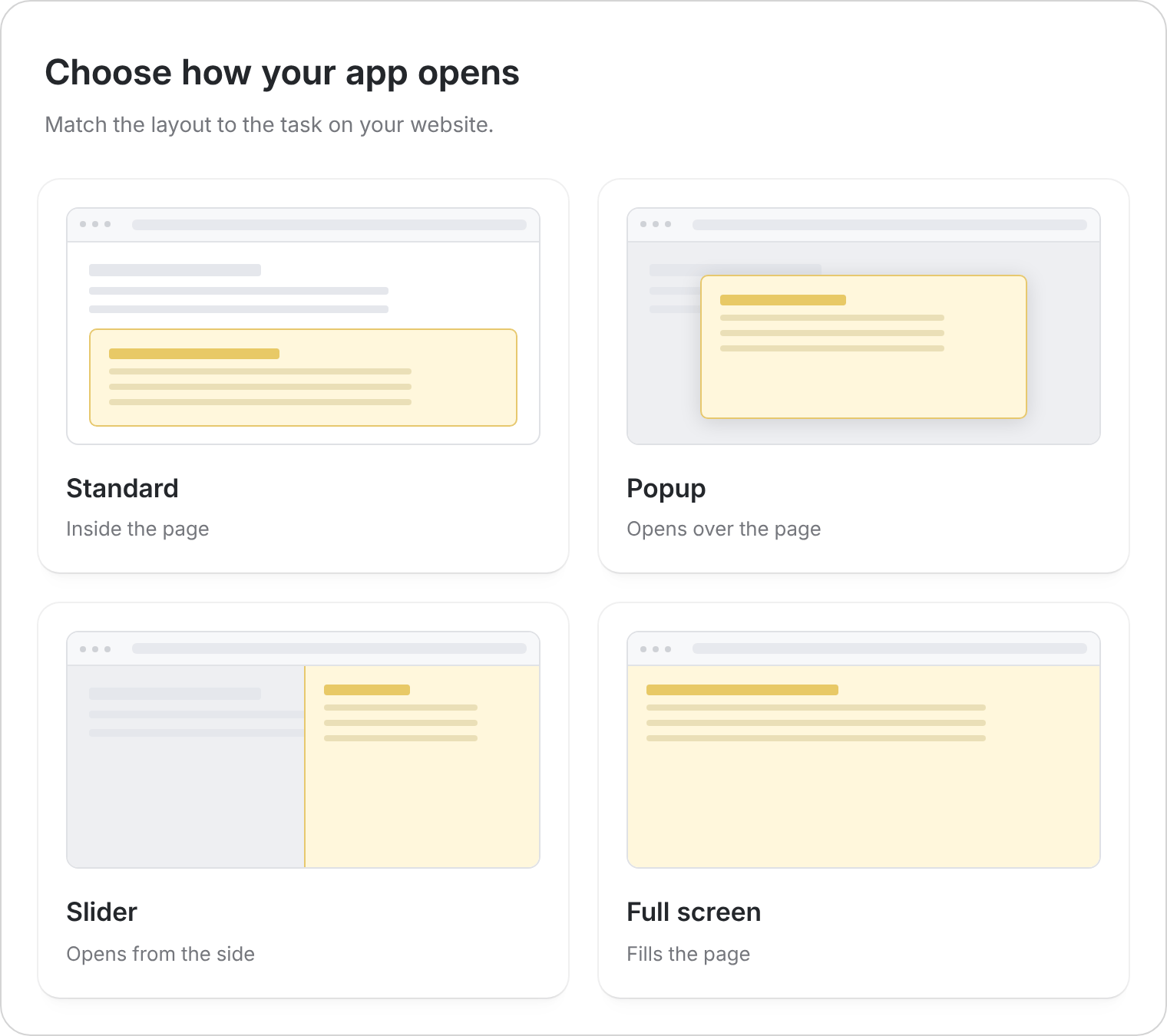
Embedding lets you place a published Zite app inside another website or open it from a button on that site. Use it for customer portals, internal tools, dashboards, knowledge bases, docs, and landing pages.

Open embed settings

After publishing your app, click Share in the upper right corner, then choose Embed. Screenshot 2025-12-16 at 2.23.57 PM.png The embed settings panel shows a live preview of your app. Use the Desktop and Mobile tabs to check how the embed will appear on different screen sizes before copying the code.

Choose an embed type

Zite supports four embed types:
  • Standard: adds your app as an inline section on the page.
  • Popup: opens your app in a centered modal when someone clicks a button.
  • Slider: opens your app in a side panel from the left or right.
  • Full screen: opens your app as a full-page embedded experience.
After choosing an embed type, adjust the settings, click </> Get the code, and paste the code into your website, CMS, or web builder.

Standard embed

Use Standard when your app should appear as part of the page content, such as inside a dashboard, customer portal, help article, or internal wiki.
Standard embed settings with height and width controls
You can control:
  • Height: sets the embed height in pixels.
  • Width: sets how wide the embed should be. Use 100% when you want the app to fill the available page width.
Standard embeds work best when the surrounding page already has space reserved for the app. Use Popup when you want visitors to stay on the current page until they click a button, then open the app in a focused overlay.
Popup embed settings with button text, button size, floating button, and popup size controls
You can control:
  • Button text: changes the label on the launch button.
  • Button size: sets the size of the launch button.
  • Floating button: keeps the button fixed on the page instead of placing it inline.
  • Popup size: changes the size of the modal window.
Popup embeds are useful for calls to action like onboarding flows, quote requests, client portals, and support tools.

Slider embed

Use Slider when the app should open without taking over the whole screen. The page dims behind the app, and the app slides in from one side.
Slider embed settings with button text, button size, floating button, and slider side controls
You can control:
  • Button text: changes the label on the launch button.
  • Button size: sets the size of the launch button.
  • Floating button: keeps the button fixed on the page.
  • Slider side: chooses whether the panel opens from the left or right.
Slider embeds work well for tools people may open while referencing the page behind it, such as calculators, intake flows, account tools, or admin panels.

Full screen embed

Use Full screen when the Zite app should feel like the main experience on the page.
Full screen embed settings previewing a Zite app across the available screen
Full screen embeds are best for complete portals, dashboards, and app-like experiences where users should focus on the Zite app rather than the surrounding website.

Preview and copy the code

Before adding the embed to your site:
  • Use Preview to test the selected embed type.
  • Check both Desktop and Mobile.
  • Confirm popup or slider buttons use the right label and size.
  • Confirm standard embeds have enough height to avoid cramped content.
  • Click </> Get the code and paste the generated snippet into your website.
If your app changes later, you usually do not need to replace the embed code. Publish the latest version of your Zite app, then refresh the page where it is embedded.

Which embed type should I use?

Choose Standard when the app should sit directly in the page layout.
Choose Popup when someone should click a button, complete a focused task, then close the overlay.
Choose Slider when users may need to reference the original page while using the app.
Choose Full screen when the embedded Zite app should be the main interface.
Last modified on July 7, 2026