Overview

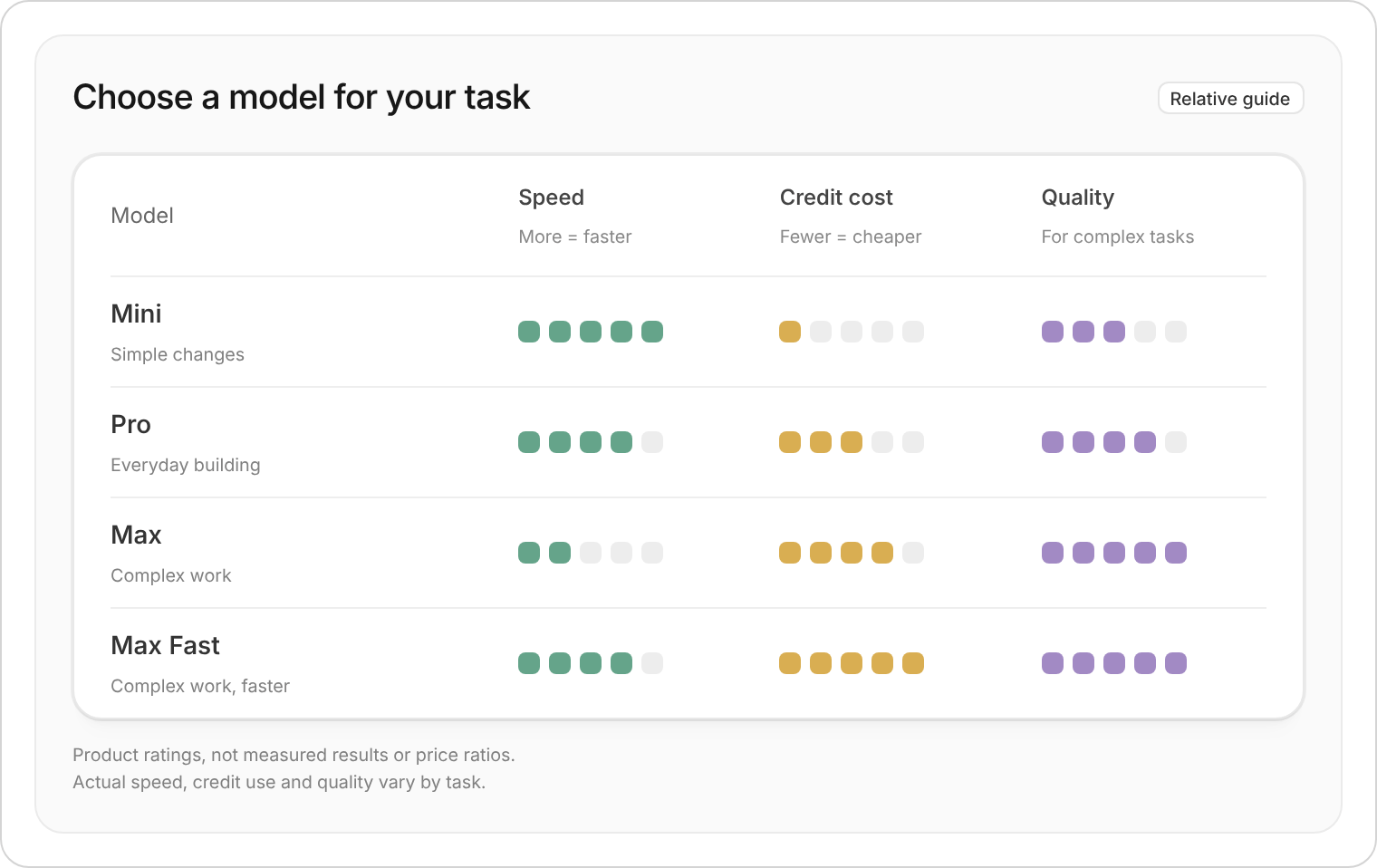
Zite offers four AI models, letting you choose the right balance of speed, intelligence, and cost for your tasks.
Different models consume credits at different rates based on their underlying AI costs. For more details on credits and usage, check out the How credits work guide.
Zite Mini (Powered by Anthropic’s Claude Haiku 4.5) The fastest and most cost-efficient model. Great for quick, simple tasks like minor text changes, small style adjustments, and straightforward edits. Zite Pro (Powered by Anthropic’s Claude Sonnet 4.6) The default model that offers the best balance of speed and intelligence. Recommended for most tasks, including adding features, fixing bugs, and updating designs. Zite Max (Powered by Anthropic’s Claude Opus 5) The most capable model for maximum intelligence. Use Zite Max for complex work, multi-step reasoning, and persistent issues that other models struggle with. Zite Max Fast (Powered by Anthropic’s Claude Opus 5) The same model as Zite Max, running in fast mode for up to 2.5x faster output. Reach for it when a long build is worth finishing sooner. It uses credits at about twice the rate of Zite Max, so treat it as a speed choice rather than a default.
Zite Max is available on Pro, Business, Team, and Enterprise plans. Zite Max Fast is available starting on the Business plan. Click here to see our pricing plans.

How to switch models

In the chat box, click the + button, select AI Model, then choose your preferred model.
AI model menu with Zite Max Fast selected
Alternatively, press Cmd + / or Ctrl + / on your keyboard to toggle the model selector.
Your model preference is saved automatically on your device.

Mode-based model behavior

Certain editor modes automatically use Zite Max regardless of your saved or selected model: This ensures that planning and conversational tasks benefit from the highest level of reasoning. If you have Zite Max Fast selected, these modes keep it — they raise a lower model up to Zite Max, but never step Fast mode back down.
Last modified on September 4, 2026